Most API candidates can read the code. Far fewer have heard someone work a corrosion-rate problem aloud, and that is the skill the exam rewards.
What is in the new API Inspector video course?
The API Inspector Bundle now carries a full video course. It opens with a short start-here module, then a shared core that API 510, 570 and 653 all lean on. Each exam then gets its own module: pressure vessels, piping and storage tanks. An exam guide and a final review close it out.
Every lesson has captions, and its slides are shown alongside it in the player.
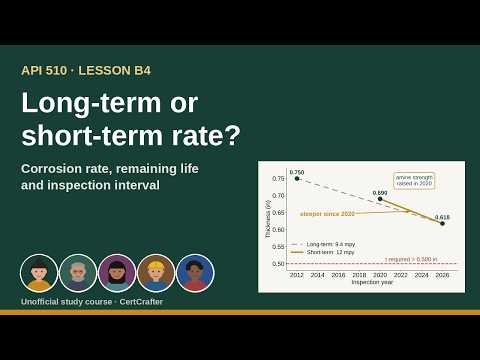 API510: Corrosion rate, remaining life and inspection interval Watch on YouTube · CertCrafter
Our channel already has a free lesson on corrosion rate, remaining life and inspection interval, if you want a feel for the teaching first.
How does one exam day actually run?
Start with the format, because the course does. API says the exam day is 7.5 hours: a short tutorial, 2.75 hours closed book, a 45-minute lunch and 3.75 hours open book. There are 170 questions, 110 closed book and 60 open book. Only 140 are scored; the rest are pretest questions.
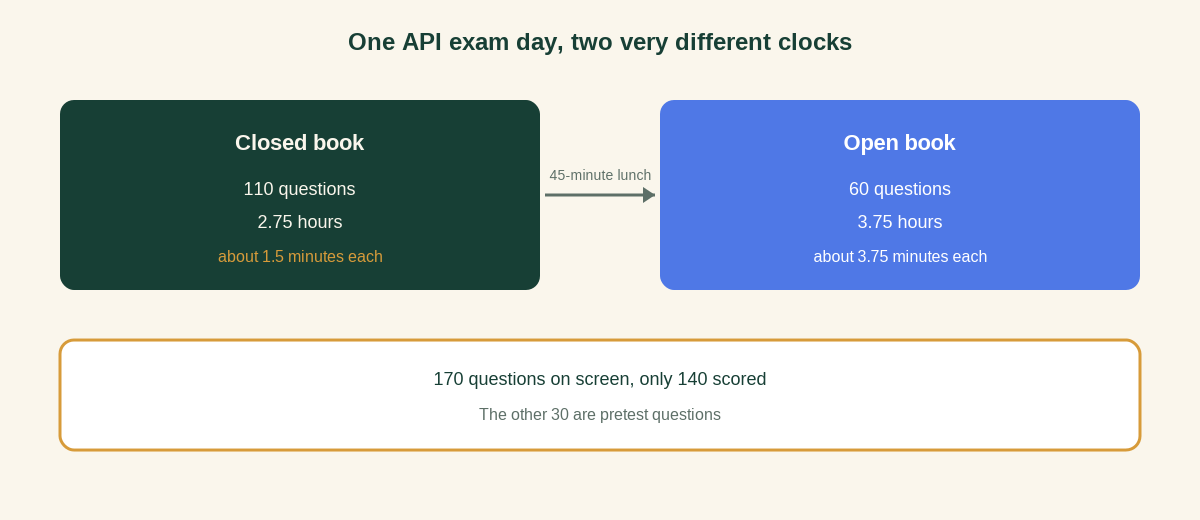
Worked example: where the 30 pretest questions come from
- The exam has 170 questions: 110 closed book and 60 open book.
- Only 140 are scored.
- So 170 minus 140 leaves 30 pretest questions that do not count.
- The halves run on different clocks, 2.75 hours for 110 questions against 3.75 hours for 60.
That is simple arithmetic on API’s numbers. The practical point is pace: a closed-book question that won’t yield quickly should be flagged and left, and the open-book half is where you spend time finding the clause. The API 510 Complete Exam Kit and the API 510 page work this pacing under timed conditions, with every answer explained.
Why does a video help on a real inspection?
On site, nobody hands you a clean problem. You get a thickness reading, a last-inspection date and a corrosion allowance, and you decide when the next inspection falls due. Watching someone talk through that sequence shows the order of thought: which reading counts, what the rate is, how long the metal has left.
A page of notes states the rule. A lesson shows it applied, and the shared core means the same reasoning serves a vessel, a pipe run and a tank shell.
What does the course cover module by module?
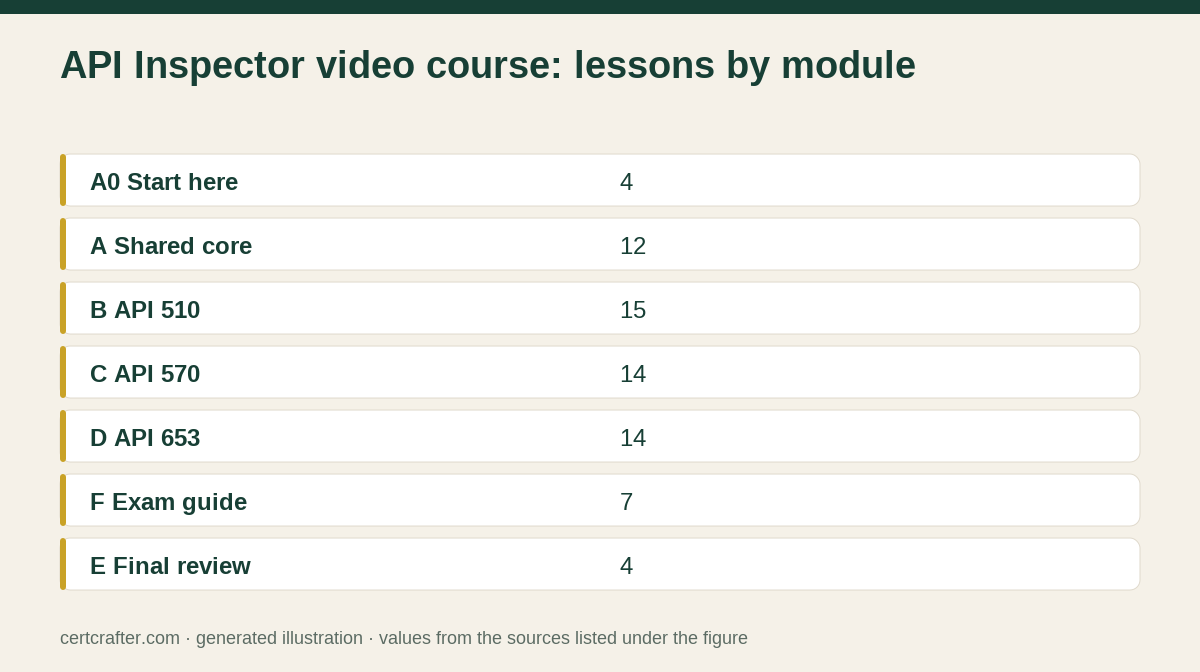
The order follows the work: the habits all three exams share first, then one module per inspector exam. Corrosion rates, remaining life and inspection intervals sit in the API 510 module, and the same arithmetic returns for piping and tanks.
Can I try it before I buy?
Yes. Two preview lessons play on the API Inspector Bundle page with no sign-in: How the API exams really work, and Corrosion rates, remaining life and inspection intervals.
What does it cost, and what about earlier buyers?
The bundle holds the three kits plus the full video course for all three exams. Since 22 November 2026 each single kit has the video lessons for its own exam and the shared ones (API 510: 42 lessons, about 4.7 hours; API 570 and API 653: 41 lessons each, about 4.5 and 4.4 hours). Earlier bundle buyers get the videos at no extra cost.
The offer box on this page shows the live price and any discount, with its real end date. The code stops working at the end of 31 December 2026. Since 20 November 2026 the single kits are $69 each, so the three kits alone total $207; the bundle with the full course for all three exams is $199.
If you sit only one exam, a single kit is the better buy. If you plan two or three, read which API exam to take first and then the bundle page. The kits are API 510, API 570 and API 653, and the free 20-question API 510 sample needs no sign-in. API is a trademark of the American Petroleum Institute. certcrafter.com is not affiliated with API, and this course is unofficial.
Your next step: play the first preview lesson, then time yourself on a few sample questions.
Comments
Comments are read by a person before they appear. How we moderate.