An API 510 calculation question rarely fails on the arithmetic. It fails on which number goes where, and on which part of the vessel the question is really about. Most of the maths is a subtraction and a division.
This page works one example through, on two components at once, then shows how inspectors use the result and where candidates lose marks.
Which calculations does API 510 expect you to do?
Start with what API says. Its Body of Knowledge describes code calculation questions as oriented toward existing pressure vessels, not new ones. You check and perform calculations for in-service deterioration, repairs, rerates and alterations. Only internal pressure loadings are considered.
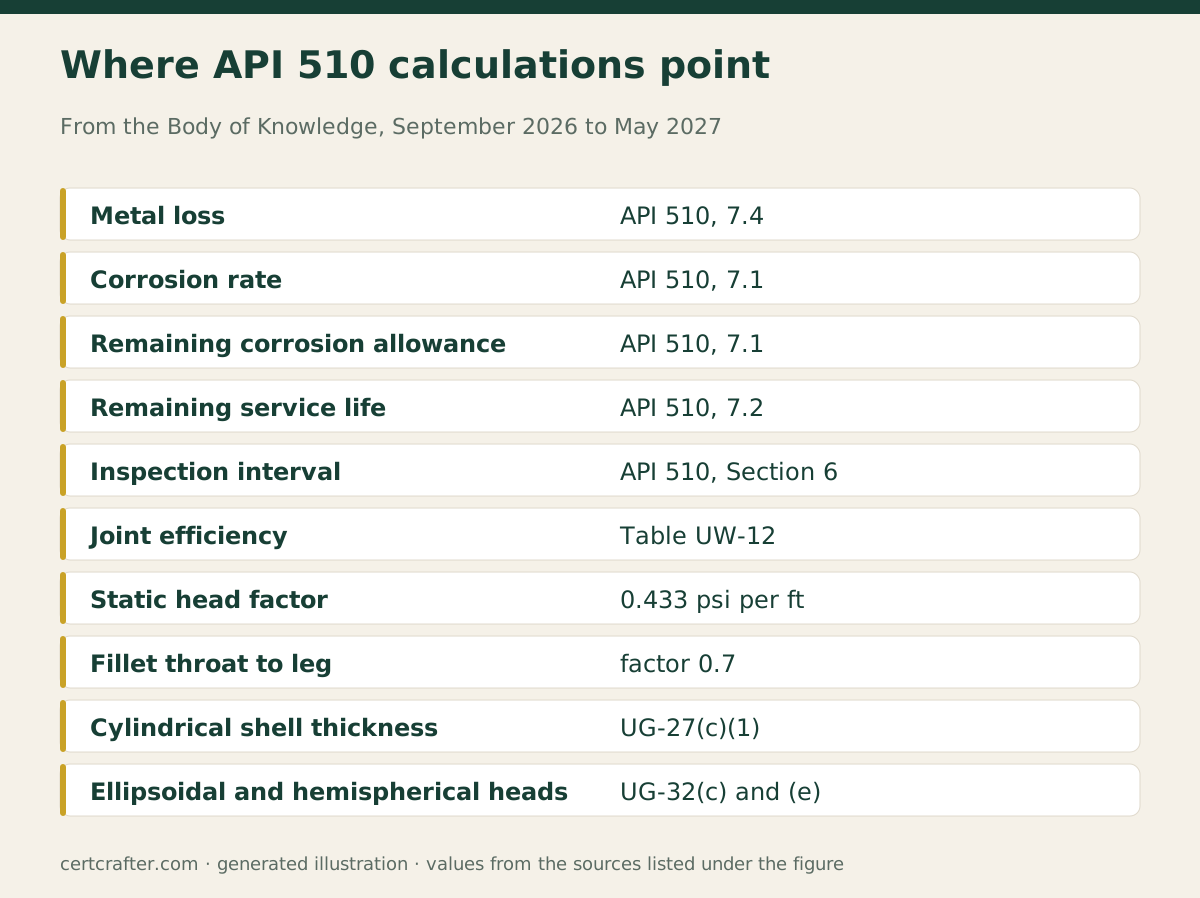
Domain I groups the calculations into nine categories. Corrosion rates and inspection intervals come first, and they cover metal loss (API 510, 7.4), corrosion rate (7.1), remaining corrosion allowance (7.1), remaining service life (7.2) and the inspection interval (Section 6). The Body of Knowledge adds that the formulas for these, and the rules for setting intervals, may be closed book during the exam.
 API 510 — Three millimetres of allowance, a quarter mill a year. Now the interval. Watch on YouTube · CertCrafter
Our channel has a short on the same chain: API 510, three millimetres of allowance, a quarter mill a year.
The other categories are joint efficiencies, static head, internal pressure, external pressure rules, pressure testing, impact testing, weld sizes at openings and nozzle reinforcement. Most of those send you to ASME Section VIII, Division 1, and the open-book part is where you open it.
How do you get from two readings to a remaining life?
Think of the wall as a budget. The earlier reading is what you had, the latest reading is what is left, and the required thickness is the floor you may not go below. The margin between the latest reading and the floor is what you can still spend.
Four steps, and the Body of Knowledge gives the third one in so many words: remaining corrosion allowance is actual thickness minus required thickness.
- Metal loss: earlier reading minus latest reading.
- Corrosion rate: metal loss divided by the years between the two readings.
- Remaining corrosion allowance: latest reading minus required thickness.
- Remaining life: remaining corrosion allowance divided by the corrosion rate.
The interval is a separate job. It comes out of the Section 6 rules, applied to the life you found. Open the code for those. Do not trust a figure from a blog, this one included.
Worked example: two components, one vessel
These numbers are invented for practice, so check the method and ignore the figures. A vessel has a shell course and an ellipsoidal head. Each has its own required thickness and its own readings, taken five years apart.
| Step | Shell course | Ellipsoidal head |
|---|---|---|
| Earlier reading | 0.640 in |
0.560 in |
| Latest reading | 0.560 in |
0.510 in |
| Metal loss | 0.080 in |
0.050 in |
| Corrosion rate (loss divided by 5 years) | 0.016 in per year |
0.010 in per year |
| Required thickness | 0.500 in |
0.470 in |
| Remaining corrosion allowance | 0.060 in |
0.040 in |
| Remaining life (allowance divided by rate) | 3.75 years |
4 years |
Look at the allowance row first. The head has less to spend, 0.040 in against 0.060 in. A quick reader picks the head. But the shell is losing metal 0.016 in a year against 0.010 in, so it runs out first. The shell governs, at 3.75 years.
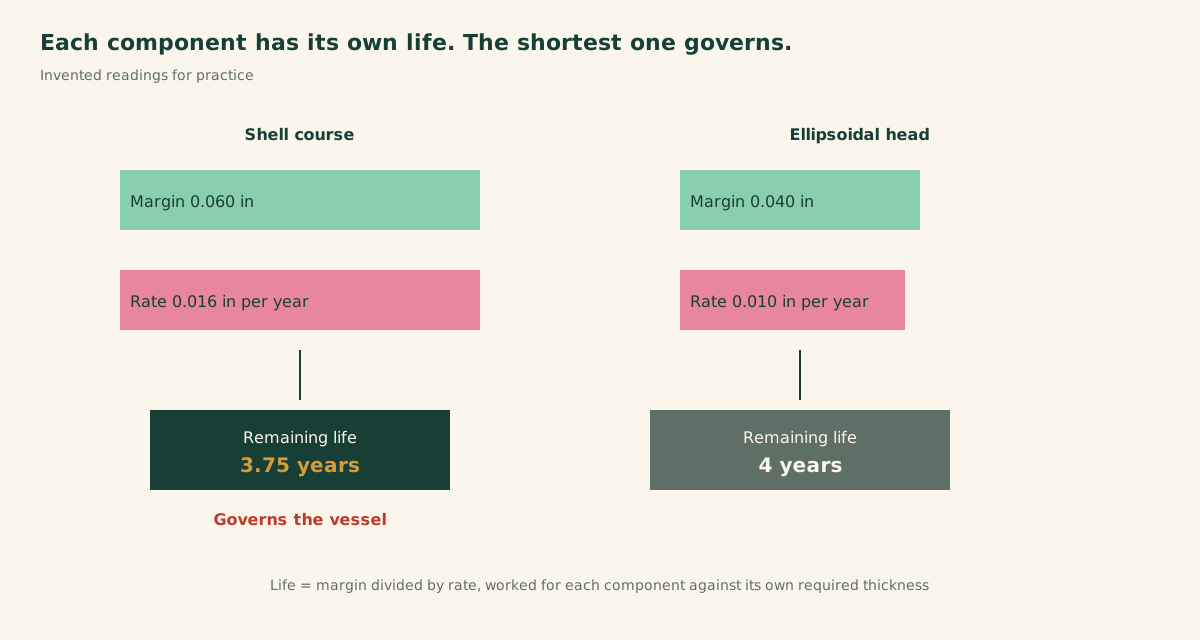
The rule behind it is simple. Every pressure retaining component has its own required thickness, its own readings and its own rate, so it has its own life. The vessel takes the shortest.
Do the same example again in millimeters. The Body of Knowledge expects the formulas in US customary and SI units, and a second pass in the other system is half the exam preparation.
How do inspectors use this on a real vessel?
Nobody works from one pair of readings. A vessel has many points, read on different dates by different people with different gauges. The calculation is the easy part. Judging the data comes first.
A reading that goes up between visits is a gauge, couplant or surface problem, not a vessel that healed. Inspectors check the scan position and the instrument before they believe either number. They also ask what the vessel holds and which damage mechanism is likely, because a rate from a short run of readings can flatter you or frighten you.
Then they set each point beside its neighbors. A point that corrodes twice as fast as the ones around it is a finding in its own right. A spreadsheet won’t say so unless somebody asks.
Records decide the rest. A reading with no date, no location and no method can’t give a rate. Most disputed lives in the field turn out to be disputed records, which is why the Body of Knowledge also lists inspection records and reports among its practical topics.
What other calculations sit beside this one?
Other cases follow the same logic of tracing an input to its source. For static head, the Body of Knowledge fixes the specific gravity at 1.0 and lists the conversion factor of 0.433 psi per foot, and it separates vessel MAWP from vessel part MAWP. For a fillet weld, you convert between throat and leg with the factor 0.7. For test pressure, you compensate for temperature under UG-99 and UG-100. Joint efficiency comes from the radiography marking on the nameplate and Table UW-12.
None of these is hard on its own. What makes them tiring is the sequence inside a long question: find the joint efficiency, then the required thickness, then add the corrosion allowance, then compare with the measured wall. Candidates who lose a step usually lose it in the middle, where the question quietly switches from one unit system to the other or hands you a static head figure you must add to the pressure first.
Describing them is enough here. Drill each one until you can start it cold, then learn where the exam wants you to open the book.
Where do candidates lose marks on these calculations?
The inputs fail, not the arithmetic.
Using one component for the whole vessel. Each part has its own life, and the shortest one governs.
Using the nominal wall as the floor. The floor is the required thickness for that part, not the thickness on the drawing.
Using the age of the vessel as the time. The time is between the two readings you are comparing.
Mixing units. A rate in millimeters per year divided into a margin in inches gives a confident wrong answer. Convert first, then divide.
Stopping at the life. A question that asks for the interval wants the Section 6 rule applied to your life.
Hunting for a formula. The closed-book part has 110 questions in 2 hours 45 minutes, so the corrosion chain has to be in your head. The open-book part has 60 questions in 3 hours 45 minutes, and its calculations send you to the code for the rest. The exam has 170 questions with 140 scored, and passing is a scaled 400 on a 200 to 500 scale, not a percentage. Answer every one.
Two questions from our free sample are embedded below. The first asks how remaining life is set when two components carry different margins, which is this example in words. The second is a radiography calculation, the sort you open the book for.
What should you do next?
Take your own numbers from a vessel you know, or invent a set, and work the table above in inches and then in millimeters, closed book, with a timer. Then try the embedded questions and compare your working with each explanation.
For the wider picture, read API 510 thickness and intervals and API 510 common mistakes. The product page is at API 510 Pressure Vessel Inspector, the practice tests at the API 510 bundle, the free sample at the quiz, and more guides in the API 510 hub.
Comments
Comments are read by a person before they appear. How we moderate.