Here are the ten, in the order you will meet them: the editions you study, the calculations you run, the welding and repair rules you apply, and the way you read the score.
| Mistake | Where it shows up | The fix |
|---|---|---|
| 1. Studying the wrong edition | Preparation | Work from the effectivity sheet for your window |
| 2. Training on paper books | Open-book half | Practice finding clauses in on-screen PDFs |
| 3. Treating closed-book as the light half | 110 questions | Memorize the formulas and interval rules |
| 4. Calling remaining life the interval | Domain I | Finish the chain, one component at a time |
| 5. Static head and joint efficiency slips | Domain I | Use 0.433 psi per foot and read the nameplate marking |
| 6. Studying what is excluded | Scope | Read the exclusion lists first |
| 7. Guessing welding variables | Domain II | Sort essential from nonessential before you read options |
| 8. Letting the inspector decide what the engineer decides | Repairs | Know who holds each authority |
| 9. Chasing a percentage | Scoring | Aim at the scaled 400 and answer every question |
| 10. Late or thin applications | Before the exam | Document experience and watch the deadline |
Which preparation mistakes cost the most marks?
Three of them, and all three are decided before you open a question bank.
Mistake 1: the wrong edition. The September 2026, January 2027 and May 2027 windows share one effectivity sheet. It lists API 510, 11th Edition, October 2022, with Errata 1 (March 2023) and Errata 2 (2025), API RP 572 5th Edition, RP 577 3rd Edition with its 2025 erratum, RP 578 4th Edition, ASME PCC-2 (2022), and the 2025 ASME Boiler and Pressure Vessel Code. API’s body of knowledge adds a plain warning: some organizations and jurisdictions work to other editions, and the exam is based on the ones in the effectivity sheet. On a plant the edition in your owner-user’s program governs. In the exam it is the sheet. Know which room you are in.
Mistake 2: training on paper. Papers, notes and books are not allowed at the Prometric center. PDFs of the codes appear on your computer in the open-book portion, and only the sections listed on the effectivity sheet are available. So the skill being tested is finding a requirement fast in a document you cannot annotate. Practice that on screen, with the same sections.
 API 510 The distractor on this one catch four candidates out of five. Watch on YouTube · CertCrafter
Our channel has a short on a distractor pattern that catches many candidates. Watch it once you have read the rest of this post.
Mistake 3: closed-book as the easy half. It is 110 questions in 2 hours 45 minutes, against 60 open-book questions in 3 hours 45 minutes. The body of knowledge says the formulas for metal loss, corrosion rate, remaining allowance, remaining life and the rules for setting intervals may be closed book. The closed-book part tests everyday working familiarity, and the open-book part tests detail an inspector can find but would not commit to memory. That is a fair description of the job. You do not look up the corrosion rate formula at a vessel.
What do candidates get wrong in the calculations?
Domain I is where arithmetic meets judgment, and the traps are small.
Mistake 4: stopping one step early. Metal loss, corrosion rate, remaining corrosion allowance, remaining service life, and then the interval from Section 6. A question may offer your remaining life as an answer to an interval question. And each component has its own chain: the shell, a head and a nozzle neck are each worked against their own required thickness. Our thickness and intervals post walks the whole chain with numbers.
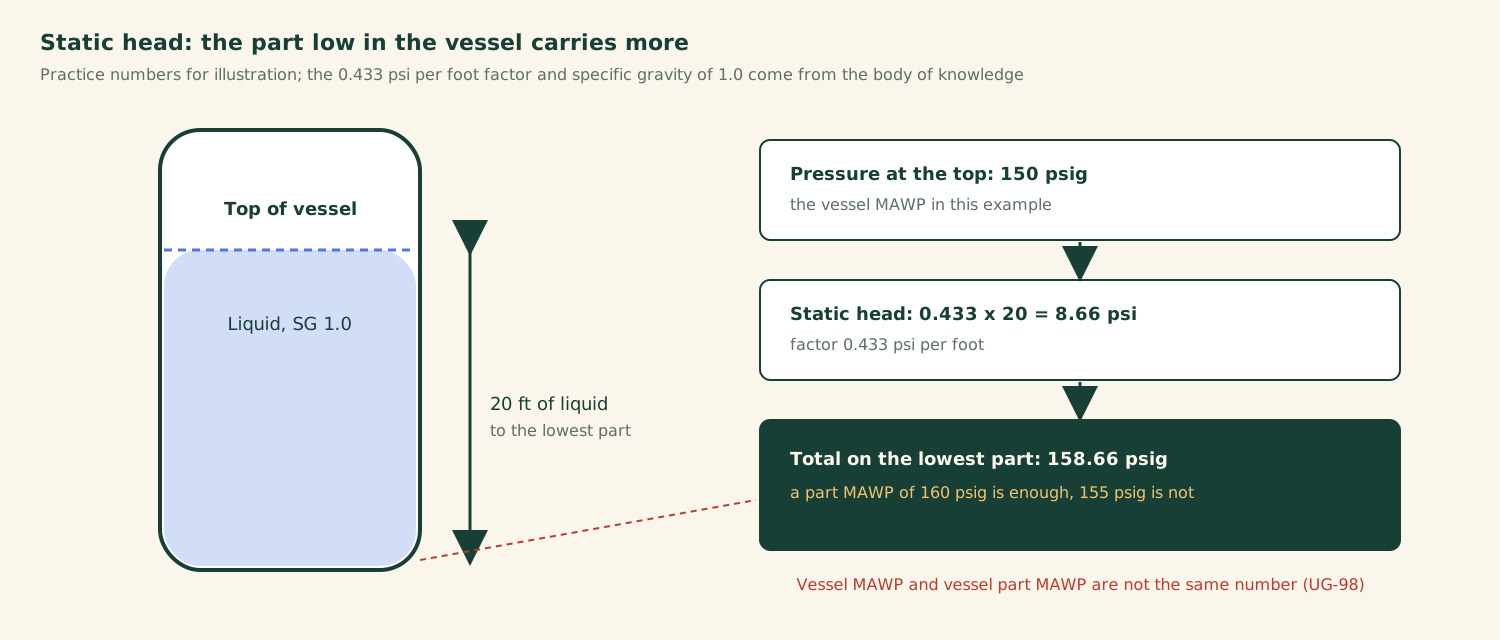
Mistake 5: static head and joint efficiency. The body of knowledge fixes the static head conversion at 0.433 psi per foot and says all static head is based on a specific gravity of 1.0. It also separates vessel MAWP from vessel part MAWP (UG-98). The joint efficiency comes from the weld joint category, the radiography marking on the nameplate and Table UW-12. Candidates pull “E” from memory and are off by one row.
Worked example: a part low in the vessel
These numbers are invented for practice, so check the method and ignore the figures.
A vessel has a MAWP of 150 psig at the top. A lower shell course sits 20 ft below the top of the liquid, and the liquid has a specific gravity of 1.0.
- Static head:
0.433 x 20 = 8.66 psi. - Total on that course:
150 + 8.66 = 158.66 psig. - Compare with the part MAWP. A part rated at
160 psigis enough. A part rated at155 psigis not.
In a refinery the same habit matters for a different reason. Pressure gauges sit at the top, the liquid sits at the bottom, and a low part can be the one that governs. The exam checks that you looked down the vessel.
What are the scope mistakes?
Mistake 6: studying what is not examined. API tells you what to leave out, and the list is long. Required thickness for wind, earthquake and other secondary loadings, external pressure calculations, flange calculations, brazing, relief valve sizing, Code Cases, and API 510 Section 9 are all named exclusions. Only internal pressure loadings are considered. For API RP 571 the exam uses a short list of mechanisms, among them corrosion under insulation, brittle fracture and wet H2S damage, not the whole document. RP 572 is examined in full, with Annex C excluded.
Time is the scarce resource, and a week spent on external pressure design is a week not spent on RP 577.
Where do welding and repair questions trip people?
Mistake 7: guessing the variable. Domain II is built on ASME Section IX. You review a WPS, a PQR and a welder performance qualification and decide whether the welder may make the production weld. The review is limited to SMAW, GTAW, GMAW or SAW, one process per document, a single supporting PQR, and base metals in P-No. 1, 3, 4, 5 and 8. Within that, the work is sorting variables into essential and nonessential. A change of electrode that stays inside the same F number and A number groups is not the same as a change of group. Candidates who memorized classifications instead of groupings get this wrong, and the sample question below shows it. One more point from API: the PQR and WPQ must be certified by signing and dating.
Mistake 8: the wrong person decides. On a real vessel, a repair is a conversation between the inspector, the engineer and the owner-user. API 510 rules for welding take precedence over Section VIII, Division 1 where they cover the same area. When postweld heat treatment is impractical, the engineer may apply an alternative, and the inspector confirms what was specified. Questions are framed as a cracked shell, a lining that heat would ruin and four plausible fixes. The wrong answers hand authority to the inspector or the welder, or ignore the alternatives the code provides.
How should you read the scoring and the application?
Mistake 9: chasing a percentage. There is none. The pass standard is a scaled 400 on a 200-500 scale, and API publishes no raw cut score. The exam has 170 questions and only 140 are scored. The other 30 are pretest items, and they are not identified. Answer all of them.
Mistake 10: a late or thin application. The minimum experience depends on education, from 1 year with an engineering or technology degree to 5 years or more with no formal education. It must come from the last 10 years, be documented on the application and is verified afterward. Deadlines are fixed per window. The January 2 to 22, 2027 window closes applications on October 29, 2026, and May 7 to 28, 2027 closes on March 4, 2027. A late application fee of 200 USD applies in the fee schedule, and the 2027 initial fee is 890 USD for members and 1,140 USD for non-members. Check the exam format, scoring and dates post for the full schedule.
What to do next
Take the ten and turn them into a one-page error log. Next to each, write the edition, paragraph or table you would open to settle it. Then run a mixed set under the real rhythm, closed-book first.
If you are still choosing between inspector exams, API 510 vs 570 vs 653 sets them side by side. The certification guide covers the body of knowledge, the free sample quiz shows where you stand, and the six practice tests drill these slips under timed conditions. More API 510 posts go domain by domain.
Comments
Comments are read by a person before they appear. How we moderate.