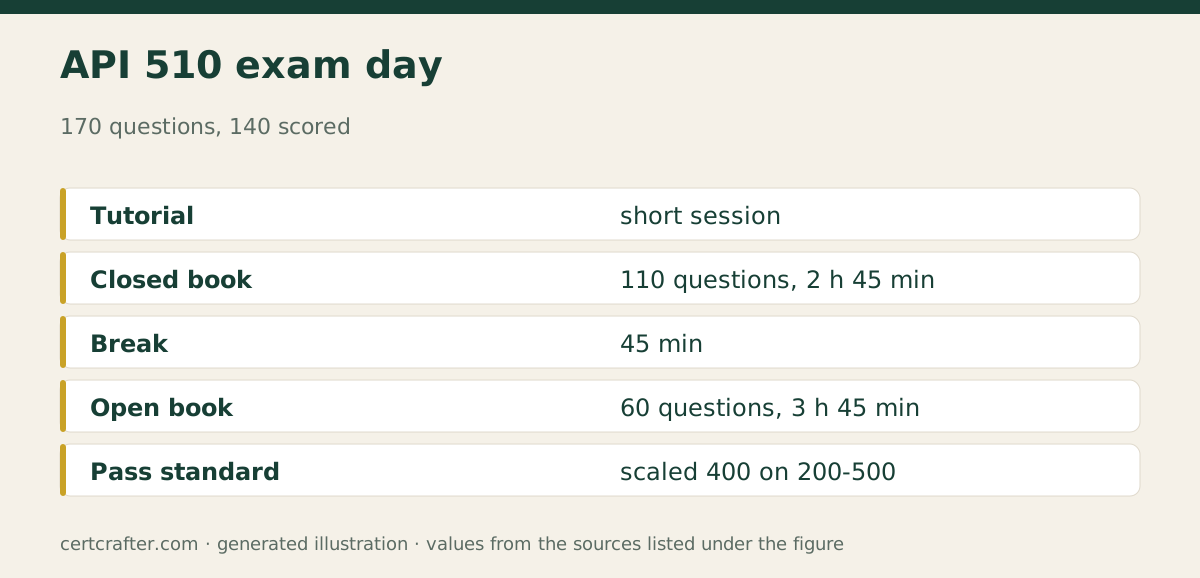
Seven and a half hours in the chair, 170 questions on the screen, and only 140 of them counted. That gap is the first thing worth understanding about the API 510 exam.
The day comes in two halves. A short tutorial, then 110 closed-book questions across 2 hours 45 minutes. A 45-minute lunch. Then 60 open-book questions across 3 hours 45 minutes. Testing time is 6.5 hours, and the tutorial and break fill out the rest of the 7.5-hour day.
If you came here to pick a window rather than to study, the date you want is October 29, 2026. That is when applications close for the January 2 to 22, 2027 administration, the next one on the calendar.
What does the API 510 exam day actually look like?
Set the questions against the clock and the design shows itself. The closed-book half gives you roughly a minute and a half per question. The open-book half gives you closer to four minutes. Same exam, same candidate, two completely different jobs.
The closed-book half tests what you carry in your head. Corrosion rates, remaining life, inspection intervals, damage mechanisms, the general rules for welding and for nondestructive examination. API’s body of knowledge says plainly that the formulas for metal loss, corrosion rate, remaining corrosion allowance, remaining service life and inspection interval may be closed book, along with the rules for setting intervals. Spend that half hunting for a formula you should know and you will arrive at the longer half already behind.
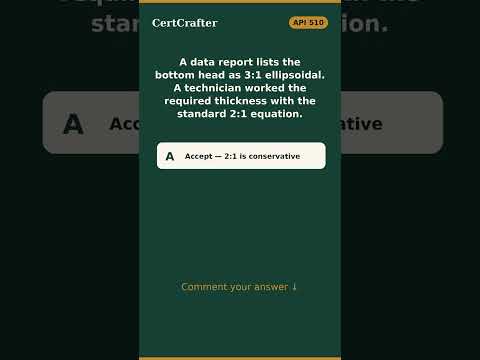 API 510 — Three millimetres of allowance, a quarter mill a year. Now the interval. Watch on YouTube · CertCrafter
 The open-book half tests whether you can find things. Papers, notes and books are not allowed in the test center. The listed codes and standards come up as PDFs on your computer during the open-book portion, in English, and that is the whole of your reference material. Tabbing a paper copy of API 510 at home builds a skill the room will not let you use. Practice searching a PDF instead.
A short interval calculation of the kind the closed-book half runs on sits on our channel: allowance, rate, interval.
How is the API 510 exam scored?
Passing is a scaled 400 on a 200-500 scale. Not a percentage.
The distinction matters more than it looks. Scaling lets API hold one standard across exam forms that differ slightly in difficulty, which means the number of raw correct answers sitting behind a 400 moves from one form to the next. API publishes no raw figure, so any specific percentage you read on a forum is somebody’s reconstruction rather than a number API stands behind.
Thirty of your 170 questions are unscored pretest items, seeded to gather statistics for future forms. They are not flagged on screen. Answer all 170 as though every one counts, because from the chair you cannot tell which thirty do not.
API 510 certification runs for a three-year term and is accredited by ANSI, which built the exam to meet ISO 17024. That accreditation is the reason the scoring works this way rather than on a raw mark out of 140.
When are the next API 510 exam windows and application deadlines?
API 510 runs three administrations a year. Each is a three-week window, and each application closes about two months before its window opens.
| Exam window | Application deadline |
|---|---|
| January 2 to 22, 2027 | October 29, 2026 |
| May 7 to 28, 2027 | March 4, 2027 |
| September 3 to 24, 2027 | July 2, 2027 |
The deadline is the line people miss. They diary the window, see three weeks of availability, and find out in December that the January sitting stopped taking applications in October. No part of the process speeds up to accommodate that.
API 510, API 570 and API 653 deliberately sit in different months, so a test center is never carrying all three inspector exams at once. API 510 owns January, May and September.
What does the API 510 exam cost?
| Fee | API member | Non-member |
|---|---|---|
| Initial certification, 2026 schedule | $875 | $1,125 |
| Initial certification, 2027 schedule | $890 | $1,140 |
| Recertification, 2026 schedule | $745 | $855 |
| Recertification, 2027 schedule | $760 | $870 |
| Reschedule | $350 | $350 |
| Late application | $200 | $200 |
Read the reschedule line before you book anything. Moving a booked API 510 appointment costs $350 whichever side of the membership line you are on, and that is a serious fraction of the exam fee. Treat the date as fixed the moment you have it.
Worked example: planning backward from the January 2027 window
- The window runs January 2 to 22, 2027, and your appointment sits somewhere inside those three weeks.
- Applications close October 29, 2026. Apply after that and the late application fee of $200 lands on top of the exam fee.
- Budget from the right fee schedule. Initial certification is $875 for API members and $1,125 for non-members on the 2026 schedule, and $890 and $1,140 on the 2027 one.
- Confirm you qualify first. With a BS or higher in engineering or technology you need 1 year of supervising or performing the inspection work API 510 describes. With a two-year associate’s degree it is 2 years, with a high school diploma 3 years, and with no formal education 5 or more years. The experience has to have been earned in the last 10 years with an authorized inspection agency.
- Study against the September 2026 effectivity sheet. It covers the September 2026, January 2027 and May 2027 windows, so the January sitting is examined on that list and not on a newer one.
- Rehearse the two halves separately, then together, in the 2:45 and 3:45 shape with the break in between.
Work backward like this and the planning collapses into one real constraint: the application date, which sits months ahead of everything else and does not move.
Which publications is the API 510 exam written from?
The September 2026 effectivity sheet lists API 510 in its 11th Edition of October 2022, with Errata 1 of March 2023 and Errata 2 of 2025. Alongside it sit API RP 572 in its 5th Edition of November 2023, API RP 576 in its 5th Edition of September 2024, API RP 577 in its 3rd Edition of October 2020 with Errata 1 of September 2025, and API RP 578 in its 4th Edition of February 2023.
ASME comes in as the 2025 Edition of the Boiler and Pressure Vessel Code, limited by section. From Section V you get Articles 1, 2, 6, 7 and 23, with Article 23 narrowed to SE-797. Division 1 of Section VIII brings the Introduction, UG, UW, UCS and Appendices 1 to 4, 6, 8 and 12. Welding only from Section IX, with brazing excluded. ASME PCC-2 of 2022 is in scope article by article, from Article 101 through the repair articles to Article 502.
API RP 571 is the one that catches people out. Only the sections the sheet names are examinable, which is Section 2 plus fifteen named damage mechanisms, from amine stress corrosion cracking through sulfidation to wet H2S damage. Reading the whole of RP 571 is a fine use of a career and a poor use of exam preparation time.
What to do next
Put the deadline in your calendar before you do anything else, then work out whether you can be ready for that window or the one after it. Picking the window first and the readiness second is how people end up paying $350 to move a date.
Then check your footing. The scored ten-question sample shows where you stand in an afternoon, the two questions on this page cover an interval decision and a remaining life decision, and the certification guide sets out eligibility and the body of knowledge in full. Other API 510 posts go section by section, and the six practice tests are written to the September 2026 effectivity sheet. Pull the current dates yourself from API’s schedules and fees page and keep them beside your notes.
Comments
Comments are read by a person before they appear. How we moderate.