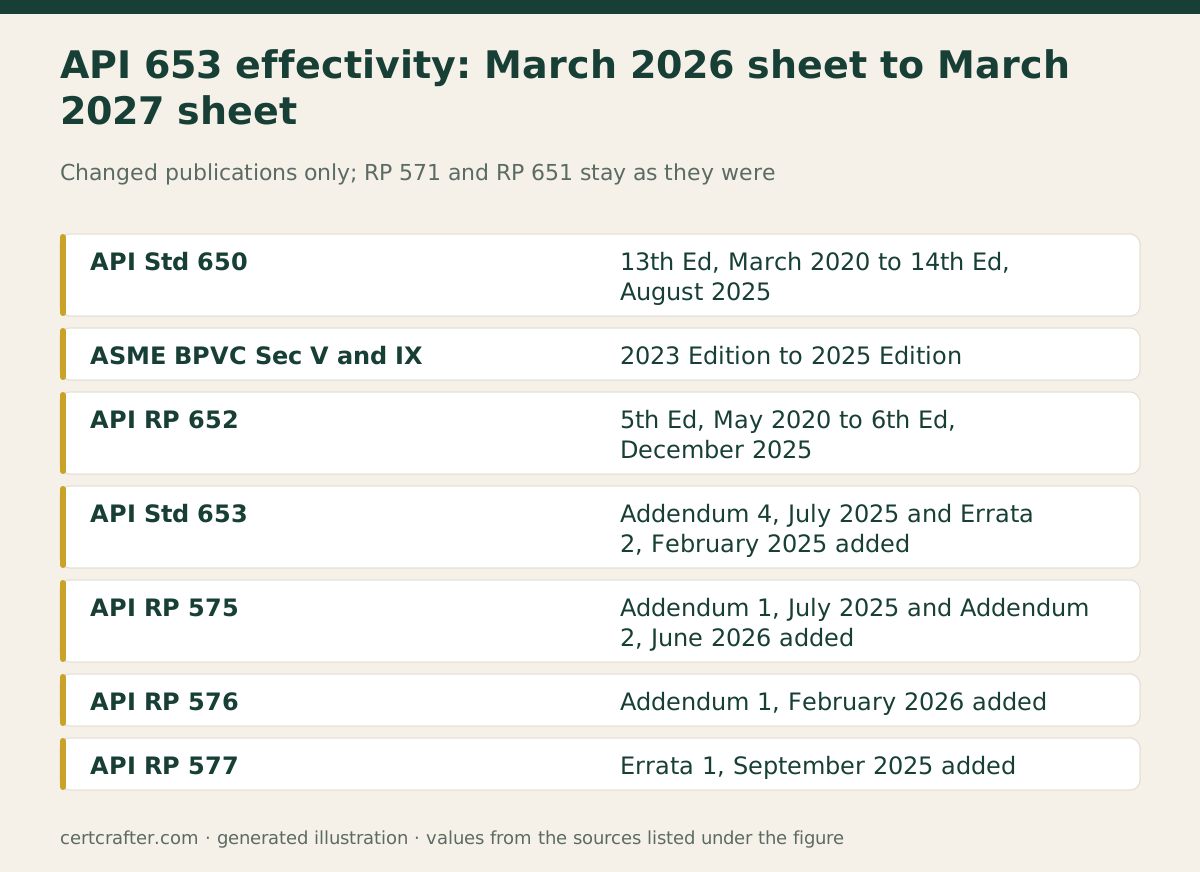
Nine publications sit on the API 653 effectivity sheet, and seven of them carry something new on the March 2027 version of it. One of those changes is large. API 650, the construction standard this exam leans on hardest, goes from the 13th Edition of March 2020 to the 14th Edition of August 2025.
If you are applying for a seat now, the newer list is yours. The November 2026 window was the last one examined against the March 2026 list, and its application deadline passed on September 4, 2026. Every window from March 12, 2027 onward uses the publications below.
Both sheets are two-page documents, and the differences between them are easy to miss when you read them a year apart. So here they are, line by line.
What changed between the March 2026 and March 2027 effectivity sheets?
| Publication | March 2026 sheet | March 2027 sheet |
|---|---|---|
| API Std 650, Welded Tanks for Oil Storage | 13th Edition, March 2020, with Errata 1 of January 2021 | 14th Edition, August 2025 |
| ASME Boiler and Pressure Vessel Code, Sections V and IX | 2023 Edition | 2025 Edition |
| API RP 652, Lining of Aboveground Petroleum Storage Tank Bottoms | 5th Edition, May 2020 | 6th Edition, December 2025 |
| API Std 653, Tank Inspection, Repair, Alteration, and Reconstruction | 5th Edition November 2014, Addenda 1 to 3, Errata 1 | 5th Edition November 2014, Addenda 1 to 4, Errata 1 and Errata 2 of February 2025 |
| API RP 575, Inspection Practices for Atmospheric and Low-Pressure Storage Tanks | 5th Edition, September 2024 | 5th Edition, plus Addendum 1 of July 2025 and Addendum 2 of June 2026 |
| API RP 576, Inspection of Pressure-relieving Devices (two sections only) | 5th Edition, September 2024 | 5th Edition, plus Addendum 1 of February 2026 |
| API RP 577, Welding Processes, Inspection, and Metallurgy | 3rd Edition, October 2020 | 3rd Edition, plus Errata 1 of September 2025 |
| API RP 571, Damage Mechanisms (listed paragraphs only) | 3rd Edition, March 2020 | 3rd Edition, March 2020 |
| API RP 651, Cathodic Protection of Aboveground Petroleum Storage Tanks | 5th Edition, August 2024 | 5th Edition, August 2024 |
The bottom two rows are the only ones you can ignore. Everything above them moved.
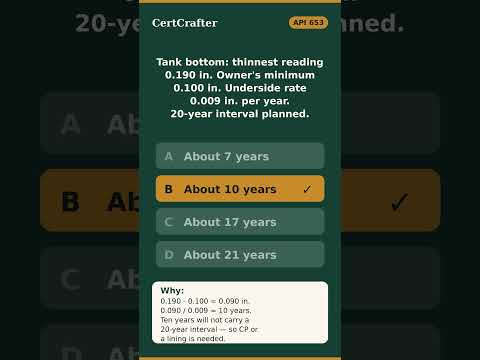 API 653 — Settlement, thickness, interval — one calculation, one number. Watch on YouTube · CertCrafter
 API 653 did not get a new edition, which is the part that catches people. It is still the 5th Edition of November 2014, same cover, same spine. What it picked up is Addendum 4 of July 2025 and Errata 2 of February 2025, on top of the three addenda and one errata the earlier sheet listed. An addendum revises requirements inside a standard without renumbering the book around them, so a copy that looks current can be quietly out of date in the clauses you quote most.
Why does the API 650 edition change matter more than the rest?
Because the open-book half of the exam is mostly API 650 work. Table and figure lookups, the one-foot method, the toughness and impact-test tables, weld-size details, the Annex B settlement procedures. That is where 60 questions and 3 hours 45 minutes of your exam day go.
An edition change does two things to that work. It can change what a requirement says, and it can change where the requirement lives. The second one is what costs you time in the chair. When lookup practice turns into muscle memory for table numbers and annex letters, a new edition breaks that memory without announcing it. You still arrive at the right value. You just spend ninety seconds finding it instead of twenty, sixty times over.
So rebuild the lookup practice against the edition on the sheet. Take each path you rely on, open it, and confirm the requirement is still where you expect. Do that on a screen with a search box, because the test center shows the documents as on-screen PDFs during the open-book portion and nothing you tabbed at home comes into the room with you.
The short version of how a thickness, settlement and interval question hangs together is on our channel: Settlement, thickness, interval.
ASME moves too. Sections V and IX go to the 2025 Edition of the Boiler and Pressure Vessel Code, while the examinable scope stays as it was: Section V Articles 1, 2, 6, 7 and 23, with Article 23 limited to SE-797, and Section IX for welding only.
Which exam windows run on the new sheet?
The March 2027 sheet covers three administrations: March 2027, July 2027 and November 2027.
| Exam window | Application deadline |
|---|---|
| March 12 to April 2, 2027 | January 7, 2027 |
| July 9 to 30, 2027 | May 6, 2027 |
| November 5 to 26, 2027 | September 2, 2027 |
API 653 sits in March, July and November, which is its own cycle and not the one API 510 or API 570 follow. Each deadline falls roughly two months before its window opens, and that gap is where most planning goes wrong. People diary the window and miss the application.
Worked example: planning backward from the March 2027 window
Take the first window on the new sheet and work backward from it.
- The window runs March 12 to April 2, 2027. You pick your Prometric appointment inside those dates.
- The application closes January 7, 2027, about twelve weeks from today. Apply after that and a late application fee of $200 applies on top of the exam fee.
- The 2027 initial certification fee is $890 for API members and $1,140 for non-members. Recertification is $760 and $870. Moving a booked appointment costs $350, so treat the date as fixed once you have it.
- Obtain the publications on the March 2027 list, not the ones you studied last cycle. API 650 14th Edition and ASME BPVC 2025 are the two that will bite.
- Split the study the way the exam splits itself: 110 closed-book questions against 60 open-book ones, which is most of your reading in the smaller half.
There is no reschedule out of an edition change. Apply for March 2027 with notes written to API 650 13th Edition and you study the wrong book for twelve weeks, then find out about it in the chair with the clock running.
Which publications does the March 2027 sheet list?
- API RP 571, 3rd Edition of March 2020, only the paragraphs the sheet names
- API RP 575, 5th Edition of September 2024, with Addenda 1 and 2
- API RP 576, 5th Edition of September 2024, with Addendum 1, two sections only
- API RP 577, 3rd Edition of October 2020, with Errata 1
- API Std 650, 14th Edition of August 2025
- API RP 651, 5th Edition of August 2024
- API RP 652, 6th Edition of December 2025
- API Std 653, 5th Edition of November 2014, with Addenda 1 to 4 and Errata 1 and 2
- ASME Boiler and Pressure Vessel Code 2025, Section V Articles 1, 2, 6, 7 and 23, and Section IX for welding
Anything outside that list is not examinable, however sensible it looks on a tank job. ASME Section VIII is not on it, and neither is API RP 2350.
What has not changed?
The exam shape. There are still 170 questions, 140 of them scored and 30 unscored pretest items that are not flagged, so you answer everything. The closed-book session is 110 questions in 2 hours 45 minutes, then a 45-minute break, then 60 open-book questions in 3 hours 45 minutes. That is 390 minutes of testing.
Passing is still a scaled 400 on a 200-500 scale, with no published percentage behind it. Delivery is still in person at Prometric. For a sense of the difficulty, the most recent published result is the November 2025 administration: 503 candidates at 60.8 percent.
The construction standard is still API 650, which is why its edition carries so much weight here.
What to do next
Check which window your application actually targets. If it is March 2027 or later, bin any practice material written to the 13th Edition, because its table references and acceptance values may not survive the edition change, and a wrong lookup in the open-book half is indistinguishable from not knowing the subject.
Then pull the current sheet yourself from API’s schedules and fees page and keep it with your notes. Run the scored ten-question sample to see where you stand, work the two questions on this page, and read the free API 653 practice questions for the exam-day mechanics. The certification guide covers eligibility and the body of knowledge, the other API 653 posts go section by section, and the six practice tests are written to the March 2027 list.