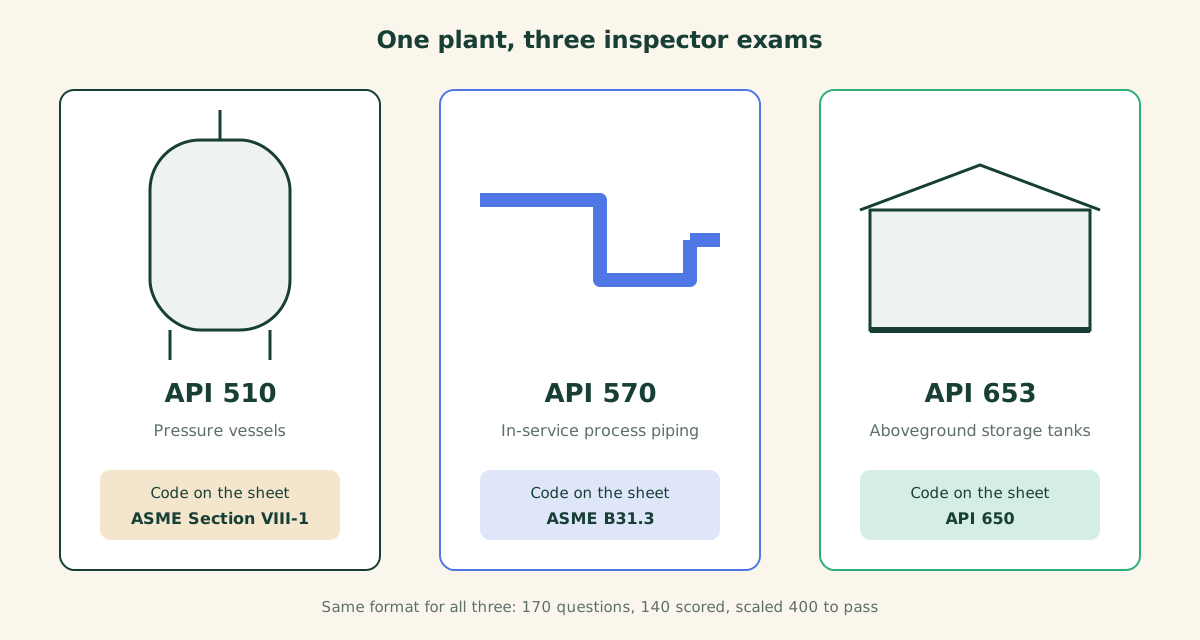
The three API inspector exams are built the same way and fee the same. That surprises people who expect one of them to be the “hard” one. API’s own pages give 170 questions, 140 of them scored, a scaled pass mark of 400, and one price for all three.
So the choice is not about difficulty. It is about what you inspect, which code you can already read, and which window you can make.
What is each exam actually about?
API 510 is for pressure vessels. API’s page says a certified pressure vessel inspector needs broad knowledge of the maintenance, inspection, repair and alteration of pressure vessels. API 570 is for in-service metallic piping systems, and the program lists inspection, alteration and repair of those systems. API 653 is for aboveground storage tanks, and it satisfies the minimum qualifications set out in API Standard 653, which covers tank inspection, repair, alteration and reconstruction.
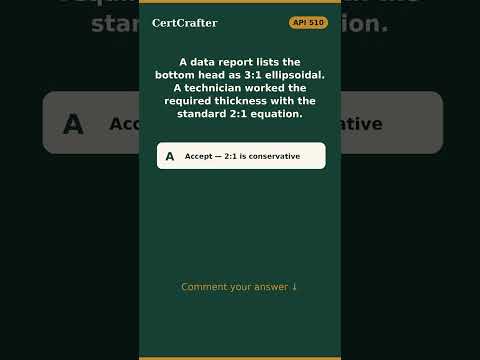 API 510 — Three millimetres of allowance, a quarter mill a year. Now the interval. Watch on YouTube · CertCrafter
Think of a refinery unit. A separator drum is a 510 item. The line leaving it is a 570 item. The product tank at the end of the line is a 653 item. One site, three inspection codes, and an inspector is often asked about more than one in a single shift.
The course channel has a short on how a thickness allowance turns into an inspection interval on a vessel, three millimetres of allowance and a quarter mill a year, which is the kind of reasoning all three exams reward.
What is the same across all three?
Almost everything about the day. Each exam is 7.5 hours long: a short tutorial, 2.75 hours for the closed-book part, a 45-minute lunch, then 3.75 hours for the open-book part. There are 170 questions, 110 closed-book and 60 open-book. Only 140 count. The other 30 are pretest questions, and you can’t tell which they are.
All three are in person at designated test centers. The codes show up as PDFs on your screen during the open-book part, and only the sections on the effectivity sheet load. Each certification is valid for three years, and each is accredited by ANSI under ISO 17024.
The money is the same too. The 2027 initial certification fee for 510, 570 and 653 is $890 for API members and $1,140 for non-members. Recertification is $760 and $870. Rescheduling is $350 and a late application is $200 extra.
The pass mark is a scaled 400 on a 200 to 500 scale. API publishes no raw percentage, so a forum claim that you need 70 percent has nothing behind it.
What is different, and does it matter?
Three things differ, and they matter in this order.
The first is the code you read for the open-book half. A vessel inspector works from API 510 with ASME Section VIII Division 1, Section V and Section IX. A piping inspector works from API 570 with ASME B31.3, plus Sections V and IX. A tank inspector works from API 653 with API 650. The 510 list does not lead to B31.3, and the 653 list does not include Section VIII or B31.3 at all.
The second is the edition. The September 2026 sheet for API 510 lists the 2025 editions of ASME Sections V, VIII-1 and IX. The 2026 API 570 sheet lists the 2023 edition of the ASME code and the 2024 edition of B31.3. The March 2027 API 653 sheet lists API 650 in its 14th Edition. Three exams, three different edition sets, so notes from one don’t carry to another.
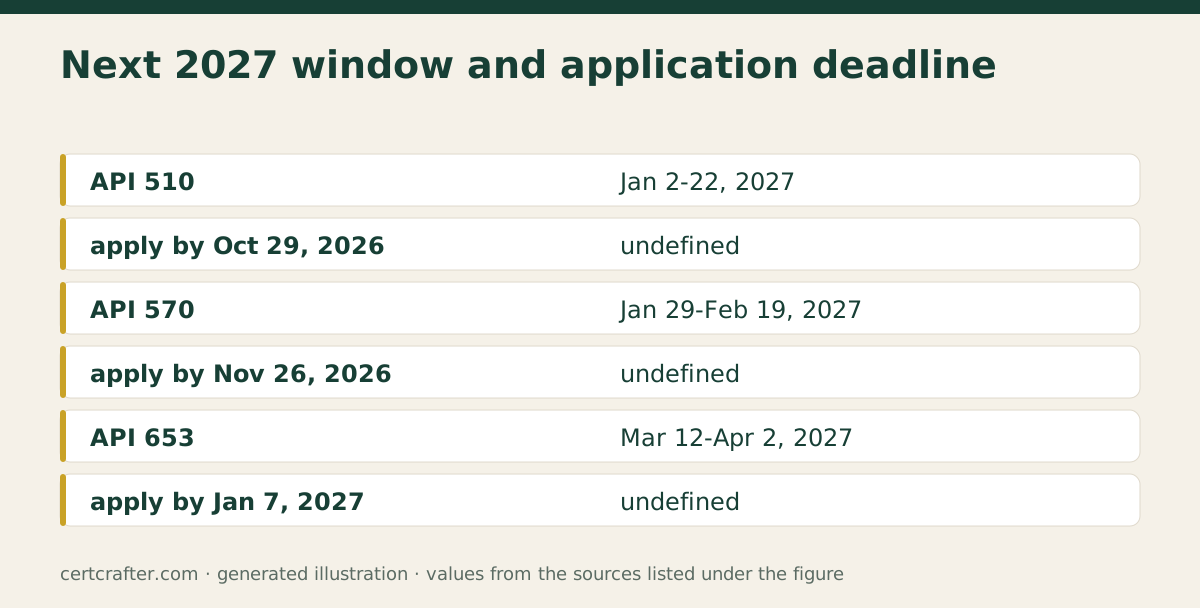
The third is the window. The next ones are in the table below, and the dates drive the plan more than any other factor.
| Exam | Next 2027 window | Application deadline |
|---|---|---|
| API 510 | January 2 to 22, 2027 | October 29, 2026 |
| API 570 | January 29 to February 19, 2027 | November 26, 2026 |
| API 653 | March 12 to April 2, 2027 | January 7, 2027 |
How do the experience rules affect which one you can sit?
The qualification table is the same shape for all three, and it is checked after you apply. A bachelor’s degree or higher in engineering or technology needs 1 year of supervision or performance of inspection activities as described in that exam’s code. A two-year degree needs 2 years, one of them in inspection activities. A high school diploma needs 3 years, and no formal education needs 5 or more.
The detail that catches people is that the experience has to be in that equipment. For API 570 it is in-service piping systems. For API 653 it is aboveground storage tanks. Years in vessel fabrication do not fill the 570 box. All of it must have been acquired within the last 10 years while employed by, or under contract with, an authorized inspection agency as defined in the code itself.
Worked example: choosing a first exam
Take an engineer with a bachelor’s degree who has worked 14 months on a refinery turnaround team. Most of that time went on vessel internals and a smaller share on piping circuits. They want one certification before the end of spring 2027.
- Check the qualification table. A bachelor’s degree needs 1 year of inspection activity. The 14 months were mostly vessel work, so 510 is the exam they clearly qualify for. Piping may qualify too, but only for the months actually spent on piping inspection.
- Match the window. The January 2 to 22, 2027 window for 510 closes applications on October 29, 2026, which is 12 days from today. That is tight but doable. If it slips, May 7 to 28, 2027 has a deadline of March 4, 2027.
- Price it. At the 2027 member fee of $890, one sitting costs $890. Missing a booked date and rescheduling adds $350.
- Decide on the second exam later. If the engineer then moves to piping work, API 570 on January 29 to February 19 is the next window, with applications closing November 26, 2026.
Anyone planning all three pays that fee three times, plus $350 for any booked date moved.
What does industry practice say about the order?
Inspectors don’t usually collect these in a fixed order. They collect them as the job demands. A site with a large vessel population pushes people toward 510 first. A site with long process piping runs and corrosion circuits leans 570. A terminal or tank farm needs 653.
What practice does show is that the three share a way of thinking. Each one asks you to turn a measured thickness into a rate, a remaining life and an interval, and to tell a repair from an alteration. A 570 sample question has an inspector decide whether a rewelded line needs a pressure test: an alteration normally does, while for a repair the inspector may accept suitable examination instead. A 510 sample question has an owner user who wants the code applied to a vessel outside its stated scope: the owner user may do that and should record the decision in the file. Different equipment, same habit of reading what the code actually allows.
If you hold one, the second is shorter work than the first because the reasoning carries over. The code details do not.
Where do candidates go wrong when comparing the three?
They assume the reference list carries across. The 653 sheet has no Section VIII on it, and the 570 sheet has no Section VIII either. Studying from a vessel book for a tank exam burns weeks.
They also treat the edition as a detail. The three sheets name different editions, and the 570 sheet stays on the 2023 ASME edition while 510 and the March 2027 653 sheet use 2025. Practice material written to the wrong edition points you at the wrong clause, then you meet the right one in the chair with the clock running.
And they split time evenly when the exam does not. The 110 closed-book questions get 2 hours 45 minutes, about a minute and a half each, with no codes in front of you. The 60 open-book questions get 3 hours 45 minutes. The longer block rewards navigation, but the larger block rewards what you carry in your head. Once the closed-book part is submitted, you do not go back.
Last, they chase a percentage. There isn’t one to chase.
What to do next
Open the effectivity sheet for the one window you can realistically make, and read it before you buy any book. Run the free ten-question API 510 sample to find out where you stand. The API 510 certification guide covers eligibility and the body of knowledge, the other API 510 posts go section by section, and the practice tests are written to the September 2026 list.
For dates, deadlines and costs of each exam on its own, see the API 510 exam format, scoring and dates post, the API 570 version and the API 653 version. If tanks are your side of the plant, the API 653 certification page and the API 570 certification page are the place to compare.
Comments
Comments are read by a person before they appear. How we moderate.