The next API 653 window you can still apply for runs March 12 to April 2, 2027, and applications for it close on January 7, 2027.
That is most of the planning problem in one line. The November 6 to 27, 2026 administration is still printed on API’s schedule, which is why people keep aiming at it, but its application deadline was September 4, 2026. Three weeks of availability in November buys you nothing if the paperwork window shut in September.
API 653 runs three times a year. Each sitting is a three-week window, and each application closes roughly two months before that window opens.
When are the next API 653 exam windows and application deadlines?
| Exam window | Application deadline |
|---|---|
| March 12 to April 2, 2027 | January 7, 2027 |
| July 9 to 30, 2027 | May 6, 2027 |
| November 5 to 26, 2027 | September 2, 2027 |
March, July and November belong to API 653. The months are not an accident. API 510 takes January, May and September, and API 570 takes February, June and October, so no test center is ever carrying all three inspector exams at once. If you are stacking two of them, the calendar has already decided your order for you.
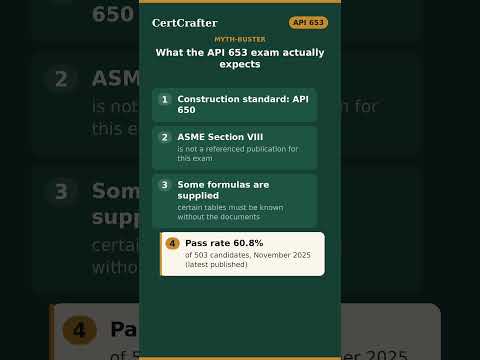 API 653 — Myth: API 653 is only for crude oil storage. Watch on YouTube · CertCrafter
 One thing worth settling before you spend money on a window: what the certification actually covers. A short answer to the commonest wrong assumption about its scope sits on our channel, in the crude oil myth.
What does the API 653 exam day look like?
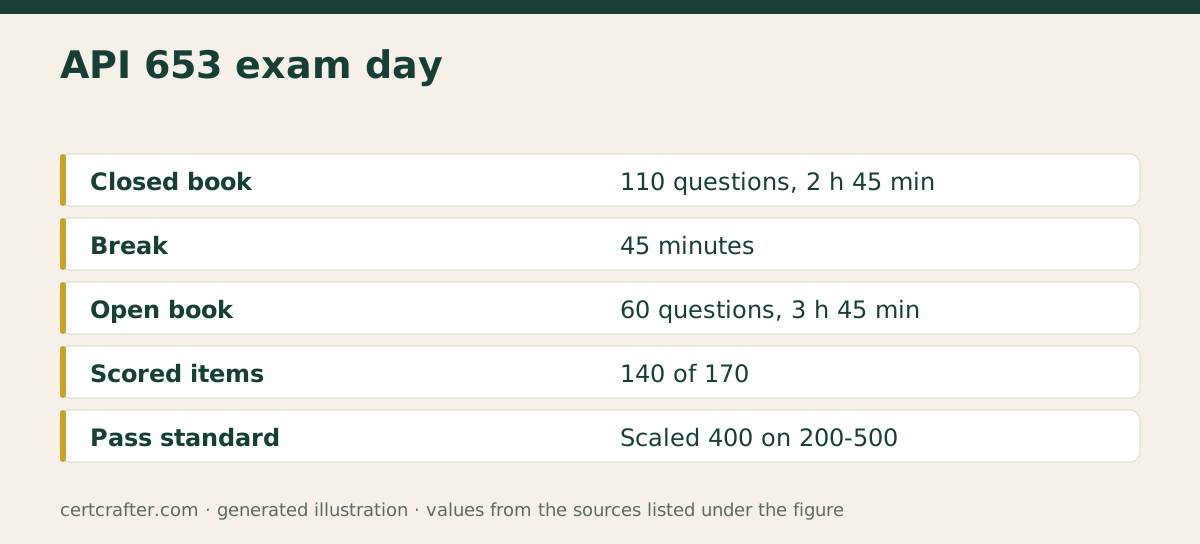
Seven and a half hours, start to finish. A short tutorial session, then 110 closed-book questions across 2 hours 45 minutes, a 45-minute lunch break, then 60 open-book questions across 3 hours 45 minutes.
Two numbers circulate for this exam and both are correct. API’s schedules and fees page lists API 653 at 6.5 hours, which is testing time and nothing else. The certification page says 7.5 hours, which is the day, tutorial and lunch included. Book your flight against the second one.
Set the questions against the clock and the design shows itself. The closed-book half gives you about 1.5 minutes a question. The open-book half gives you about 3.75. Same candidate, same chair, two different jobs, and the second one is only possible because the first one is over.
Papers and books do not come into a Prometric computer testing center. The codes and standards you are examined on appear as PDFs on your own screen during the open-book portion, presented in English, and that is all the reference material there is. Tabbing a paper copy of API 653 at the kitchen table trains a skill the room will not let you use. Practice searching a PDF instead.
The two questions on this page show the split from both sides. One is a closed-book judgment call about a tank whose file has no construction drawings and almost no inspection history, where nothing can be looked up and the answer is a decision. The other is marked open book and hands you a procedure qualification record with preheat and thickness entries written as ranges rather than as the values used, which is a document review against a requirement you are expected to find.
How is the API 653 exam scored?
Passing is a scaled 400 on a 200-500 scale. There is no published percentage, and the distinction is worth more than it first appears.
Scaling lets API hold one standard across forms that differ a little in difficulty, so the raw number of correct answers behind a 400 moves from form to form. API publishes no raw cut score, which means any firm percentage you read on a forum is somebody’s reconstruction. The certification runs for a three-year term and is accredited by ANSI against ISO 17024, and that accreditation is precisely why the scoring works this way rather than as a mark out of 140.
Of your 170 questions, 140 are scored. The other 30 are unscored pretest items being trialled for future forms, and they carry no flag on screen. Answer all 170. From the chair you cannot tell which thirty are free.
How hard is it? The most recent administration API has published figures for is November 2025: 503 candidates, 60.8% of them passing.
What does the API 653 exam cost?
| Fee | API member | Non-member |
|---|---|---|
| Initial certification, 2026 schedule | $875 | $1,125 |
| Initial certification, 2027 schedule | $890 | $1,140 |
| Recertification, 2026 schedule | $745 | $855 |
| Recertification, 2027 schedule | $760 | $870 |
| Reschedule | $350 | $350 |
| Late application | $200 | $200 |
Read the reschedule line before you book anything. Moving a booked API 653 appointment costs $350 regardless of membership, and that is a serious slice of the exam fee for a change of date. Treat the appointment as fixed the moment you have it.
Worked example: planning backward from the March 2027 window
- Pick the window. March 12 to April 2, 2027, with your appointment somewhere inside those three weeks.
- Work back to January 7, 2027, the application deadline. Miss it and the $200 late application fee lands on top of the exam fee, assuming the application is taken at all.
- Check eligibility before you pay. A BS or higher in engineering or technology needs 1 year of supervising or performing the inspection activities API 653 describes. A two-year degree or certificate needs 2 years, a high school diploma 3 years, and no formal education 5 or more years. That experience has to have been earned within the last 10 years while employed by or under contract with an authorized inspection agency.
- Budget from the 2027 column: $890 as an API member, $1,140 if not.
- Study against the March 2027 effectivity sheet, which governs the March, July and November 2027 windows. It moves API 650 to its 14th Edition of August 2025 and ASME BPVC Sections V and IX to their 2025 Editions.
- Rehearse the two halves separately, then run them together in the 2:45, 45-minute, 3:45 shape at least twice before the day.
Do the arithmetic in that order and the planning collapses to a single hard constraint, which is the application date sitting months ahead of everything else.
What does API 653 cost to keep?
Certification lasts three years, and recertification is its own small project rather than a renewal button.
You can apply 90 days before your expiry date and for a 90-day grace period after it, with late fees once the expiry date passes. Let the grace period run out and the certification expires outright: new application, new fees, and the full examination again. Over each three-year cycle you have to show that at least 20% of your time went on performing or supervising tank inspection activities, and complete 24 hours of continuing professional development spread across at least two categories. Every six years a webquiz is added on top: 25 questions on how the codes have changed, open book, four hours, pausable up to three times. Fail it twice and recertification is gone, and you are back to the full exam.
Against that, $760 or $870 every three years is the smaller number in the room. The thing that costs people their certification is the calendar, not the fee.
What to do next
Put January 7, 2027 in your calendar now, then decide whether you can be ready for March or should aim at July. Choosing the window first and the readiness second is how a $350 reschedule happens.
Then find your level. The scored ten-question sample does that in an afternoon, the free practice questions walk through five with full explanations, and what changes on the March 2027 sheet covers the edition shift in detail. The certification guide sets out eligibility and the body of knowledge, other API 653 posts go section by section, and the six practice tests run the real closed-book and open-book split. Pull the dates yourself from API’s schedules and fees page and keep them beside your notes.
Comments
Comments are read by a person before they appear. How we moderate.