My 4 engineering books go FREE on Kindle Fri 6 – Tue 10 Nov (PT). See the books → FREE on Kindle now: all 4 engineering books, until Tue 10 Nov 11:59 pm PT. Ends in . Grab yours → My 4 books: FREE on Kindle Fri 6 – Tue 10 Nov (PT). See → FREE on Kindle now: 4 books, left Grab yours →

API 510 Practice Questions, Set 2 (Free)

By Sandeep Bandyopadhyay, Senior aerospace engineer · PMP, MBA, Six Sigma

TL;DR

This second set of free API 510 practice questions covers a penetrant examination run in the cold, a fillet welded patch and a hydrotest after a shell repair. Each comes with its full explanation. They sit in the exam's 170-question format, 110 closed book in 2 hours 45 minutes and 60 open book in 3 hours 45 minutes, of which 140 are scored. Passing is a scaled 400 on a 200-500 scale.

Original questions, not exam dumps. Every CertCrafter question is written from the published body of knowledge and the referenced codes. None is copied from a live exam, and CertCrafter is independent: not affiliated with or endorsed by any awarding body.

A pressure vessel with a pressure gauge displayed at an industrial expo
Photo: Pressure vessel and gauge displayed at an industrial expo by Shixart1985 (Wikimedia Commons), CC BY 2.0, via Wikimedia Commons.

Most API 510 candidates can recite a procedure and still miss the question that changes one condition in it. Cold metal, a shortcut repair, an owner with a stress limit: the constraint is the question.
Video: API 510 — Three millimetres of allowance, a quarter mill a year. Now the interval. API 510 — Three millimetres of allowance, a quarter mill a year. Now the interval. Watch on YouTube · CertCrafter
Image: video thumbnail, source: CertCrafter on YouTube (@certcrafters).

What do these three free API 510 questions test?

A penetrant examination, a fillet welded patch and a hydrostatic test. The first sits in the nondestructive examination part of the Body of Knowledge, the second in repairs, the third in pressure testing. Each one gives you a vessel, a situation and a rule that has to bend.

They come from the free sample behind the scored API 510 quiz. Commit to an answer before you open the explanation. The channel also has a short on the interval calculation if you want the thickness side of the same job.

Why does a penetrant test fail in cold weather?

Liquid penetrant work is simple until the weather turns. Penetrant is thicker when it is cold, so it creeps into a tight discontinuity more slowly and comes back out more slowly. A technician who follows the usual routine on cold steel is following a routine that was never qualified for that surface.

On a turnaround, this is the shift that starts at dawn on a cold shell. A competent inspector asks what the surface temperature is before anything gets sprayed, and wants to see the procedure that covers it. The method belongs to ASME Section V, Article 6, which the Body of Knowledge lists with its mandatory appendices.

The exam builds the same trap with two faults in one stem. One is the cold surface. The other is a technician who reads the weld the instant the developer goes on. Developer needs time before interpretation starts, and a reading taken too early looks clean because nothing has bled out yet. Candidates who find only one fault pick an answer that fixes half the problem.
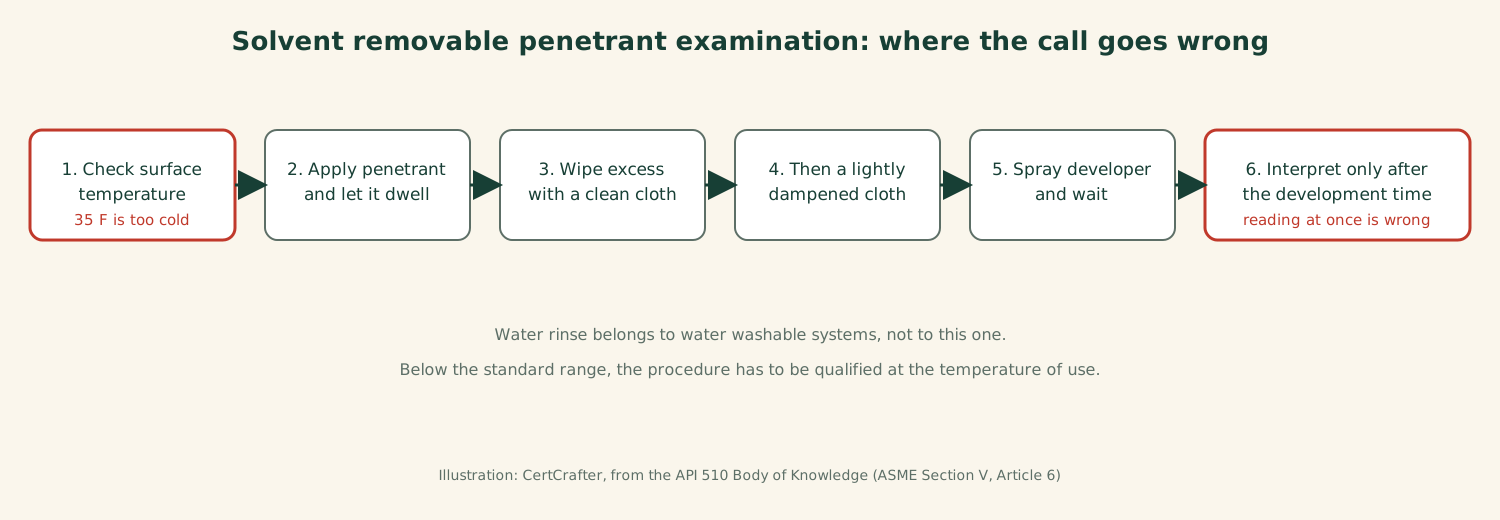
Six steps of a solvent removable penetrant examination, with the cold surface at step 1 and the immediate reading at step 6 marked as the two faults
Illustration: CertCrafter, from the API 510 Body of Knowledge. Illustration: CertCrafter, from API 510 Body of Knowledge, September 2026 to May 2027.

The distractors are made from true statements about other methods. Water rinsing is correct for water washable systems and wrong for a solvent removable one, where excess is wiped with a clean cloth and then a lightly dampened one. Fluorescent only is not a rule at all. Ask which technique the stem describes before you test the options against it.

When can a fillet welded patch go on a vessel?

When the engineer has designed it. Plants like patches because they are fast and the vessel stays in service. Inspectors get uneasy for the same reason. ASME PCC-2 Article 212 covers fillet welded patches, and API 510 recognizes them, but neither makes the patch a field decision.

The design is worked out and signed off by the engineer. The patch follows layout rules for its shape, corner radii, size against the vessel, the surface it goes on and the condition of the metal under it. The inspector’s job is to check that what was built matches what the engineer signed off, and to say so on the record.

The exam question swaps the authority. It tempts you to let the inspector sign off a patch because it is temporary, or to restrict patches to pitting, or to treat a patch as a rerate. Each distractor is a plausible habit and none is the code position. A patch restores pressure-carrying capability, so the vessel is not cut down to the wall left underneath.
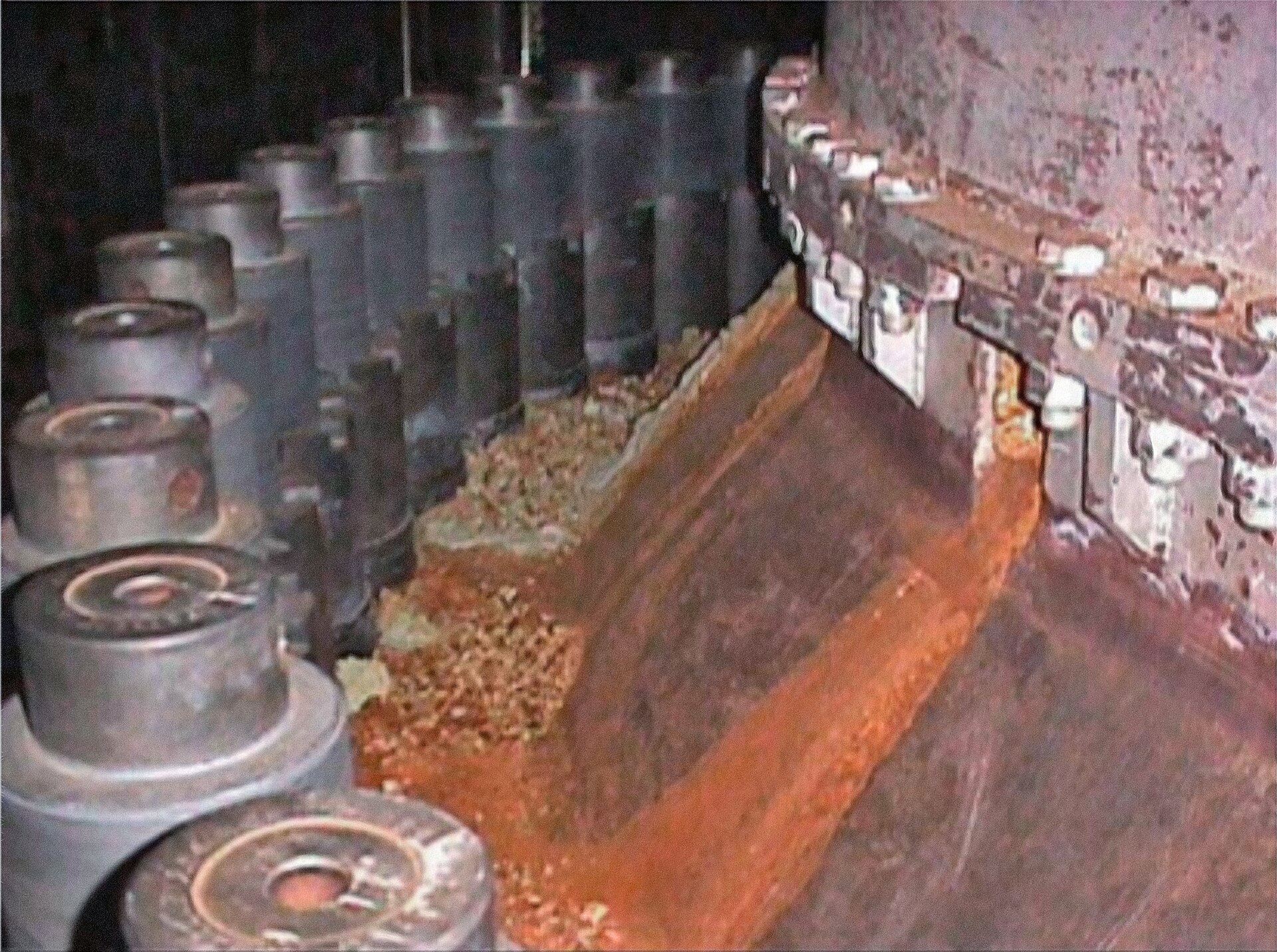
Orange rust-colored deposits piled against the steel surface of a pressure vessel head, with a row of grey control rod drive nozzles on the left
Photo: Reactor Pressure Vessel at the Davis-Besse Nuclear Power Station (14678591802) by Nuclear Regulatory Commission from US (Wikimedia Commons), Public Domain, via Wikimedia Commons.

How is a hydrotest pressure set after a repair?

From the code’s test factor on the MAWP, then corrected for temperature. Allowable stress falls as metal gets hotter, so the code lets you multiply by the ratio of the allowable stress at the test temperature to the allowable stress at design temperature. Pressure testing is in the Body of Knowledge under Section I, and the calculation sits in ASME Section VIII, Division 1, UG-99 and UG-100.

The separator in the third question has a design temperature of 700 F and is tested with ambient water. The metal is much cooler in the test than at design, so the ratio is greater than one and the test pressure rises above the plain factor times MAWP. That is why the owner’s stress limit matters: the shell stress at the corrected pressure still has to be checked against the code limit before the pump starts. Real hydrotest procedures carry the same check.

The API 510 Complete Exam Kit works more calculations like this under timed conditions, with every answer explained.

Two distractors reverse the ratio or drop it. Flipping it would lower the test pressure and defeat the correction. Another reaches for an older factor carried in much earlier editions. When an option feels familiar from an old course, check which edition it came from. The September 2026 sheet lists API 510 as 11th Edition with Errata 1 and 2, and the 2025 editions of ASME Sections V, VIII Division 1 and IX.

How is the API 510 exam built?

Answering takes the same discipline all day. There are 170 questions, 140 scored and 30 unscored pretest items. The first part is 110 closed-book questions in 2 hours 45 minutes. After a 45-minute break come 60 open-book questions in 3 hours 45 minutes. The exam runs in person at Prometric with references on screen.
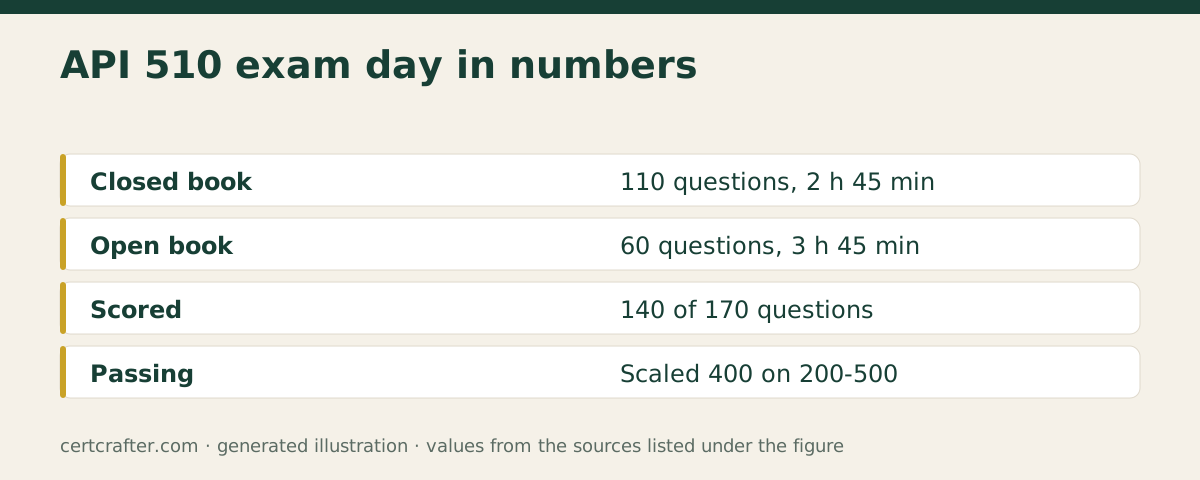
API 510 exam day in numbers: closed book 110 questions in 2 hours 45 minutes, open book 60 questions in 3 hours 45 minutes, 140 of 170 questions scored, passing a scaled 400 on a 200 to 500 scale
Illustration: CertCrafter, from the API 510 certification page. Illustration: CertCrafter, from API 510 Pressure Vessel Inspector certification page.

You cannot tell which items are pretest, so every question gets full effort. Passing is a scaled 400 on a 200-500 scale, not a published percentage.

When is the next API 510 window?

The January 2027 application deadline, October 29, 2026, has passed. The next two windows:

Exam window Application deadline
May 7 - 28, 2027 March 4, 2027
September 3 - 24, 2027 July 2, 2027

Fees and dates are on API’s schedules and fees page, and the exam format, scoring and dates post goes through the rest.

How do you get value from three free questions?

Treat them as a mirror for one habit, not as a readiness check. Miss one and write down why: the wrong method, a dropped factor, the wrong authority. Then look for the same slip in the next question you do.

API 510: The 10 Most Common Mistakes and API 510 Thickness and Inspection Intervals cover the neighboring ground. The API 510 guide holds the fact sheet and the hub of API 510 guides lists the rest. Next, try the free sample quiz under a timer.

What these questions will not do

None is copied from a live exam. They are original, written from the published Body of Knowledge and the referenced codes, and no practice set replaces the codes. The API 510 practice test bundle gives full-length runs in the real rhythm. The API 510 Complete Exam Kit works more of these under timed closed-book and open-book conditions, with every answer explained.

Try these free questions

  1. [Open book] A solvent removable visible penetrant examination is run on a nozzle weld at 35 F (2 C). The technician applies penetrant, waits ten minutes, wipes with a solvent dampened cloth, sprays developer and reads immediately. What should the inspector correct?

    1. The removal step, since excess penetrant must be rinsed off with water before developer is applied.
    2. The penetrant type, since only fluorescent penetrant may be used on pressure vessel welds.
    3. The temperature and the immediate reading, both of which fall outside what the method allows.
    4. The dwell time, since ten minutes floods the surface and leaves an unreadable background.
    Show the answer and explanation

    Answer: C. Two things are wrong. The examination is being run at 35 F (2 C), below the standard temperature range for penetrant examination of roughly 40 F to 125 F (5 C to 52 C), and at lower temperatures the penetrant is more viscous, so the procedure has to be qualified at the temperature of use before the results mean anything. The technician also read the surface the instant the developer went on. Developer needs its own development time for penetrant to bleed back out of a tight discontinuity, and the code sets a minimum before interpretation begins. Option 1 misstates the technique, because for a solvent removable penetrant the excess is wiped off with a clean cloth and then with a lightly dampened cloth, while a water rinse belongs to water washable systems. Option 2 invents a restriction that does not exist, since visible penetrant is acceptable on vessel welds. Option 4 attacks a dwell time that is reasonable.

  2. A refinery proposes a fillet welded patch over a corroded area on the shell of gas plant reflux drum D-501. What does API 510 require before that repair may be used?

    1. Design approval by the engineer, with the patch sized and shaped to the code rules.
    2. Only the inspector's agreement, since a lap patch is by definition a temporary repair.
    3. That the patch go on the outside surface only, and only over pitting rather than general thinning.
    4. That the vessel first be rerated to the thickness remaining under the corroded area.
    Show the answer and explanation

    Answer: A. A fillet welded patch, sometimes called a lap patch, is recognised by API 510 but it is not a free choice for the inspector or the welder. The code requires the design to be worked out and approved by the engineer, and the patch to be laid out to the rules the code gives for such patches, which cover the shape, the corner radii, the size relative to the vessel, the surface it goes on, and the condition of the metal underneath. Option 2 gives the inspector an authority the code reserves for the engineer. Option 3 states restrictions that are not the code position, since a fillet welded patch may be used over general thinning as well as pitting, and the design rules rather than a blanket prohibition decide where it can sit. Option 4 confuses a patch with a rerate, because the patch is intended to restore pressure carrying capability, so the vessel is not reduced to the wall left underneath.

  3. [Open book] V-1204 is an SA-516 Gr 70 separator with an MAWP of 300 psig (2068 kPa) and a design temperature of 700 F (371 C). A hydrostatic test follows a shell repair, using ambient water, and the owner insists the shell stress stay inside the code limit. How should the test pressure be set?

    1. Multiply 1.3 times MAWP by the ratio of allowable stress at test temperature to that at 700 F, then check the shell stress against the code limit.
    2. Use 1.3 times MAWP with no stress ratio applied, because the ratio applies only when the test metal is hotter than the design temperature of the vessel.
    3. Use 1.5 times MAWP and then apply the stress ratio, since 1.5 is the traditional hydrostatic factor for a vessel that is already in service.
    4. Multiply 1.3 times MAWP by the ratio of the allowable stress at 700 F to the allowable stress at the temperature of the test water.
    Show the answer and explanation

    Answer: A. Hydrostatic test pressure for an existing vessel starts from 1.3 times the MAWP, and because allowable stress falls as temperature rises, the code lets that figure be multiplied by the ratio of the allowable stress at the test temperature to the allowable stress at design temperature. With ambient water and a 700 F design temperature the ratio is greater than one, so the test pressure rises, and the constraint the owner set means the resulting shell stress still has to be checked against the code limit before the pump is started. Option 2 drops the ratio entirely and gives a test lower than the code allows for this vessel. Option 3 uses 1.5 times MAWP, the factor carried in much older editions, which no longer applies to a test set this way. Option 4 inverts the ratio by putting the hot allowable on top, which would lower the test pressure instead of raising it and defeat the whole point of the correction.

Take the full free 10-question sample with scoring →

Frequently asked questions

How is this set different from the first free API 510 set?

It uses three different questions from the free sample: a penetrant examination on a cold surface, a fillet welded patch and a hydrotest after a shell repair. The first set covered a crack repair, an insulation call and a radiograph.

Are these API 510 sample questions from the real exam?

No. They are original questions written from the published Body of Knowledge and the referenced codes. They show how a decision with a constraint attached is framed, not what appears on a live exam.

What score do you need to pass the API 510 exam?

A scaled 400 on a 200-500 scale. API publishes no raw percentage, so advice that quotes one is a guess.

Official sources

  1. API 510 Pressure Vessel Inspector certification page — accessed 8 November 2026
  2. API ICP Schedules & Fees — accessed 8 November 2026
  3. API 510 Publications Effectivity Sheet, September 2026, January 2027 and May 2027 — accessed 8 November 2026
  4. API 510 Body of Knowledge, September 2026, January 2027 and May 2027 — accessed 8 November 2026

Exam rules change. Check the awarding body's official page before you apply. CertCrafter is independent and is not affiliated with or endorsed by any awarding body.

Was this helpful?

Comments

    Comments are read by a person before they appear. How we moderate.