Most API 510 plans fail in the same place: they spend months reading and a few days practising. The exam rewards the reverse, because half of it is finding and applying requirements under a clock.
What should an API 510 study plan actually contain?
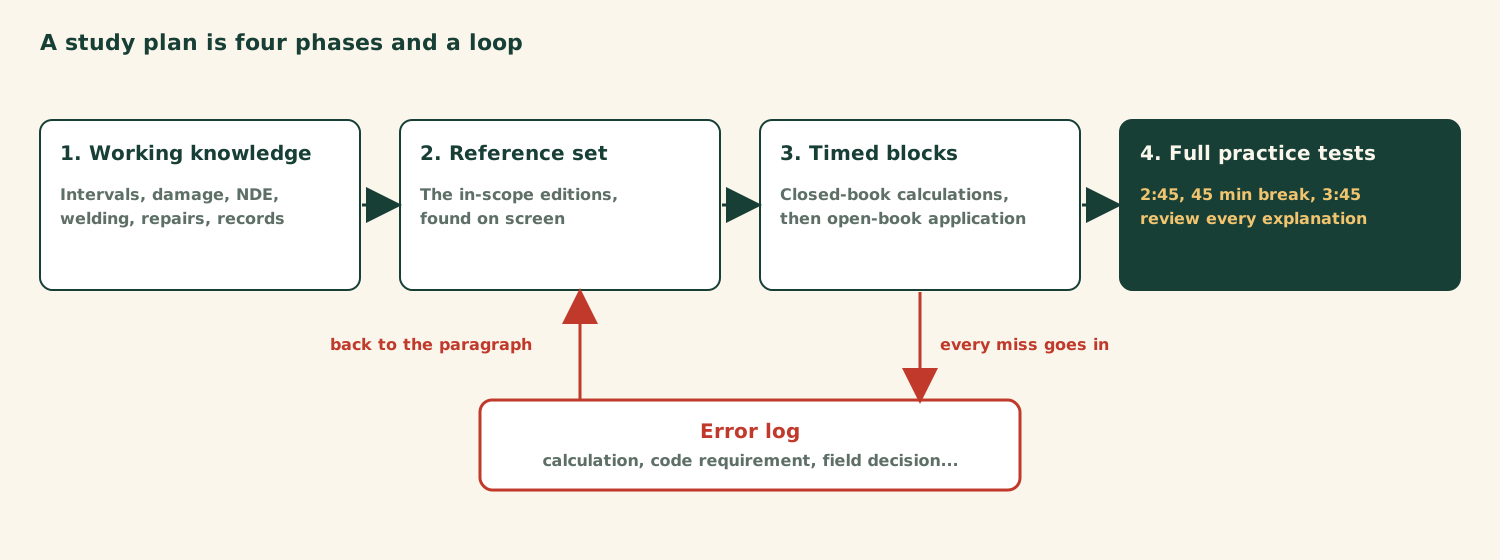
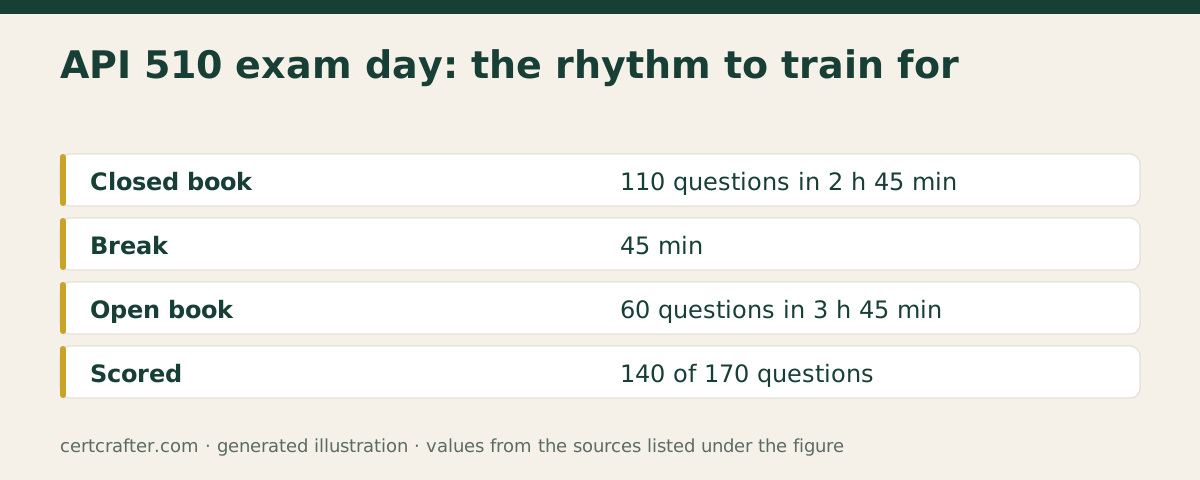
Four phases, in order. The exam day is 7.5 hours: 110 closed-book questions in 2 hours 45 minutes, a 45-minute break, then 60 open-book questions in 3 hours 45 minutes. Of the 170 questions, 140 are scored. The pass standard is a scaled 400 on a 200-500 scale, and API publishes no percentage, so a plan built around “get 70%” has no anchor.
| Phase | What you do | How you know it is done |
|---|---|---|
| 1. Working knowledge | Read for understanding across the five domains | You can explain each idea to a colleague without the page |
| 2. Reference set | Open the in-scope editions on screen and find things | You locate a requirement in seconds, not minutes |
| 3. Timed blocks | Closed-book calculations, then open-book application | Your misses are shrinking and changing type |
| 4. Full tests | Whole exams at the real rhythm | You finish with time to review |
Nothing here is a number of hours. That is deliberate. API gives no study time, and a candidate with ten years on vessels needs a different phase 1 than one who has never read the code.
What do you learn first, and in what order?
Start with the thing the body of knowledge puts first: Domain I, thickness measurements, inspection intervals and vessel integrity. It is calculation heavy, it is closed book for the core formulas, and everything else in the code assumes you can read a thickness trend.
Then widen. The five domains are thickness and intervals, welding procedure and qualification evaluation, nondestructive examination, and two practical knowledge domains, general and specific. Work through them as one connected picture of a vessel’s life: how it was built, how it deteriorates, how you find the damage, and how it is repaired and recorded.
The body of knowledge also fixes what is out. Only internal pressure loadings are considered for the calculations, and API RP 571 is used for a short list of mechanisms, not the whole document. Check the effectivity sheet before you read anything cover to cover.
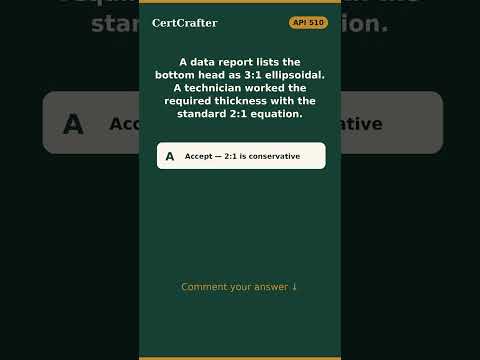 API 510 — Three millimetres of allowance, a quarter mill a year. Now the interval. Watch on YouTube · CertCrafter
Our channel has a short that walks the allowance, rate and interval chain, which is a good first calculation to own.
How do inspectors learn this on the job?
Nobody studies a vessel in the order of an exam syllabus. On a plant you meet it as a thickness report that does not match last cycle’s, a nozzle with insulation damage, a repair package that needs a weld procedure checked. You open the code to settle one question, and you learn the paragraph because it mattered.
Copy that. Take a real or imagined vessel and walk the chain: what is it made of, what damage mechanisms apply, which NDE finds them, what interval follows from the corrosion rate, and who authorizes a repair. A plan that follows one vessel through its life sticks better than five separate subject blocks.
Experienced inspectors tend to over-trust memory in the open-book half. The body of knowledge says open-book questions use detailed information you are expected to find but would not normally commit to memory. That is a search skill, and it fades if you do not use it.
How do you practise the reference set on screen?
Papers, notes and books are not allowed at the Prometric center. In the open-book portion, PDFs of the pertinent codes are on your computer, and only the sections listed on the effectivity sheet are available. For September 2026 to May 2027 that means API 510 11th Edition with Errata 1 and 2, the listed RP 571 mechanisms, RP 572, RP 576, RP 577 and RP 578, the 2025 ASME Sections V, VIII Division 1 and IX, and the named PCC-2 articles.
So build the habit on a screen. Take a question, decide which document owns the answer before you search, and use the PDF’s own search. Train around the real tool, not a tabbed and highlighted paper copy you cannot bring.
Worked example: planning backward from the May 2027 window
Take a candidate aiming at the May 7 to 28, 2027 window. The application deadline for that window is March 4, 2027, and experience must be documented on the application, then verified.
- Fix the deadline first. Everything runs back from March 4, 2027, because the application needs documented experience and a supervisor who answers.
- Give the final phase the closing stretch before the window: full practice tests at the real rhythm, one review session per test.
- Put phases 2 and 3 between, so the reference set is familiar before you time yourself against it.
- Whatever time is left at the start goes to phase 1, and it shrinks if you already work on vessels.
The shape matters more than the lengths. The API 510 Complete Exam Kit works timed blocks and full tests like these, with every answer explained.
What goes in the error log?
The log is what turns practice into progress. Tag every miss by type: calculation, code requirement, field decision, diagnosis, acceptance, authorization and records, or selection under constraint. Write the paragraph or table that settles it.
After a few blocks the pattern shows. If most misses are calculation, drill closed-book arithmetic in both US customary and SI units, since the body of knowledge expects both. If they are code requirement, go back to phase 2. If they are field decisions, the wrong person is deciding in your head: repairs and alterations involve the engineer and owner-user, not only the inspector.
Where do candidates go wrong with study plans?
They train on the wrong edition. They treat closed-book as the easy half, though it is 110 questions. They never time themselves until the final week. They skip reviewing correct answers, which hides guesses that happened to land. And they plan from a pass percentage that does not exist.
Another common slip is leaving the application to the end. Windows have fixed deadlines, and a late application carries a fee in the API schedule.
What to do next
Write your target window and its application deadline at the top of a page, then draw the four phases backward from it. Take the free sample quiz to see where phase 1 starts.
The certification guide has the domains, and the six practice tests cover phases 3 and 4. Two posts pair well with this plan: thickness and intervals for the first calculation chain, and the common mistakes for your error log headings. More API 510 posts are on the hub.
Comments
Comments are read by a person before they appear. How we moderate.