API 510 Practice Questions (Free, With Explanations)

By Sandeep Bandyopadhyay, Senior aerospace engineer · PMP, MBA, Six Sigma

TL;DR

Three free API 510 practice questions sit on this page, each with its full explanation. They follow the exam's shape: 110 closed-book questions in 2 hours 45 minutes, then 60 open-book questions in 3 hours 45 minutes. That is 170 questions, 140 of them scored. Passing is a scaled 400 on a 200-500 scale. The September 2026 to May 2027 windows use API 510, 11th Edition, and the 2025 ASME code.

Original questions, not exam dumps. Every CertCrafter question is written from the published body of knowledge and the referenced codes. None is copied from a live exam, and CertCrafter is independent: not affiliated with or endorsed by any awarding body.

A worker in protective clothing cleaning an industrial surface with a high-pressure jet
Photo: High-Pressure-Cleaning-with-Personal-Protective-Equipment-01 by CEphoto, Uwe Aranas (Wikimedia Commons), CC BY-SA 3.0, via Wikimedia Commons.

Well-prepared API 510 candidates lose more marks to the way the exam day is built than to any single topic. The three free questions on this page, and the rest of it, are about that gap.
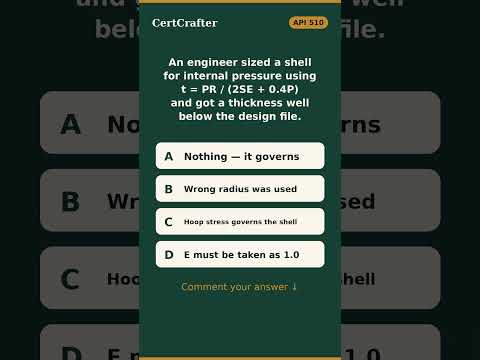
Video: API 510 The distractor on this one catch four candidates out of five. API 510 The distractor on this one catch four candidates out of five. Watch on YouTube · CertCrafter
Image: video thumbnail, source: CertCrafter on YouTube (@certcrafters).

What do these free API 510 questions test?

The three questions cover a weld repair, an insulation call and a radiograph, in three parts of the Body of Knowledge: welding evaluation, general practical knowledge and specific practical knowledge. None asks you to recite a number. Each puts you in front of a decision with a constraint attached, which is how API 510 reads on the day.

All come from the free sample behind the scored API 510 quiz. Take them cold and commit to an answer before you open the explanation.

How do inspectors handle a repair where heat treatment is impractical?

Postweld heat treatment is the textbook answer, and plants often cannot do it. The engineer specifies the method, the welding procedure covers it, and the inspector checks that what happens on the shell matches the paper. ASME PCC-2 Article 209, alternatives to postweld heat treatment, is on the effectivity sheet.

Candidates lose this one by treating the code as a list of prohibitions. It is closer to a list of conditions. When a stem says the usual method is impossible, look for what the code offers in its place and who is allowed to choose it.

Where does corrosion under insulation get found?

Mostly where somebody went looking. Corrosion under insulation hides behind the jacket, so a sound-looking vessel can be losing metal for years. Inspectors rank their effort by temperature and by cycling, because water that dries and rewets the steel does the damage. On a turnaround, the call is where one hour of scarce access buys the most information. RP 571 section 3.22 lists the mechanism for the exam, and RP 572 covers inspection practice for vessels. The second question asks you to place that hour.

How should you read a radiograph question?

By the character of the indication first, the size second. Cracks, incomplete fusion and incomplete penetration are planar. Slag and porosity are volumetric. The code treats the two families differently, and the exam leans on that difference.

On a job, the examiner reports and the inspector decides, with ASME Section V, Article 2 for the method and Section VIII Division 1 for acceptance. The third question baits you with a measurement. Ask what kind of flaw it is, and the number stops mattering.
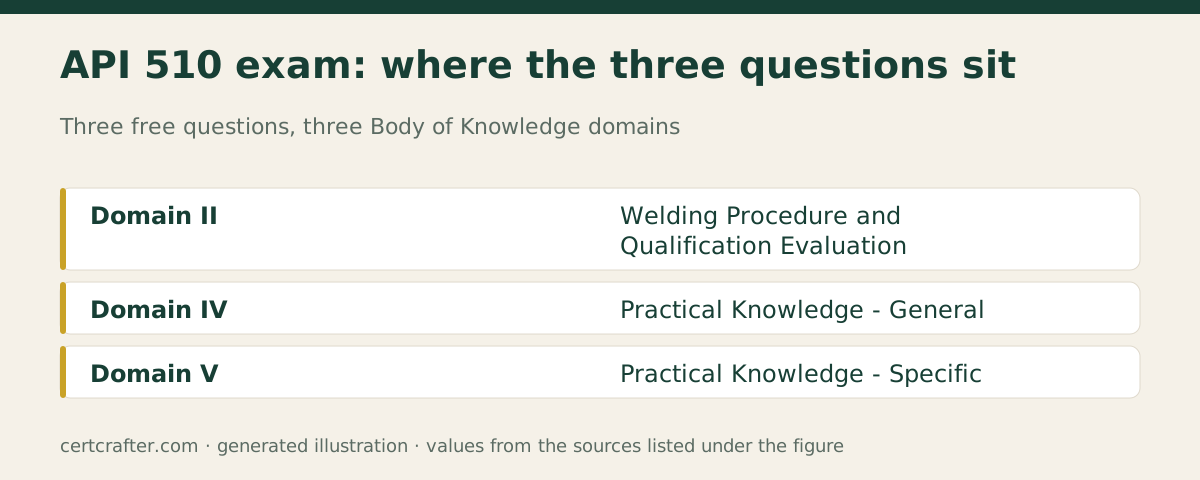
Three free questions mapped to three Body of Knowledge domains: Domain II welding procedure and qualification evaluation, Domain IV practical knowledge general, Domain V practical knowledge specific
Where the three questions sit in the Body of Knowledge. Illustration: CertCrafter, from API 510 Body of Knowledge, September 2026 to May 2027.

How is the API 510 exam structured?

The exam day is 7.5 hours at a Prometric test center: a short tutorial, 2.75 hours closed book, a 45-minute lunch break and 3.75 hours open book. There are 170 questions, 110 closed book and 60 open book, and 140 are scored. The 30 pretest items are not marked, so every question gets full effort.

No papers, notes or books are allowed. PDFs of the listed code sections appear on screen in the open-book portion only, so rehearse on screen.
Process reactors inside an industrial plant building
Photo: Blue Grass Chemical Agent-Destruction Pilot Plant Supercritical Water Oxidation Reactors (13427597204) by PEO ACWA (Wikimedia Commons), CC BY 2.0, via Wikimedia Commons.

What score do you need to pass API 510?

A scaled 400 on a 200-500 scale. API publishes no raw percentage, so treat any “you need 70 percent” advice as a guess.

Which calculations should be in your head before the clock starts?

The Body of Knowledge expects you to calculate metal loss, corrosion rate, remaining corrosion allowance and remaining service life, and to set the inspection interval from Section 6, in both US customary and SI units. API says those formulas may be closed book.

Static head catches people who skip the picture. With a specific gravity of 1.0, the static head on a part is 0.433 psi per foot times the height of liquid above it, and the total on that part is the MAWP at the top plus that head. The vessel part MAWP has to cover that total, which is why API asks you to know vessel MAWP from vessel part MAWP (ASME Section VIII, UG-98).
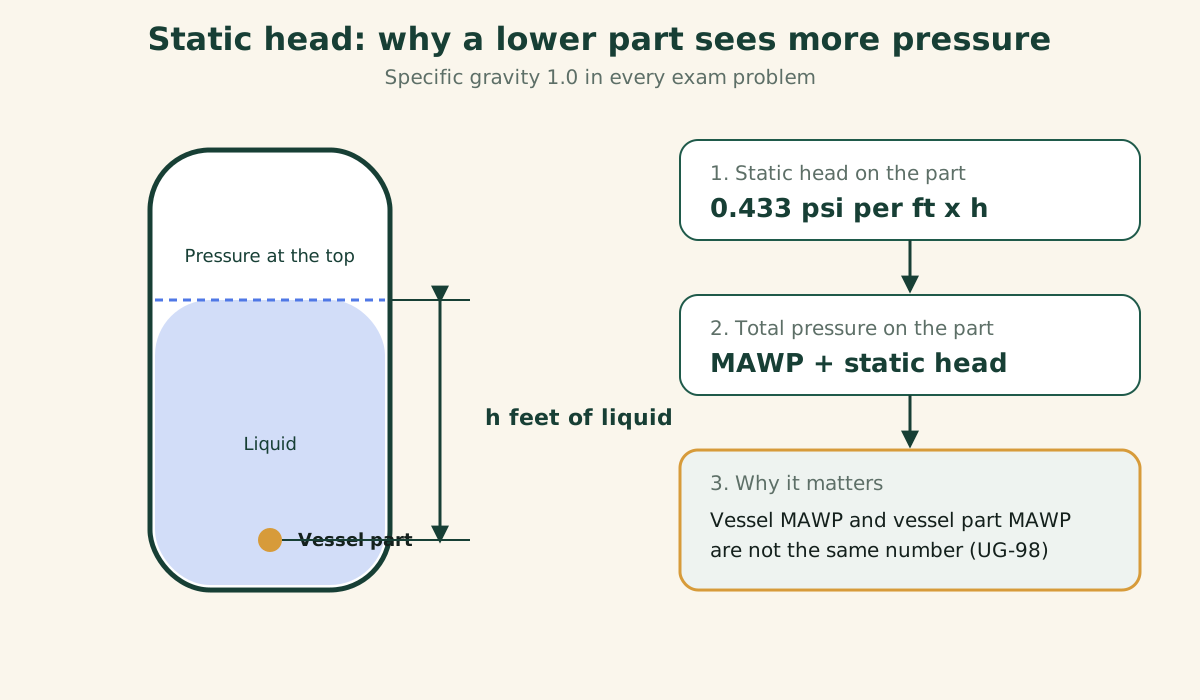
A vessel with liquid above a marked part, h feet of liquid, and three steps: static head is 0.433 psi per foot times h, total pressure is MAWP plus static head, and vessel MAWP and vessel part MAWP differ
Illustration: CertCrafter, from the API 510 Body of Knowledge. Illustration: CertCrafter, from API 510 Body of Knowledge, September 2026 to May 2027.

A stem that gives elevations is telling you to add head. The API 510 Complete Exam Kit drills these calculations, with every answer explained.

Which code editions apply from September 2026 to May 2027?

The sheet for these windows lists API 510, 11th Edition (October 2022) with Errata 1 and 2, API RP 571, 572, 577 and 578, the 2025 ASME code (Sections V, VIII Division 1 and IX) and ASME PCC-2, 2022. Practice material written to an older sheet can point you at requirements that no longer apply.

When are the API 510 exam dates and fees?

The September 2026 window has closed. The next three:

Exam window Application deadline
January 2 - 22, 2027 October 29, 2026
May 7 - 28, 2027 March 4, 2027
September 3 - 24, 2027 July 2, 2027

Initial certification on API’s 2027 schedule is $890 for API members and $1,140 for non-members, and a late application adds $200. Detail is on API’s certification page and schedules and fees page. The exam format, scoring and dates post has more.

How should you use three free questions?

Not as a readiness test. They can expose a habit. Read every explanation, including on the ones you got right. When you miss one, log it by Body of Knowledge section and by the kind of mistake.

The channel has a short on the distractor that catches most candidates. API 510: The 10 Most Common Mistakes and API 510 Formulas With Worked Examples go further. The API 510 guide has the full fact sheet, and the hub of API 510 guides lists the rest.

What these questions will not do

None is copied from a live exam. They are original, written from the published Body of Knowledge and the referenced codes, and no practice set replaces the codes themselves. The API 510 practice test bundle gives full-length runs in the real rhythm. The API 510 Complete Exam Kit works more of these under timed closed-book and open-book conditions, with every answer explained.

Try these free questions

  1. [Open book] A crack in the SA-516 Gr 70 shell of V-1204 has to be repaired by welding, but the vessel cannot be removed and local postweld heat treatment would damage the internal trays and lining. Working from API 510, what should the inspector do?

    1. Authorize the weld with no heat treatment, since API 510 exempts repair welds on vessels already in service from heat treatment
    2. Have the engineer apply an API 510 alternative to heat treatment, either controlled preheat or controlled deposition welding
    3. Require full vessel postweld heat treatment after the repair whatever the damage to the internals
    4. Reject welding and have the crack covered by a bolted and gasketed patch plate instead
    Show the answer and explanation

    Answer: B. API 510 recognises that postweld heat treatment is sometimes impractical on an installed vessel and lets the engineer substitute one of two approaches: welding with a controlled preheat maintained throughout the repair, or a controlled deposition technique, often called temper bead, in which later passes refine and temper the heat affected zone of earlier ones. Both carry conditions on material grouping, thickness, procedure qualification and notch toughness, which is why the engineer specifies the method and the inspector confirms it rather than the welder deciding at the vessel. Option 1 is simply untrue, because the code provides alternatives rather than an exemption. Option 3 ignores what the code offers and trades a repairable crack for damaged internals and lining. Option 4 puts a bolted patch over a through wall defect in the pressure boundary, which leaves the crack free to grow under pressure and is not an accepted permanent repair for a vessel returning to service.

  2. A five-year external inspection covers two vessels: V-210, bare carbon steel running at 400 F (204 C), and V-215, insulated carbon steel cycling between 150 F and 250 F (66 C and 121 C). Scaffold time allows insulation removal at one vessel only. Where should it go, and why?

    1. V-215, because its metal temperature sits in the band where corrosion under insulation is most active and the jacket hides it.
    2. V-210, because a bare hot surface loses metal faster than one that is protected by insulation and cladding.
    3. V-215, because insulation has to be stripped in full at every external inspection whatever the operating temperature.
    4. Neither, because infrared thermography from grade will show wet insulation and makes any removal unnecessary here.
    Show the answer and explanation

    Answer: A. Corrosion under insulation is driven by water reaching the steel at temperatures where it stays liquid and keeps the surface wet, and by cycling in and out of that band, which repeatedly dries and rewets the surface and concentrates whatever is dissolved in it. V-215 cycles between 150 F and 250 F under insulation, squarely in the susceptible territory, and the jacket hides any evidence, so that is where limited scaffold time buys the most information. Option 2 sends the effort to the bare vessel at 400 F, but a bare surface can be seen from grade and at that temperature it stays dry. Option 3 calls for total insulation removal at every external inspection, which no plant does and the code does not require, since removal is targeted at susceptible locations. Option 4 relies on thermography, which can show wet or missing insulation but cannot show the condition of the steel beneath it.

  3. [Open book] A radiograph of the repair weld in the 0.75 in shell of V-1204 shows a straight dark line along one fusion face over a length of 3/16 in. The examiner reports it as incomplete fusion. Is it acceptable?

    1. Yes, since it is shorter than one third of the shell thickness
    2. Yes, if the total length of indications of this kind stays under the limit allowed for 12 in of weld
    3. Yes, if a follow up ultrasonic examination shows it is not surface breaking
    4. No, incomplete fusion is not permitted at any length in a radiographed pressure vessel weld
    Show the answer and explanation

    Answer: D. Radiographic acceptance for pressure vessel welds rejects cracks, incomplete fusion and incomplete penetration outright, with no length allowance, because these are planar flaws with sharp tips that concentrate stress and can grow under pressure and thermal cycling. Length limits exist only for rounded and elongated inclusions such as slag, which are volumetric and far less damaging. So the 3/16 in dimension has no bearing on the disposition, the character of the indication settles it, and the weld has to be excavated and rewelded. Option 1 applies a thickness related length rule that belongs to slag rather than to fusion flaws. Option 2 makes the same category error and adds an accumulated length rule from the same slag criteria. Option 3 treats a buried location as mitigating, but the criteria for these flaws do not distinguish surface breaking from subsurface, and a second examination cannot make an unacceptable flaw acceptable. The excavated area is rewelded and radiographed again.

Take the full free 10-question sample with scoring →

Frequently asked questions

How many free API 510 practice questions are on this page?

Three, each with its options and a full explanation. They come from the free sample behind the scored API 510 quiz. The paid bundle holds 1,020 questions across six complete practice tests.

Do three questions tell me whether I am ready for API 510?

No. They show whether a habit is sound, such as how you treat a radiograph or a repair without heat treatment. Readiness shows up in full 170-question runs timed to 2 hours 45 minutes closed book and 3 hours 45 minutes open book.

What score do you need to pass the API 510 exam?

A scaled 400 on a 200-500 scale. API publishes no raw percentage, so a claim that you need 70 or 80 percent is not supported by the pages API publishes.

Official sources

  1. API 510 Pressure Vessel Inspector certification page — accessed 24 October 2026
  2. API ICP Schedules & Fees — accessed 24 October 2026
  3. API 510 Publications Effectivity Sheet, September 2026, January 2027 and May 2027 — accessed 24 October 2026
  4. API 510 Body of Knowledge, September 2026, January 2027 and May 2027 — accessed 24 October 2026

Exam rules change. Check the awarding body's official page before you apply. CertCrafter is independent and is not affiliated with or endorsed by any awarding body.

Was this helpful?

Comments

    Comments are read by a person before they appear. How we moderate.