
Most API 510 candidates read Domain V as one more topic list. It is a reading list with fences around it, and the fences decide where your study hours go.
What does Domain V of the API 510 exam cover?
Domain IV names topics. Domain V names documents. Under the heading Practical Knowledge - Specific, the body of knowledge lists API 510 itself, RP 571, RP 572, RP 576, RP 577, RP 578 and ASME PCC-2. Next to each one it says how much of that document can be tested.
That is the whole structure. No formulas, no paragraph numbers to memorize. A question in this domain is written from inside one of those documents, so the first job is knowing which documents, and which parts of them, are in play.
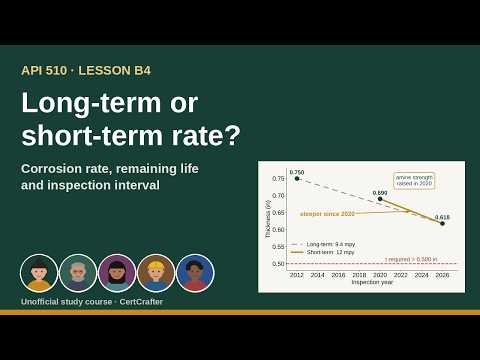 API510: Corrosion rate, remaining life and inspection interval Watch on YouTube · CertCrafter
Our channel has a short on corrosion rate, remaining life and inspection interval, which is the calculation side of what API 510 itself asks.
Which documents are in scope, and how much of each?
The scope rules are short and easy to get wrong from memory.
| Document | Scope rule in the body of knowledge |
|---|---|
| API 510 | All of it, except Section 9 and Appendix E |
| API RP 571 | Section 2 and a named list of mechanisms only |
| API RP 572 | Entire document, Annex A and B included, Annex C not |
| API RP 576 | Entire document, except the annexes |
| API RP 577 | Entire document |
| API RP 578 | Entire document |
| ASME PCC-2 | Each listed article and its appendices |
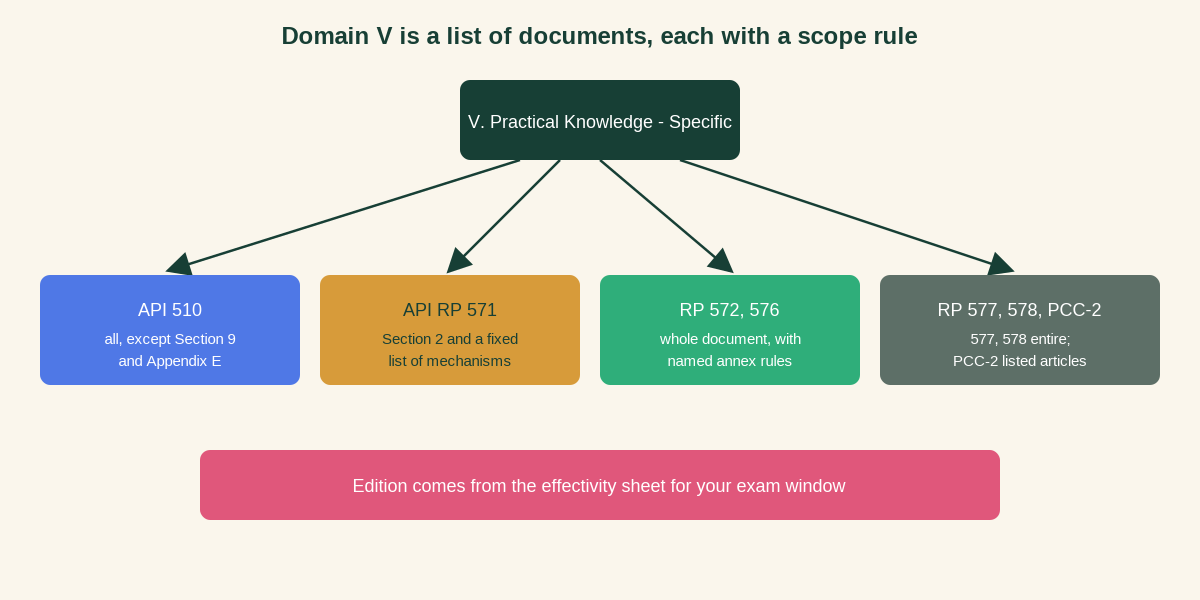
The edition is a separate question. The September 2026 effectivity sheet lists API 510 as the 11th Edition, October 2022, with Errata 1 (March 2023) and Errata 2 (2025). It lists RP 572 as the 5th Edition, November 2023, and PCC-2 as the 2022 edition. The same sheet covers the September 2026, January 2027 and May 2027 windows.
How much of RP 571 and PCC-2 can the exam use?
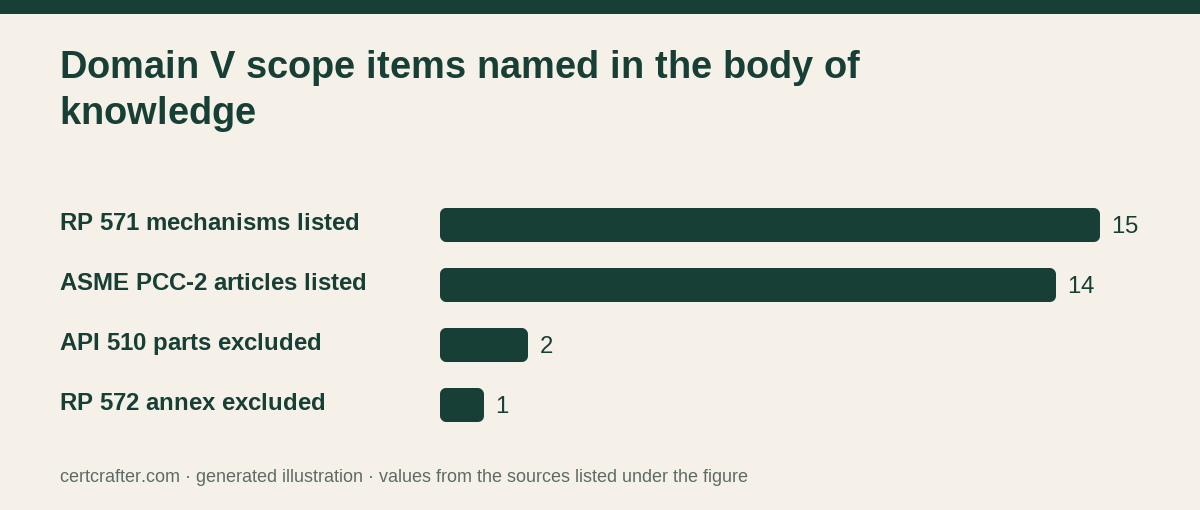
RP 571 is a large document, and only a slice of it counts. The body of knowledge lists 15 mechanisms by paragraph, plus Section 2 on terms and definitions. They include amine stress corrosion cracking, brittle fracture, corrosion under insulation, naphthenic acid corrosion, sulfidation and wet H2S damage.
PCC-2 is the other fence. The list names 14 articles, mostly about repair: butt-welded insert plates, external weld buildup, alternatives to postweld heat treatment, fillet welded patches, flaw excavation, hot taps, and pressure and tightness testing. The exam covers each article and its appendices.
One check worth doing yourself. The body of knowledge and the effectivity sheet each carry a mechanism list, and the text we read from the two PDFs did not match line for line. The body of knowledge shows Atmospheric Corrosion at 3.8, for example, and the sheet text we extracted did not. Open both files for your own window and compare them before you decide a mechanism is out.
How do inspectors use these documents on a real vessel?
On site, each document answers a different question. API 510 tells you what the owner-user must do and when. RP 572 describes how to inspect, vessel type by vessel type. RP 571 explains why a vessel in a given service is thinning or cracking. RP 576 covers the relief devices that protect it. RP 577 and RP 578 cover the welding and the material identity behind it. PCC-2 describes how a repair may be done.
A turnaround shows the chain. You find thinning under insulation. RP 571 names the mechanism. API 510 sets the evaluation and the interval. PCC-2 offers repair routes if the vessel needs one. Then material verification under RP 578 confirms what you are welding to.
Field mistakes happen when one document is asked to answer another’s question. People set an interval from RP 572 habits, or accept a repair from experience when the article says otherwise.
How are Domain V questions framed, and where do candidates lose marks?
The body of knowledge says only information covered in the listed references, in the listed editions, is used for questions, and that the closed-book part tests everyday working familiarity while the open-book part tests detail you find but would not normally memorize. Domain V sits in both.
Candidates lose marks three ways. They study a mechanism or annex outside the fence and burn hours. They answer from plant practice or an older edition, when the body of knowledge says the exam follows the effectivity sheet. Or they know the document names and never practice finding things in them, so the open-book part runs out of time.
Worked example: is this question fair game?
Take a study note on mechanical fatigue in RP 571, and decide whether to spend an evening on it.
- Find the document. The note comes from RP 571, so the scope rule is the named list.
- Check the list. Mechanical fatigue is not among the 15 mechanisms shown in the body of knowledge.
- Check the sheet for your window, in case the two lists differ.
- Decide. If it is on neither list, drop it and spend the evening on a listed mechanism such as corrosion under insulation.
The same four steps work for an annex in RP 572 or a PCC-2 article.
The API 510 Complete Exam Kit works more of these under timed conditions, with every answer explained.
How should you study Domain V?
Build a one-page scope map from the table above and mark each document as read, skimmed or not started. Then go inside the fences, starting with the documents you have never used on the job: RP 576 and PCC-2 are common gaps for inspectors who work mainly on thickness data.
Practice finding, not reading. The open-book part gives you references on screen, so time yourself locating a requirement.
What to do next
Write down the seven scope rules without looking, then check them against the body of knowledge. Fix the ones you got wrong first.
The general practical knowledge guide covers Domain IV, and the study plan orders all five domains. The free sample shows where you stand, and the API 510 hub lists every guide. The product guide has the exam format.
Comments
Comments are read by a person before they appear. How we moderate.