Most candidates with six weeks left read for five of them and practise for one. The exam wants the reverse, because half of it is finding and applying a requirement against the clock.
How should you split six weeks for API 510?
Build it backward from the window. The API 510 window runs January 2 to 22, 2027, and today is November 24, so you have about six weeks. The application deadline, October 29, 2026, has passed, so this plan assumes your authorization is already in hand. If it is not, the next window is May 7 to 28, 2027 with a March 4, 2027 deadline.
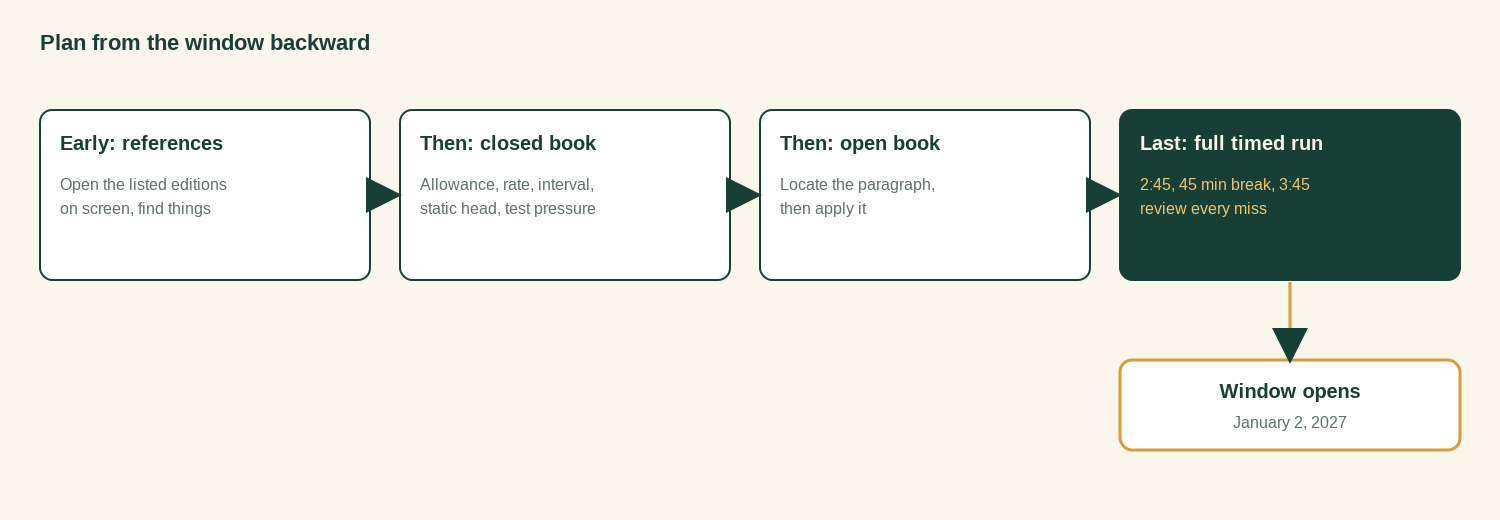
The shape is simple. Early weeks go to the listed references and closed-book calculations. The middle goes to open-book application. The last stretch is full runs at the real rhythm. In the first week, get the references open on screen. By the third, closed-book calculations should feel routine. In the fifth, you sit complete timed runs and review each one the next day.
That is the whole skeleton, and it is deliberately not a daily timetable. A candidate with ten years on vessels shortens the early part. A candidate new to the code lengthens it and should be honest about whether six weeks is the right window.
What does the exam day look like, and why does the plan copy it?
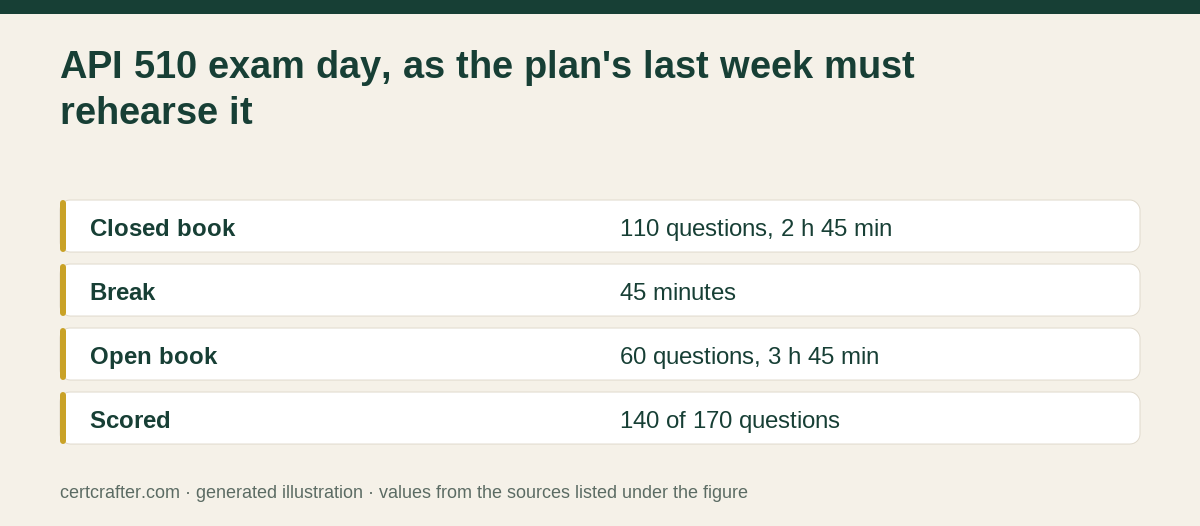
The exam day is 7.5 hours: a short tutorial, 2.75 hours closed book, a 45-minute break, then 3.75 hours open book. There are 170 questions, of which 140 are scored. The other 30 are pretest items, and you cannot tell which. The closed-book part has 110 questions and the open-book part has 60.
The pass standard is a scaled 400 on a 200 to 500 scale, not a percentage. So a plan built on a target percentage has no anchor. Aim for finishing with time to review, and for misses that shrink.
 API510: Corrosion rate, remaining life and inspection interval Watch on YouTube · CertCrafter
Our channel has a short on corrosion rate, remaining life and inspection interval, the calculation chain the closed-book half leans on.
What should you practise first for the closed-book half?
The body of knowledge says the formulas for corrosion rate, remaining life and inspection interval may be needed closed book. Start there. Other closed-book items it names: the static head conversion of 0.433 psi per foot, and the 0.7 factor that converts a fillet weld throat to a leg. Know both unit systems, US customary and SI, because the body of knowledge expects both.
Only internal pressure loadings are considered in the calculations. That removes a lot of reading you might otherwise do.
How do inspectors use this on a real vessel?
On a plant, nobody asks for the formula. They ask whether the vessel can run to the next outage. You pull the last two thickness readings, work out how fast the wall is going, and decide whether the interval stands.
Practise the same loop. Take any vessel you know, write down its last readings, and run it through allowance, rate and remaining life. The field mistake is mixing readings from different locations, so the “rate” is really a comparison of two different spots. On an exam question the same trap appears as a table with two sets of points.
Each pressure retaining component has its own required thickness, so each has its own remaining life. The vessel is governed by whichever runs out first.
Worked example: the allowance, rate and life chain
Say a shell was last measured at 20 mm and now reads 16 mm, four years apart. Its required thickness is 10 mm. These numbers are made up to show the steps.
- Metal loss: 20 minus 16 is 4 mm.
- Corrosion rate: 4 mm over 4 years is 1 mm per year.
- Remaining corrosion allowance: actual minus required, 16 minus 10, is 6 mm.
- Remaining life: 6 mm divided by 1 mm per year is 6 years.
Then the interval follows the rules in the code, not the arithmetic alone, so check the paragraph in the edition on your effectivity sheet. The API 510 Complete Exam Kit works more of these under timed conditions, with every answer explained.
How do you practise the open-book half?
Papers, notes and books are not allowed at the Prometric center. During the open-book part, PDFs of the listed codes are on your computer, and only the sections named on the effectivity sheet are available. For this window that means API 510 11th Edition with its errata, the listed RP 571 mechanisms, RP 572, 576, 577 and 578, the 2025 ASME Sections V, VIII Division 1 and IX, and the named PCC-2 articles.
So practise on screen. Before you search, name the document that owns the answer. Then use the PDF’s own search. The body of knowledge calls this detailed information you are expected to find but would not normally commit to memory. It is a search skill, and it fades quickly if you stop using it.
How do you rehearse the last stretch?
Copy the day. Closed book for 2 hours 45 minutes, a real 45-minute break, then the open-book session for 3 hours 45 minutes. Do it more than once before the window if you can, and review every miss, including the right answers you guessed.
Tag each miss: calculation, code requirement, field decision, diagnosis, acceptance, authorization and records, or selection under constraint. Calculation misses mean more closed-book arithmetic. Code requirement misses mean back to the references on screen.
Where do candidates lose marks in a short plan?
They study the wrong edition, treat 110 closed-book questions as the easy half, and never time themselves until the final days. They also plan around a pass percentage that does not exist.
Another slip is forgetting that your jurisdiction may use other documents. The exam is based on the editions in the effectivity sheet, whatever your site or state codifies.
What to do next
Write the January 2 date at the top of a page and draw your weeks backward from it. Take the free sample quiz to see which topics start your plan.
The certification guide lists the domains, and the six practice tests cover the timed runs. For the longer view, see the four-phase study plan and the exam format and dates. More API 510 posts are on the hub.
Comments
Comments are read by a person before they appear. How we moderate.