API 510 Welding Qualification: What the Exam Tests

By Sandeep Bandyopadhyay, Senior aerospace engineer · PMP, MBA, Six Sigma

TL;DR

Domain II of API 510, Welding Procedure and Qualification Evaluation, tests whether you can review a WPS, a PQR and a welder performance qualification against ASME Section IX and API 510, then decide if a welder may make a production weld. The scope is deliberately narrow: four processes, five P-Numbers, one process per document. Brazing is not covered.

Original questions, not exam dumps. Every CertCrafter question is written from the published body of knowledge and the referenced codes. None is copied from a live exam, and CertCrafter is independent: not affiliated with or endorsed by any awarding body.

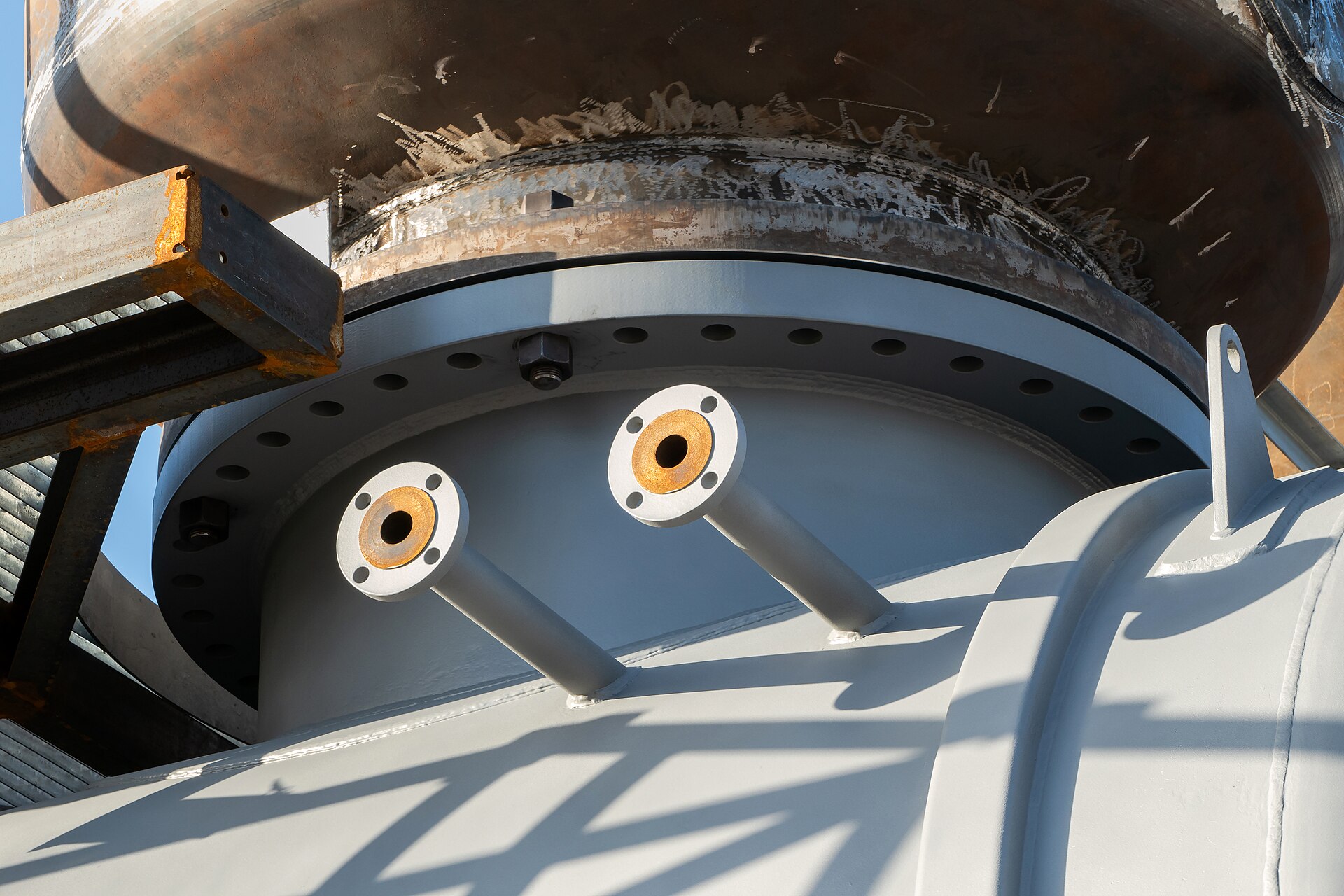
Pipe couplings welded into the shell of a pressure tank under construction
Photo: Pipe couplings on a pressure tank under construction by W.carter (Wikimedia Commons), CC0 1.0, via Wikimedia Commons.

Most API 510 candidates treat Domain II as a memory test on Section IX. It is a review job: someone hands you three documents and you decide whether the weld may go ahead.

What does Domain II of the API 510 exam cover?

Domain II is titled Welding Procedure and Qualification Evaluation, and it is based on ASME Section IX. The body of knowledge asks for familiarity with the basic requirements for qualifying procedures and welding personnel. It does not ask you to write a procedure from scratch.

You review three documents: the Welding Procedure Specification (WPS), the Procedure Qualification Record (PQR) and the Welder Performance Qualification (WPQ). Then you answer four questions about them. Do the records comply with ASME and any extra API 510 requirement? Have the essential and nonessential variables been addressed? Are the mechanical tests on the PQR the right number and type, and are the results acceptable? Is the welder qualified to make this production weld under this WPS?

Two further blocks sit beside the review. One is the general welding rules in Section VIII Division 1, Parts UW and UCS. The other is everything in API RP 577.
Video: API 510 The distractor on this one catch four candidates out of five. API 510 The distractor on this one catch four candidates out of five. Watch on YouTube · CertCrafter
Image: video thumbnail, source: CertCrafter on YouTube (@certcrafters).

Our channel has a short on the distractor that catches most candidates, which is the same habit of mind you need here: read what the document says, not what you expect it to say.

The PQR is the proof. A coupon was welded, tested, and the results recorded. The WPS is the instruction a welder follows, and it has to be supported by that PQR. The WPQ shows that a particular welder can deposit sound weld metal using a qualified WPS.
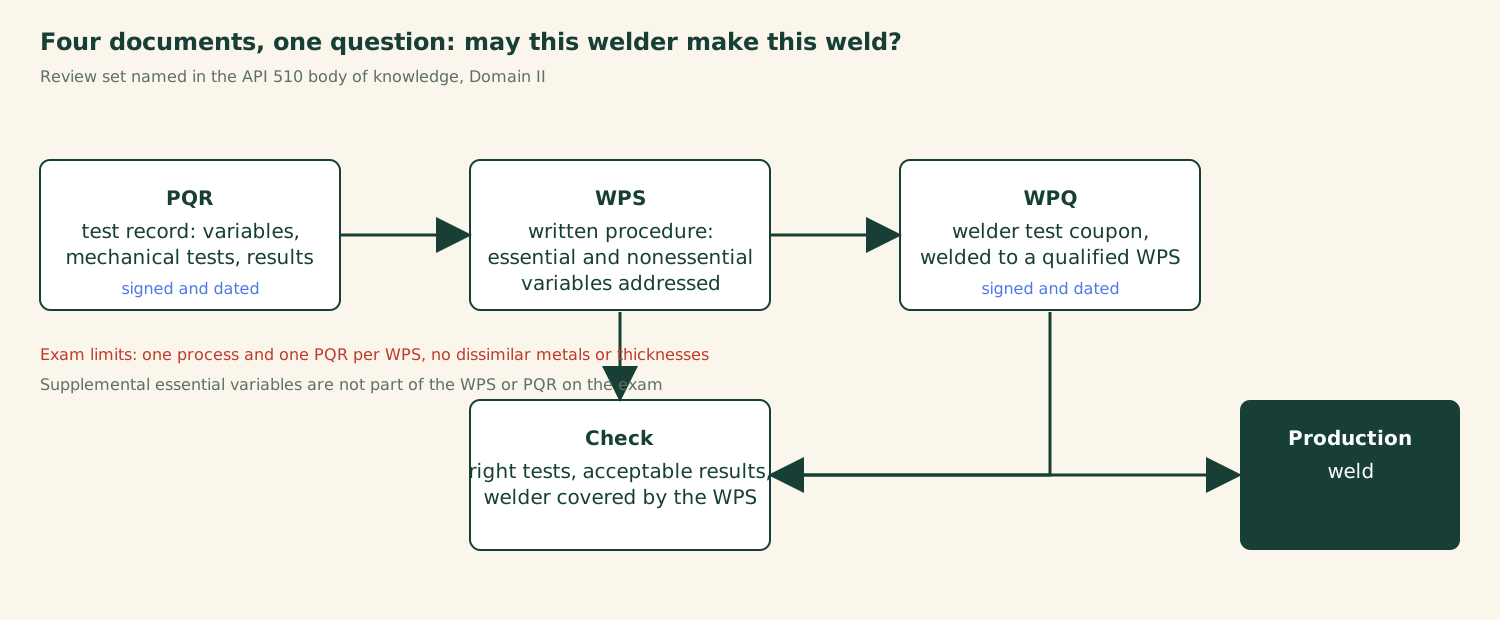
Boxes for PQR, WPS and WPQ feeding a check box that decides whether the welder may make the production weld, with the exam limits noted underneath
The review set and the question it answers. Illustration: CertCrafter, from API 510 Body of Knowledge, September 2026 to May 2027.

API adds two small rules that become easy marks. The WPQ test coupon must be welded in accordance with a qualified WPS. And the PQR and WPQ must be certified by signing and dating. Editorial items such as the WPS number, the revision level, the company name, the date and the name of the testing lab are excluded, so a question will not turn on them.

Worked example: reviewing a record set in four steps

You are handed a WPS, its PQR and a welder’s WPQ for a repair on a carbon steel shell. Work through them in this order.

  1. Confirm the process. Is it one of SMAW, GTAW, GMAW or SAW, and is it only one?
  2. Check the base metal and filler. Is the metal in P-No. 1, 3, 4, 5 or 8, with one filler per process and no dissimilar metals or thicknesses?
  3. Read the variables. For each essential variable on the WPS, does the PQR support it? Are the nonessential ones addressed?
  4. Read the welder. Was the coupon welded to a qualified WPS, is the WPQ signed and dated, and does it cover the production weld?

A “no” at any step stops the review. The record is not compliant, and that is the answer the question is usually built around.

The API 510 Complete Exam Kit works more of these under timed conditions, with every answer explained.

What do inspectors check in practice?

On a real job the paperwork usually looks complete. The problem is the gap between the document and the weld about to be made.

A WPS that was qualified for one position, one thickness range or one filler gets used for a repair that sits outside it. A welder’s qualification has lapsed or covers a different process. A PQR is attached to the WPS but its mechanical tests do not match what the procedure now claims. Experienced inspectors read the WPS against the repair package, then the PQR against the WPS, then the WPQ against both, and they hold the weld until the chain closes.
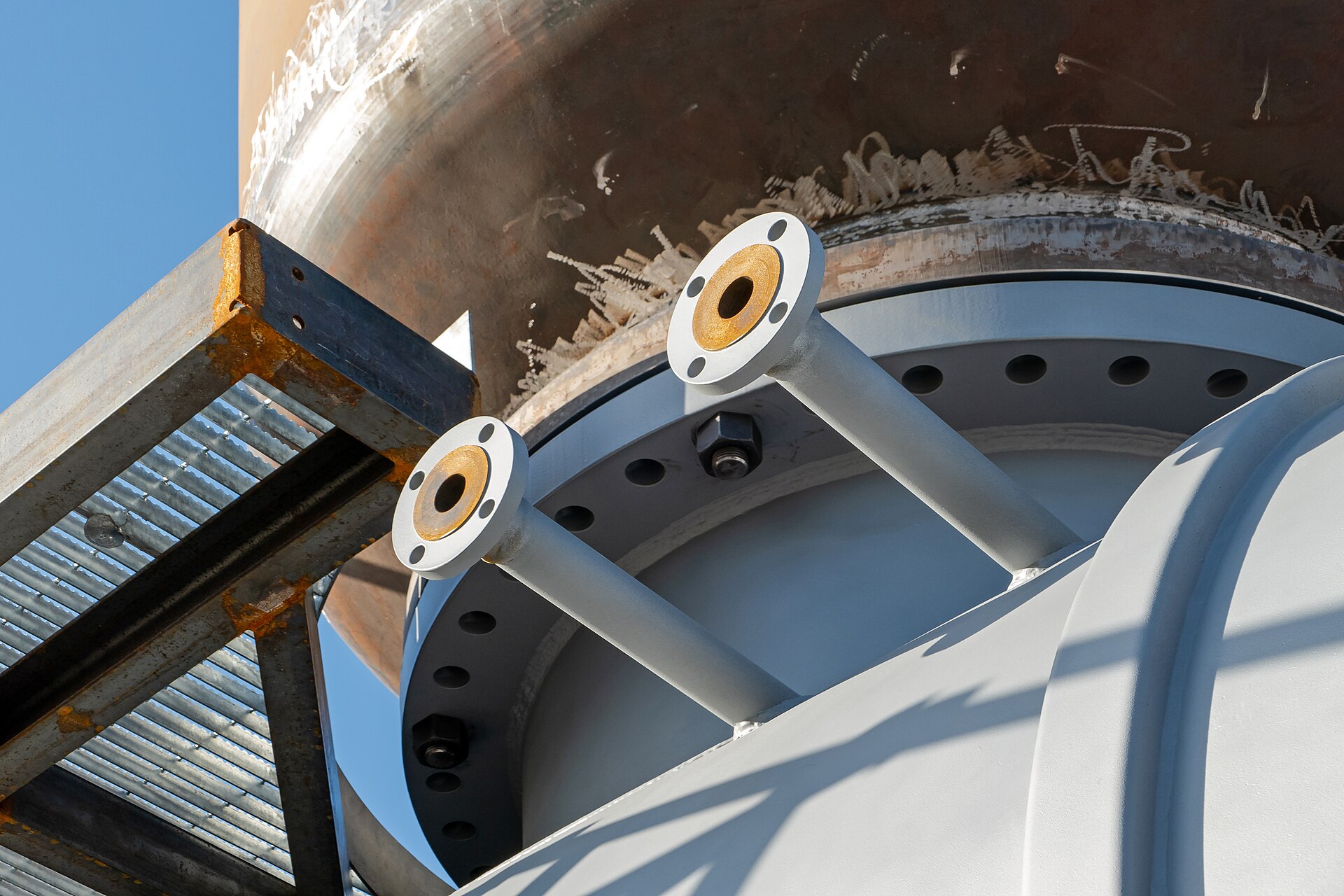
Welded pipe couplings on the outside of a pressure tank under construction
Photo: Pipe couplings on a pressure tank under construction 2 by W.carter (Wikimedia Commons), CC0 1.0, via Wikimedia Commons.

Repair welding on an installed vessel brings a second question: heat treatment. Postweld heat treatment is sometimes impractical on a vessel that cannot be moved, and API 510 gives the engineer alternatives. The decision belongs to the engineer, and the inspector confirms it is what the repair record shows. One of the free questions below tests exactly that boundary.

Which limits does API 510 put on the weld review?

The exam narrows the field on purpose, and the narrowing is the study aid.
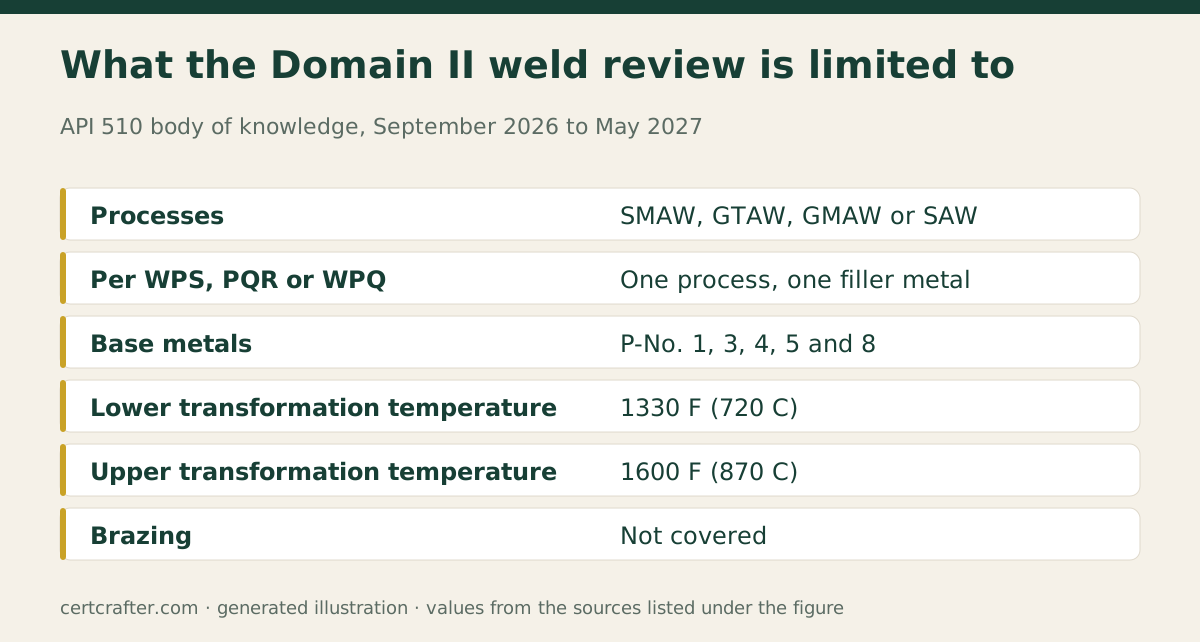
Six scope limits for the weld review: four processes, one process and filler per document, five P-Numbers, transformation temperatures of 1330 F and 1600 F, and no brazing
The scope limits for the weld review. Illustration: CertCrafter, from API 510 Body of Knowledge, September 2026 to May 2027.

For P-No. 1, 3, 4 and 5, the body of knowledge fixes the lower transformation temperature at 1330 °F (720 °C) and the upper at 1600 °F (870 °C), so you do not need to look them up. It also says supplemental essential variables are not part of the WPS or PQR you review.

One rule cuts across the whole domain. Where API 510 has a welding rule, it takes precedence over the Section VIII Division 1 rule covering the same area. When two sources seem to disagree, API 510 wins.

Where do candidates lose marks on welding qualification?

Three habits cost the most.

The first is treating a filler change as automatically fatal. ASME Section IX groups electrodes by F number and A number, not by commercial classification. A change inside the same groups is not an essential change. One of the free questions below puts an E7018 against an E7016 to see whether you know that.

The second is confusing the procedure with the person. A procedure can stay valid while a welder needs a new performance qualification, and the reverse is not true.

The third is reading the PQR for what it contains and not for what it proves. Counting the tests and judging the results is a separate step from matching the variables.

Questions on this domain are framed as short cases: a named vessel, a repair, a shop asking to change something, and four options that each match a plausible slip. Several are open book, so the skill is knowing where to look and what the paragraph really says.

What to do next

Take any WPS, PQR and WPQ you can legally see, from your own site or a textbook, and run the four steps above on them. Write down which step stopped you, if one did.

For the shape of the exam day, the exam format, scoring and dates post covers the closed-book and open-book split, and common mistakes goes across all five domains. The certification guide holds the full body of knowledge summary, the free sample quiz shows where you stand today, and the six practice tests cover this domain in full. More API 510 posts go domain by domain.

Try these free questions

  1. [Open book] A shop holds a qualified SMAW procedure for an SA-516 Gr 70 repair but wants to change from an E7018 electrode to an E7016. Under ASME Section IX, what follows?

    1. Requalification is needed, because any change of electrode classification is essential for this process.
    2. The procedure is unaffected, because filler metal identity is nonessential for shielded metal arc welding.
    3. No requalification, provided the new electrode sits in the same F number and A number groups.
    4. A new welder performance qualification is needed, although the written procedure itself remains qualified.
    Show the answer and explanation

    Answer: C. ASME Section IX does not group filler metals by their commercial classification. Electrodes are grouped by F number, which reflects usability and running characteristics, and by A number, which reflects the chemistry of the deposited weld metal. A change within the same F number and A number is not an essential variable, so a procedure qualified with one low hydrogen carbon steel electrode covers another in the same groupings and no requalification is needed. Option 1 treats every classification change as essential, which would make procedure qualification unworkable and is not what the code says. Option 2 goes too far the other way, because filler metal is not a free variable, since moving to a different F number or A number is an essential change that does require requalification. Option 4 confuses procedure qualification with performance qualification, and substituting one low hydrogen electrode for another in the same group does not invalidate the welder either.

  2. [Open book] A crack in the SA-516 Gr 70 shell of V-1204 has to be repaired by welding, but the vessel cannot be removed and local postweld heat treatment would damage the internal trays and lining. Working from API 510, what should the inspector do?

    1. Authorize the weld with no heat treatment, since API 510 exempts repair welds on vessels already in service from heat treatment
    2. Have the engineer apply an API 510 alternative to heat treatment, either controlled preheat or controlled deposition welding
    3. Require full vessel postweld heat treatment after the repair whatever the damage to the internals
    4. Reject welding and have the crack covered by a bolted and gasketed patch plate instead
    Show the answer and explanation

    Answer: B. API 510 recognises that postweld heat treatment is sometimes impractical on an installed vessel and lets the engineer substitute one of two approaches: welding with a controlled preheat maintained throughout the repair, or a controlled deposition technique, often called temper bead, in which later passes refine and temper the heat affected zone of earlier ones. Both carry conditions on material grouping, thickness, procedure qualification and notch toughness, which is why the engineer specifies the method and the inspector confirms it rather than the welder deciding at the vessel. Option 1 is simply untrue, because the code provides alternatives rather than an exemption. Option 3 ignores what the code offers and trades a repairable crack for damaged internals and lining. Option 4 puts a bolted patch over a through wall defect in the pressure boundary, which leaves the crack free to grow under pressure and is not an accepted permanent repair for a vessel returning to service.

Take the full free 10-question sample with scoring →

Frequently asked questions

Which welding processes can the API 510 weld procedure review include?

Only SMAW, GTAW, GMAW or SAW. A single WPS, PQR or WPQ carries no more than one process, filler metals are limited to one per process, and the WPS is supported by a single PQR. Brazing is not covered on the exam.

Which base metals appear in the API 510 welding questions?

The body of knowledge limits base metals to P-No. 1, 3, 4, 5 and 8. Dissimilar base metal joints and dissimilar thicknesses are excluded, and so are special processes such as corrosion-resistant overlay, hard-facing and buttering of a ferritic member.

What does the inspector check on a PQR and a WPQ?

That essential and nonessential variables are addressed, that the number and type of mechanical tests on the PQR are the proper ones with acceptable results, and that the welder is qualified for the production weld under the WPS. The PQR and WPQ must be certified by signing and dating.

Official sources

  1. API 510 Body of Knowledge, September 2026 to May 2027 — accessed 9 November 2026
  2. API 510 Pressure Vessel Inspector, exam information — accessed 9 November 2026
  3. API 510 Publications Effectivity Sheet, September 2026 to May 2027 — accessed 9 November 2026

Exam rules change. Check the awarding body's official page before you apply. CertCrafter is independent and is not affiliated with or endorsed by any awarding body.

Was this helpful?

Comments

    Comments are read by a person before they appear. How we moderate.