Most people who ask whether they qualify for API 510 count their years of plant experience and stop there. API counts a different thing: years of a specific kind of work, within a recent window, that a third party can verify.
What are the API 510 eligibility requirements?
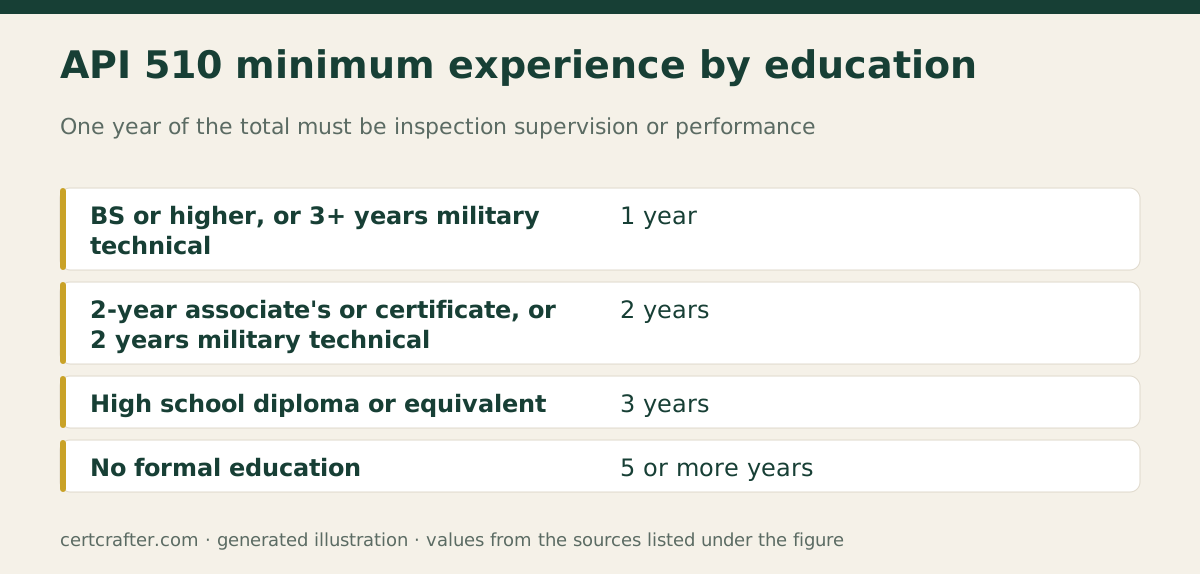
API sets the minimum from Appendix B of the API 510 standard. The requirement is a pairing of education and experience related to pressure vessels, and the lower the education, the longer the experience.
| Education | Minimum experience |
|---|---|
| BS or higher in engineering or technology, or 3+ years of military technical service | 1 year |
| 2-year associate’s degree or certificate in engineering or technology, or 2 years of military technical service | 2 years |
| High school diploma or equivalent | 3 years |
| No formal education | 5 or more years |
Read the last column carefully. Every row has the same kind of experience: design, fabrication, repair, operation or inspection of pressure vessels. And in every row, one year of the total must be supervision or performance of inspection activities as described in API 510. A BS holder with one year therefore needs that single year to be inspection work, not design office time.
The page says a dishonorable discharge disqualifies military credit. That is the only exclusion API spells out in the table.
 API 510 — Three millimetres of allowance, a quarter mill a year. Now the interval. Watch on YouTube · CertCrafter
How does the experience requirement work on a real site?
On a plant, inspection experience rarely arrives with a label. A vessel inspector at a refinery might spend a week on thickness grids, two days chasing a repair package and a day in a turnaround planning meeting. API’s wording, supervision or performance of the inspection activities in API 510, is broad enough to cover the person who runs the program as well as the person with the ultrasonic probe. It is not broad enough to cover someone who only reads the reports.
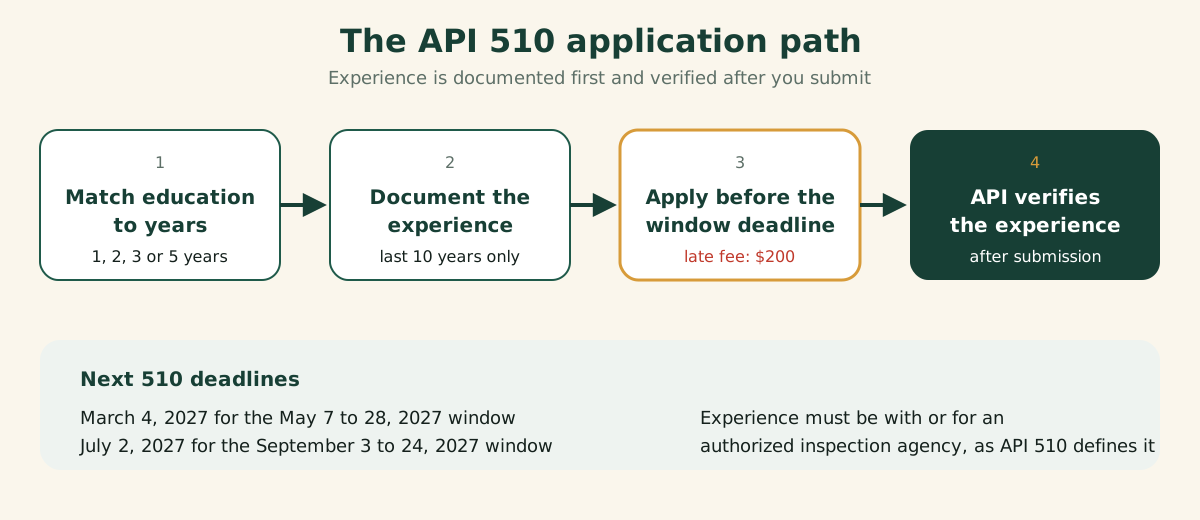
Two details decide most borderline cases. First, the experience must have been acquired within the last 10 years. A strong career that peaked 12 years ago does not carry the application on its own. Second, API says it must have been gained while employed by, or under contract with, an authorized inspection agency as defined in API 510. If you work as a contractor, that makes the paper trail simple: the agency you worked under is the one that confirms your years.
Our channel has a short that shows how the thickness and interval chain works, which is the kind of work an inspector’s supervisor will recognize on the application.
Worked example: does this candidate qualify?
The candidate below is invented, and only the method matters.
A candidate holds a 2-year associate’s degree in engineering technology. She spent three years at a fabrication shop on repair and alteration of vessels, and in the second of those years she supervised a crew doing inspection on repairs.
- Find the education row: associate’s degree, so the minimum is 2 years.
- Type of work: fabrication and repair of pressure vessels counts.
- The one-year rule: the year of supervised inspection satisfies it.
- The date test: all three years fall within the last 10 years.
She qualifies on paper. Her next problem is evidence, because the application must show these years and API verifies them afterward. A supervisor who is slow to answer a verification request is a risk on any API application, and API’s recertification page says so plainly.
The API 510 Complete Exam Kit picks up after the application, with timed closed-book and open-book practice and every answer explained.
How do you apply, and when?
API publishes the schedule by window, and the application deadline sits about two months before each one. The page for 2026 and 2027 lists these for API 510:
| Exam window | Application deadline |
|---|---|
| January 2 to 22, 2027 | October 29, 2026 |
| May 7 to 28, 2027 | March 4, 2027 |
| September 3 to 24, 2027 | July 2, 2027 |
Today is past the October 29 deadline, so the January 2027 sitting has closed for new applications. The next 510 deadline is March 4, 2027 for the May window. A late application fee of $200 appears in the fee tables for all programs, so treat the date as a hard stop and do not plan around it.
Fees are published for members and non-members. For initial 510 certification the 2026 table shows $875 for members and $1,125 for non-members, and the 2027 table shows $890 and $1,140. Rescheduling is $350 either way. The exam is in person at designated test centers, run through Prometric, and API 510 is not one of the programs offered remotely in the pages we read.
What do candidates get wrong about eligibility?
Three slips show up again and again. They are all easy to avoid with a bit of paper.
The first is mixing up total experience and qualifying experience. Ten years in a plant can still fall short if little of it was inspection work. The second is the clock: years outside the 10-year window do not count. The third is a thin application. API says the minimum experience must be documented, and that it is verified. Dates, employers, a supervisor who will answer, and a plain description of the inspection activities beat a long list of job titles.
On the exam itself, none of this is tested. Eligibility is decided before you sit. What the exam asks is on the body of knowledge, written for September 2026, January 2027 and May 2027, and covered in our exam format, scoring and dates post.
Certification then lasts three years. Recertification asks for at least 20% of your time on pressure vessel inspection activities over the period, 24 hours of continuing professional development, and an open-book web quiz every six years. Keep records from the first day, because you will need them.
What to do next
Write down your education row, your qualifying years and the supervisor who can confirm them. If the gap is a few months, finish the experience first and choose the later window.
If you are weighing the three inspector programs, API 510 vs 570 vs 653 compares them. The certification guide covers the body of knowledge, the free sample quiz shows where you stand, and the six practice tests give you the timed practice. More API 510 posts go domain by domain.
Comments
Comments are read by a person before they appear. How we moderate.