Most API 510 candidates read the body of knowledge once, as a list of topics. It is better used as a map: each line tells you which document the answer lives in.
What does the API 510 body of knowledge actually contain?
Five sections, a list of reference publications, and a list of things you are not expected to know. That last list is worth as much as the first.
API says the exam uses only information covered in the listed references, in the editions on the effectivity sheet. Questions may come from anywhere in a document unless it is specifically excluded. Some sections are named in the body of knowledge as an aid, and API states that this is not meant to exclude other paragraphs.
The exam itself is in two parts. The closed-book part tests everyday working familiarity with API 510 and the reference documents. The open-book part tests detailed information an inspector would be expected to find but would not normally commit to memory.
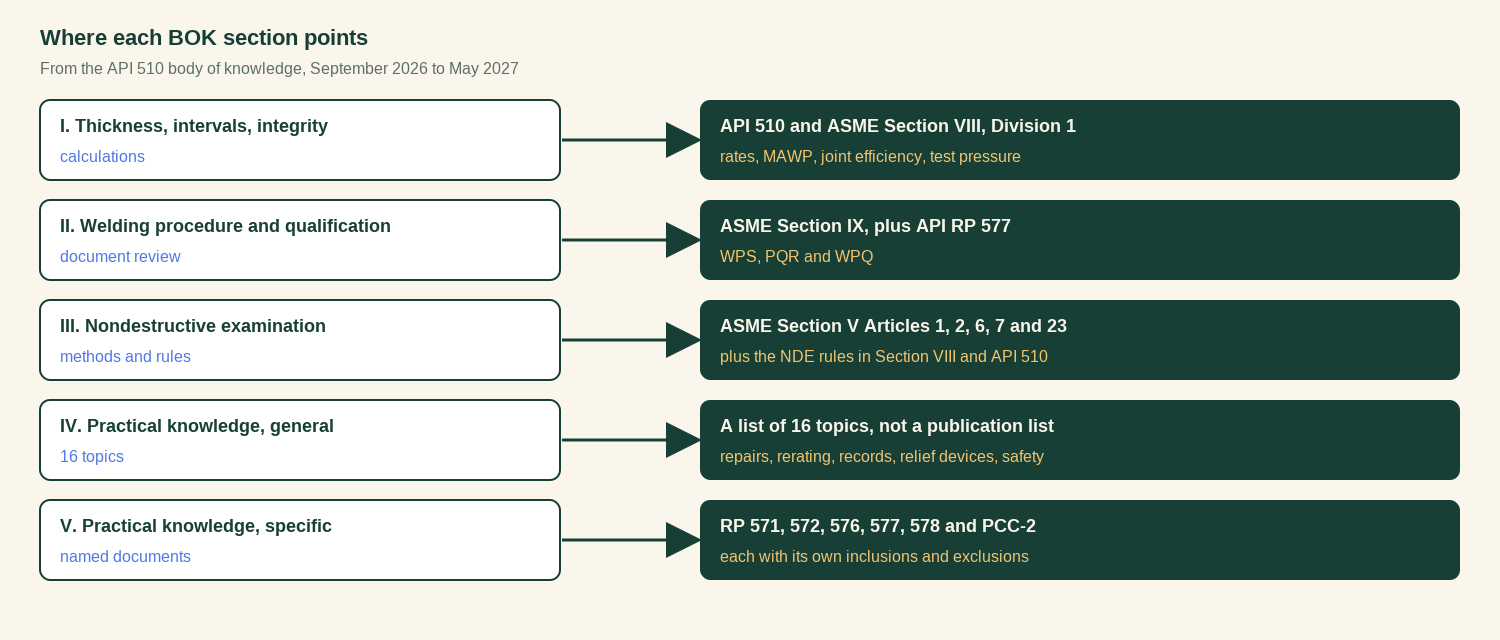
Which publications does each section point to?
| Section | Main source |
|---|---|
| I. Thickness, intervals, vessel integrity | API 510 and ASME Section VIII, Division 1 |
| II. Welding procedure and qualification | ASME Section IX, plus API RP 577 |
| III. Nondestructive examination | ASME Section V (Articles 1, 2, 6, 7, 23) |
| IV. Practical knowledge, general | A list of 16 topics |
| V. Practical knowledge, specific | API 510, RP 571, 572, 576, 577, 578 and PCC-2 |
The effectivity sheet fixes the editions. For the September 2026, January 2027 and May 2027 windows it lists API 510, 11th Edition, October 2022, with Errata 1 (March 2023) and Errata 2 (2025). RP 572 is the 5th Edition (November 2023) and RP 578 the 4th Edition (February 2023). The ASME code is the 2025 edition, and PCC-2 is the 2022 edition.
Check the sheet against what is on your screen in the exam. A jurisdiction may work from another edition. The body of knowledge notes this and says the exam is based on the sheet.
What do Sections I to III ask you to do?
Section I is the calculation section. It is oriented to vessels already in service, with only internal pressure loadings, and you work in both US customary and SI units. It covers corrosion rates, remaining life and intervals, joint efficiency, static head, internal pressure, pressure testing, impact testing, weld size at openings and nozzle reinforcement. API says the formulas for the first group may be closed book.
The welding section is document review. You read a WPS, a PQR and a welder qualification and decide whether they comply. API limits it to SMAW, GTAW, GMAW or SAW, one process per document, and a short list of base metal groups. Brazing is not covered.
Third comes NDE. It points to Section V of the ASME code for radiography, liquid penetrant, magnetic particle (yoke and prod only) and ultrasonic thickness measurement, plus the general NDE rules in Section VIII and API 510.
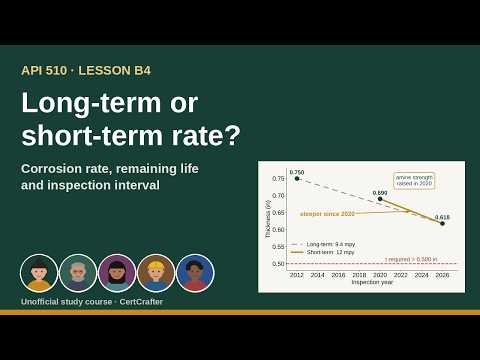 API510: Corrosion rate, remaining life and inspection interval Watch on YouTube · CertCrafter
For a short look at the Section I chain, the channel has a video on corrosion rate, remaining life and inspection interval.
Worked example: static head, the small calculation inside Section I
The body of knowledge fixes the conversion at 0.433 psi per foot of liquid, with a specific gravity of 1.0. Suppose a vessel part sits 30 feet below the liquid surface. The numbers here are invented for practice.
- Static head pressure:
0.433 x 30 = 12.99 psi. - Total pressure on that part: vessel MAWP plus
12.99 psi. - Compare that total with the MAWP of the part itself, which is a different number from the vessel MAWP.
The API 510 Complete Exam Kit works more of these under timed conditions, with every answer explained.
What do Sections IV and V ask you to know?
Section IV lists 16 topics, from organization and certification requirements and types of maintenance inspection, through corrosion and deterioration, materials, welding, NDE, remaining life, relief devices, safety, records, repairs and alterations, rerating, and pressure testing after repairs. It is a topic list, not a publication list.
Section V is where the documents are named. All of API 510 applies unless excluded; Section 9 and Appendix E are. RP 572, RP 576 (apart from annexes), RP 577 and RP 578 are examinable in full, with exceptions: for RP 572 the body of knowledge includes Annexes A and B and excludes Annex C. RP 571 is limited to listed mechanisms, such as amine stress corrosion cracking, brittle fracture, corrosion under insulation and wet H2S damage. PCC-2 is limited to named articles, from Article 101 to Article 502.
One detail repays a minute of checking. The body of knowledge lists 3.8, atmospheric corrosion, among the RP 571 items. The effectivity sheet’s list does not show it. Read both documents before you decide what to skip.
How do inspectors use these documents on a real job?
Nobody on a turnaround carries the body of knowledge. They carry the code and a few practices, and they know which one answers which question. Corrosion rate and interval come from API 510. A repair question goes to PCC-2 and API 510 together. A damage mechanism goes to RP 571, and a weld record to Section IX and RP 577.
The exam rewards the same habit. Practicing “which document, which paragraph” matters as much as practicing the arithmetic, because the open-book part gives you references on screen and time is the scarce thing.
How does exam day shape what you study first?
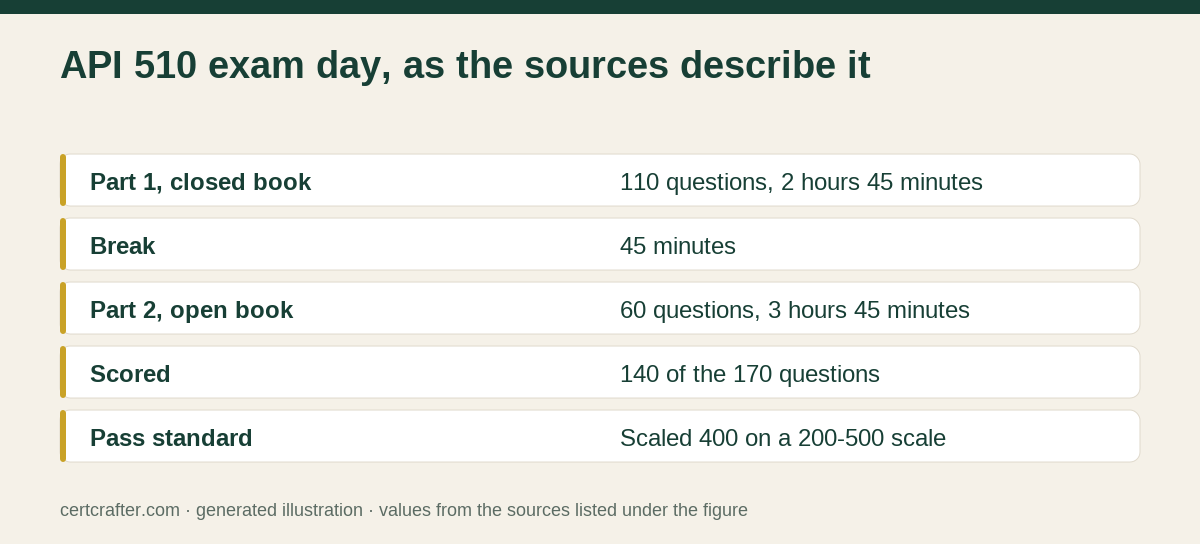
The exam has 170 questions, of which 140 are scored, and it is delivered in person at Prometric. The 2027 window for January is 2 to 22 January, and its application deadline has passed. If you are sitting then, you already hold your authorization. The work now is the order of study.
Start with Sections I and II, because they are closed book and calculation heavy and need the most repetition. Move to Section III and the Section V documents next, practicing with the reference set the way the exam shows it, on screen. Keep Section IV for the end, as a checklist of 16 topics you tick off against what you already know.
Where do candidates lose marks on the body of knowledge?
They study the title of a document instead of the inclusions. Reading all of RP 571 when only some mechanisms are examined spends hours that Section I needed. The reverse also happens: skipping an annex that the body of knowledge names.
Questions on this material are framed as short cases, often asking where a requirement sits or which rule applies when API 510 and the construction code differ. For welding, API says the rules in API 510 take precedence over those in Section VIII, Division 1. Knowing that order of precedence answers more than one question.
What to do next
Print the body of knowledge and the effectivity sheet side by side, and mark every exclusion in red. Then take the free sample quiz to see which section to start with.
For more by section, read what the exam tests on vessel NDE and welding qualification. The certification guide holds the summary, the free sample quiz shows where you stand, the six practice tests drill the calculations, and more API 510 posts go domain by domain.
Comments
Comments are read by a person before they appear. How we moderate.