
Most API 510 candidates can do the division. What costs them is not knowing which two readings to divide by.
Why does one vessel give you two corrosion rates?
Because you usually hold more than two readings. A vessel built years ago has a starting thickness, perhaps a mid-life reading, and today’s number. Measure the loss from the first reading and you get one rate. Measure it only over the last interval and you get another.
Neither is wrong. They answer different questions. The first shows what the vessel has done across its whole history. The second shows what it is doing now, which matters if the process changed, a feed got dirtier or a coating failed.
API’s Body of Knowledge lists the pieces the inspector must calculate: metal loss (API 510, 7.4), corrosion rate (7.1), remaining corrosion allowance (7.1) and remaining service life (7.2). It also says the formulas may be closed book, so the chain has to be in your head before exam day.
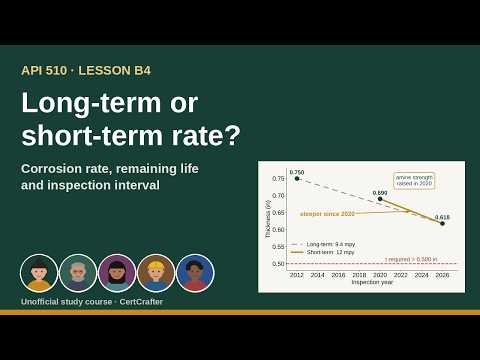 API510: Corrosion rate, remaining life and inspection interval Watch on YouTube · CertCrafter
Our channel covers the same chain in API 510: corrosion rate, remaining life and inspection interval.
What is the remaining life formula, and what goes in it?
Four steps, each one feeding the next.
- Metal loss: the earlier thickness minus the latest thickness.
- Corrosion rate: that loss divided by the years between the two readings.
- Remaining corrosion allowance: latest thickness minus required thickness.
- Remaining life: the allowance divided by the rate.
Required thickness is the floor for that component, worked out from the design rules for its own pressure and geometry. It is not the drawing thickness and it is not the original wall. Take it from the calculation record, not from memory.
Worked example: the same vessel, two rates
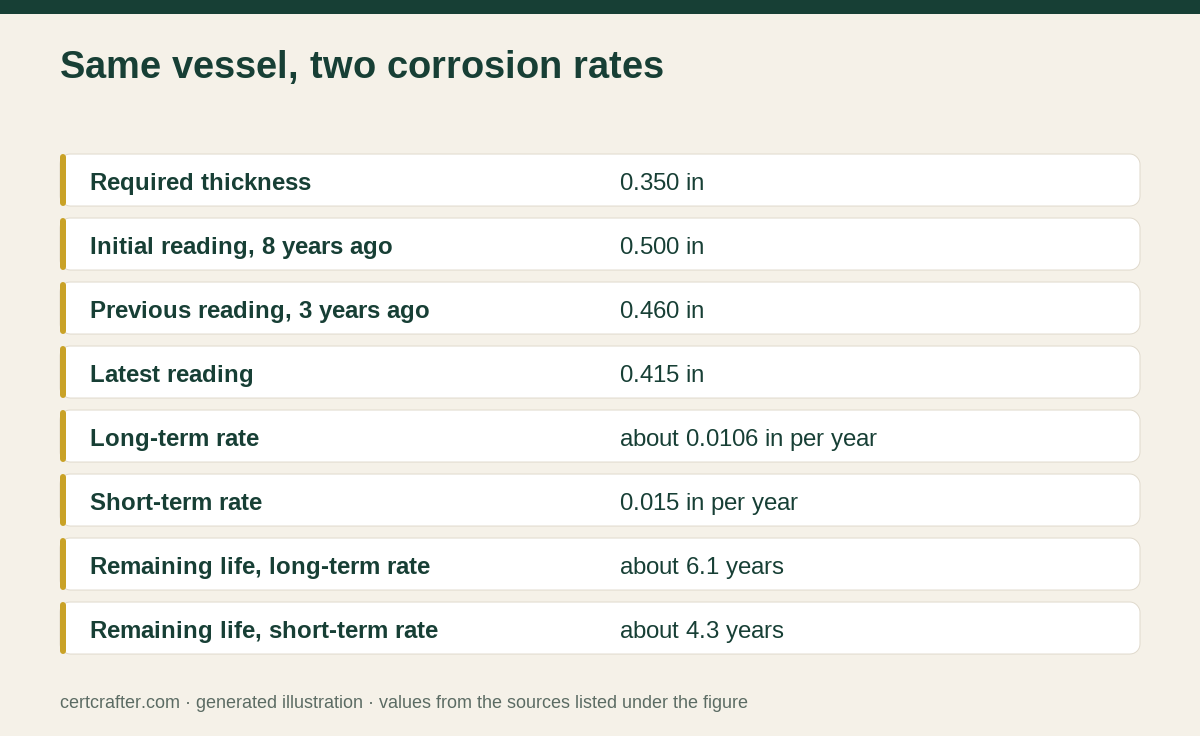
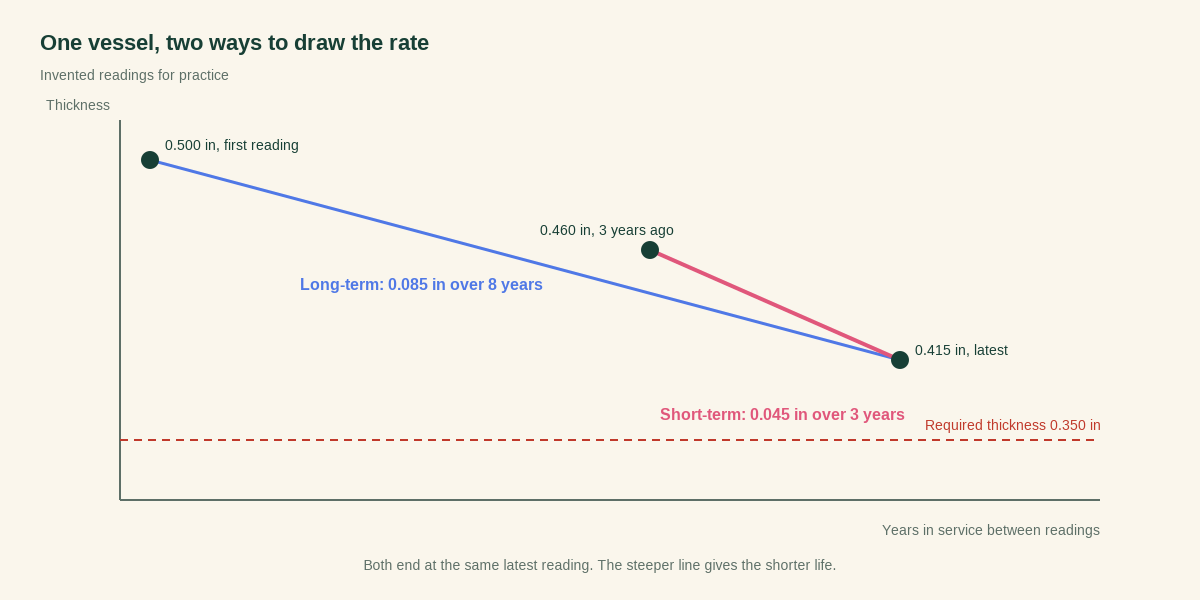
All numbers are invented for practice. A shell course has a required thickness of 0.350 in. Eight years ago the first recorded reading was 0.500 in. Three years ago it read 0.460 in. Today it reads 0.415 in.
| Step | Long-term (first reading to today) | Short-term (last interval) |
|---|---|---|
| Metal loss | 0.500 - 0.415 = 0.085 in |
0.460 - 0.415 = 0.045 in |
| Years between readings | 8 |
3 |
| Corrosion rate | about 0.0106 in per year |
0.015 in per year |
| Remaining corrosion allowance | 0.415 - 0.350 = 0.065 in |
0.065 in |
| Remaining life | about 6.1 years |
about 4.3 years |
The allowance is the same in both columns, because it depends only on today’s reading and the floor. Only the rate moves, and with it the life: six years against four.
The short-term rate is higher than the long-term one, and that gap is a finding. The vessel is losing metal faster now than it did on average. Something about the service changed, and the inspector’s next job is to ask what.
Which rate would an inspector actually use?
The cautious one, unless the evidence says otherwise. Planning inspections around six years when the recent trend says four is how a vessel reaches its minimum thickness between visits. If the short-term rate is the higher one, most inspectors will work with it and want to know why it rose.
The opposite case is also real. A short interval can show a low rate because the two readings were taken at slightly different spots, or by different gauges. One reading that looks too good to be true is a reason to recheck the point before anyone believes it.
Field practice adds a few habits that the arithmetic never shows:
- Read at the same marked location each time, so two readings describe the same metal.
- Record the method and gauge with each number, because a rate is only as good as its weakest reading.
- Compare against neighbors. A point corroding twice as fast as the points around it needs a look before anyone averages it away.
- Check what the vessel holds. A rate from a quiet year can mislead if the next year runs a different feed.
None of this changes the formula. It decides which numbers you are allowed to put in it.
Where do candidates lose marks on this calculation?
The arithmetic is rarely the problem. The setup is.
Dividing by the vessel’s age. The years in the denominator are the years between the two readings you chose, not the years since commissioning, unless the first reading is the commissioning one.
Subtracting from the wrong thickness. The allowance uses the latest reading and the required thickness. Using the nominal wall flatters every answer.
Answering the life question with an interval. Remaining life is a number of years of margin. The inspection interval is set by the Section 6 rules, applied to that life. An option that reads “four years” next to the word interval is a classic distractor.
Mixing units. A rate in millimeters per year over a margin in inches gives a confident wrong figure. The Body of Knowledge expects both unit systems, so work this case again in millimeters.
Reading the question stem too fast. When a stem gives three thickness readings and two dates, it is usually testing which pair you pick, so underline what the question asks the rate to describe before you touch the calculator.
On exam day the closed-book part has 110 questions in 2 hours 45 minutes, so this chain gets worked with no reference on screen. The exam has 170 questions with 140 scored, and passing is a scaled 400 on a 200 to 500 scale, not a percentage.
The API 510 Complete Exam Kit works more of these under timed conditions, with every answer explained.
What should you do next?
Take the table above and redo it in millimeters, closed book, with a timer. Then change the middle reading to 0.480 in and see which way the short-term rate and life move. Then try the free sample to see how these questions are framed.
For the wider picture, read API 510 formulas with worked examples and API 510 thickness and intervals. The product page is at API 510 Pressure Vessel Inspector, the practice tests at the API 510 bundle, and more guides in the API 510 hub.
Comments
Comments are read by a person before they appear. How we moderate.