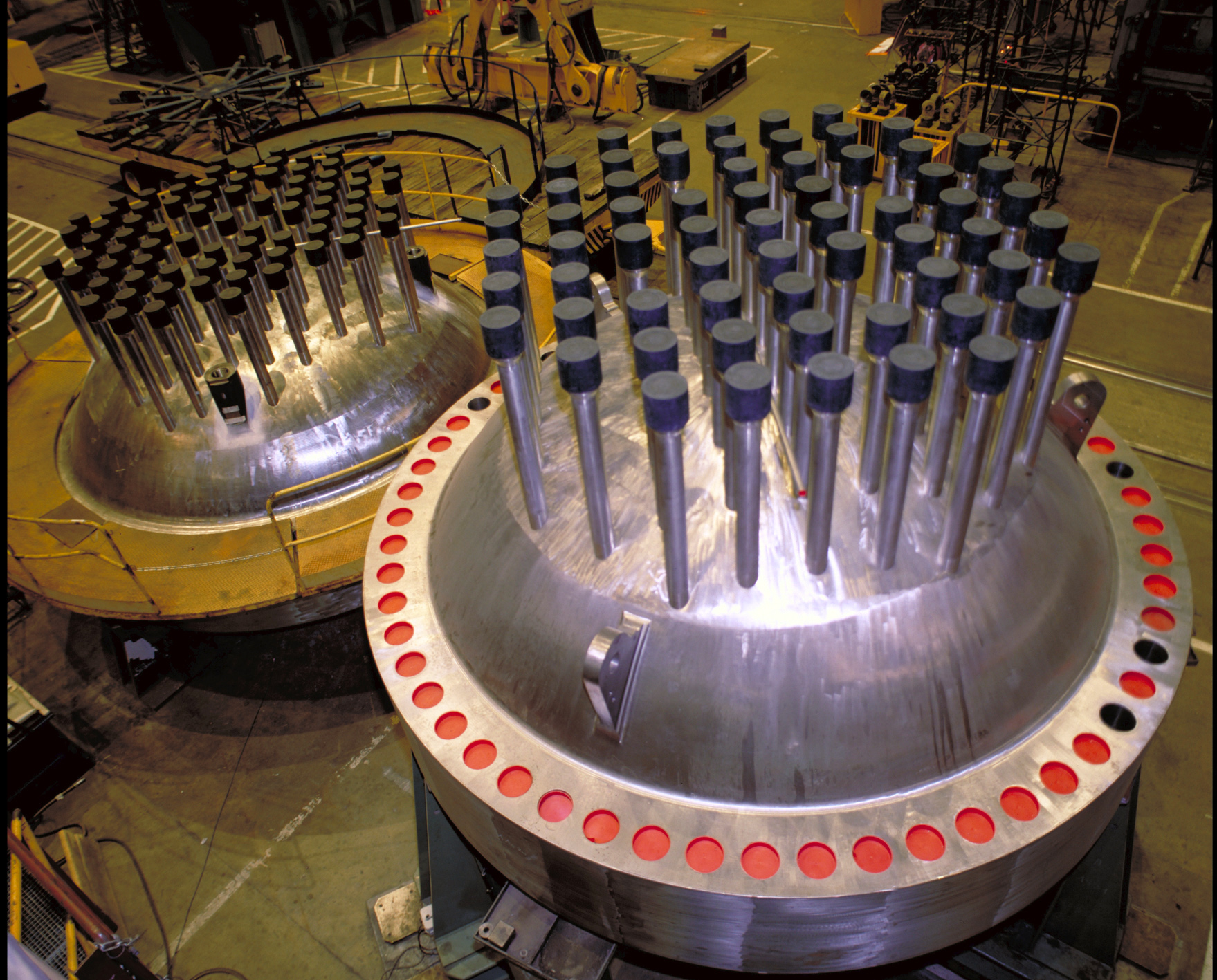
Most API 510 candidates treat Domain IV as the soft domain because it has no formulas. It is also where the exam’s wording on repairs, records and deterioration lives.
What does Domain IV of the API 510 exam cover?
The body of knowledge gives Domain IV, Practical Knowledge - General, one short list of 16 topics and a one-line rule: these topics may be covered. That is all the structure there is. No articles, no paragraphs, no formulas.
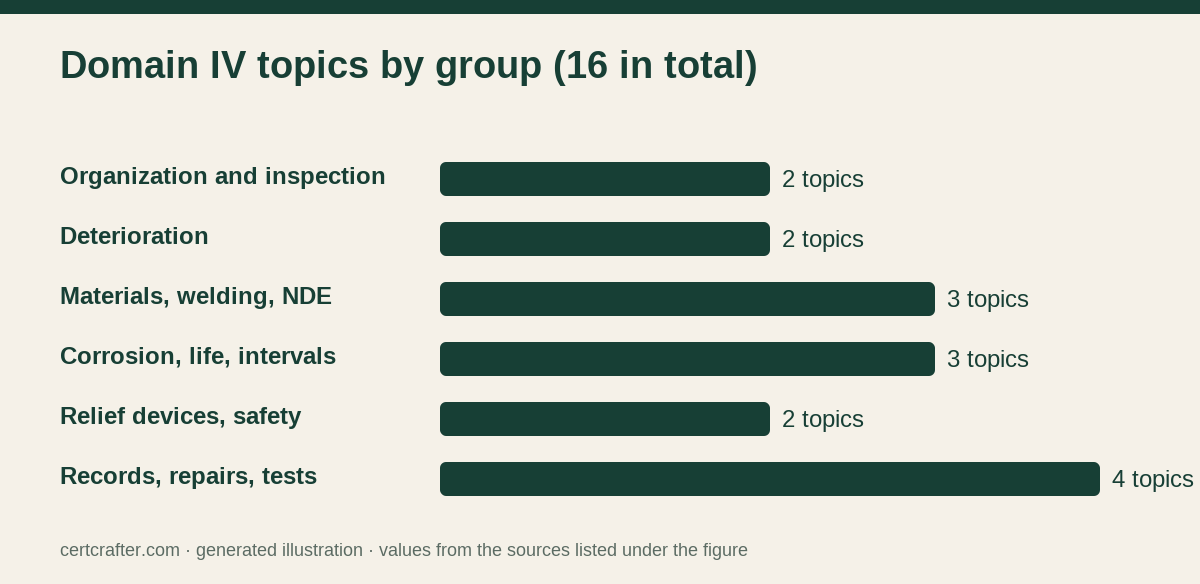
Read the list in groups and it gets easier to hold. The first two topics are about the job itself: organization and certification requirements, and the types and definitions of maintenance inspections. Then come two on deterioration: process corrosion, and mechanical, thermal and high temperature damage. Materials and fabrication problems, welding on pressure vessels and NDE methods follow. Next are corrosion and minimum thickness evaluation, remaining life, and inspection interval determination. The last group covers relief devices, safety practices, records and reports, repairs and alterations, rerating, and pressure testing after repairs, alterations or rerating.
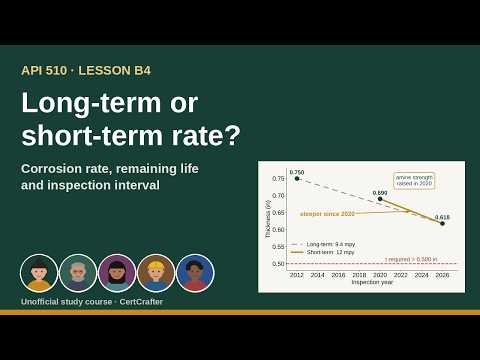 API510: Corrosion rate, remaining life and inspection interval Watch on YouTube · CertCrafter
Three of those topics, thickness, remaining life and intervals, are the same material Domain I teaches with numbers. Our channel has a short on corrosion rate, remaining life and inspection interval. Domain IV asks the same ideas without the arithmetic: what drives the interval, and what makes you shorten it.
How do the 16 topics group together?
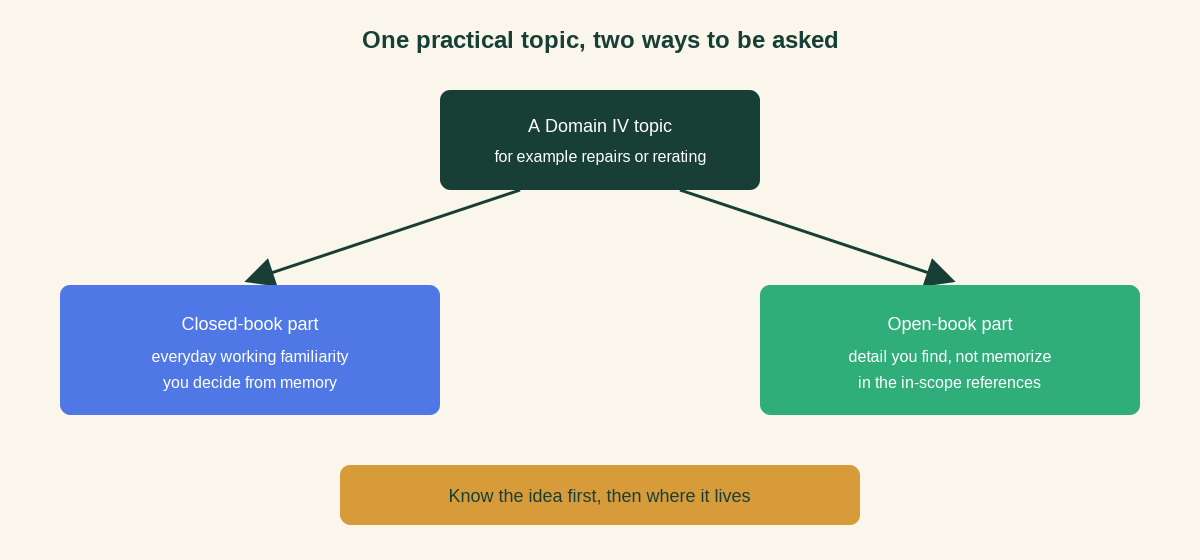
Any of them can reach you in the closed-book part as everyday working familiarity, or in the open-book part as detail you look up.
Counting by group, the last one, records, repairs, alterations, rerating and testing, is the biggest, with four topics. The grouping is ours and the body of knowledge does not weight its topics, so treat the chart further down as a study aid, not a blueprint. The useful point is that most of the list is about what happens to a vessel after it has been built, which is what an in-service inspector spends the week doing.
How do inspectors use this knowledge on a real vessel?
Domain IV is the part of the exam that looks most like the job. A vessel comes off line for a turnaround. You review the last report, decide what the inspection needs to look for, and choose the methods. Then something unexpected turns up: a pit field, a leaking repair, a nameplate that does not match the drawing.
What happens next is mostly judgment backed by the code. Do the deterioration mechanisms in the service explain the thinning? Is the vessel still fit at its present rating, or does it need a repair, an alteration or a rerate? Who has to authorize it? Which test follows, and how is the record kept so the next inspector can see what you saw?
Field mistakes cluster at the handoffs. A repair is done and nobody updates the record. A rerate is assumed without checking the thickness data behind it. A relief device is treated as someone else’s problem. The exam likes these handoffs for the same reason a plant does: they are where the paper trail breaks.
Where do candidates lose marks on Domain IV?
Three habits do most of the damage.
Skipping the list because there is no formula. The body of knowledge says the closed-book part tests everyday working familiarity with API 510 and the reference documents. That is Domain IV in one sentence. Candidates who only drill calculations arrive underprepared for exactly the questions that should be free marks.
Answering from the plant, not from the code. Your site may do things differently. The body of knowledge says the exam is based on the editions in the effectivity sheet, and that organizations using other documents or editions are noted but not followed. The September 2026 sheet lists API 510 as 11th Edition, October 2022, with Errata 1 and 2. If your habit differs from that edition, the exam answer follows the edition.
Ignoring the scope notes. Domain V narrows what the questions can be drawn from. API 510 applies in full except Section 9 and Appendix E. RP 571 is limited to listed mechanisms. RP 572 includes Annex A and B but not Annex C. RP 576 is tested except for its annexes. Studying a mechanism that is outside the list is time you do not get back.
| Reference | What the body of knowledge says is in scope |
|---|---|
| API 510 | Everything except Section 9 and Appendix E |
| API RP 571 | Section 2 and a fixed list of mechanisms only |
| API RP 572 | The whole document, Annex A and B included, Annex C not |
| API RP 576 | The whole document, annexes excluded |
| API RP 577 and 578 | The entire document |
The API 510 Complete Exam Kit works more of these under timed conditions, with every answer explained.
How should you study Domain IV?
Start from the 16-topic list and write one sentence for each topic: what the inspector decides, and which document says so. If you cannot name the document, that topic is where your open-book time will go.
Then link the topics to the work you already do. The thickness and intervals guide covers the calculation side of topics 8 to 10. The welding qualification guide and the vessel NDE guide cover topics 6 and 7 in depth. What remains, relief devices, safety, records, repairs and rerating, is where you should spend your reading hours, because no other domain teaches it.
Read the questions in the closed-book part as short field cases. Each one hands you a situation, and the right option is the one that follows the code for that situation, not the one that sounds most careful.
What to do next
Take the 16-topic list and mark each topic green, amber or red from memory, with no book open. Spend this week on the reds, starting with repairs and rerating.
The study plan lays out the order across all five domains, and common mistakes covers errors across the paper. The API 510 Complete Exam Kit has the full course, with a free sample to see where you stand. More guides are on the API 510 hub, and the product guide has the exam format.
Comments
Comments are read by a person before they appear. How we moderate.