Most API 653 candidates treat domain V as a pile of documents to skim. The body of knowledge is far more selective than that, and the candidates who read its limits study fewer pages and answer more questions.
What is “Practical Knowledge, Specific” in the API 653 exam?
It is the fifth and last domain in the body of knowledge. Domain IV describes the everyday job. Domain V lists each reference publication and, for each one, the topics that may be covered.
The documents are API RP 571 (damage mechanisms), RP 575 (inspection of atmospheric and low-pressure tanks), RP 576 (pressure-relieving devices), RP 577 (welding, inspection and metallurgy), API 653 with the related parts of API 650, RP 651 (cathodic protection) and RP 652 (tank bottom linings).
API’s own note explains why topics repeat across documents. Welding requirements, for example, live in ASME Section IX, API 650 and API 653, so the same subject can be listed under all three.
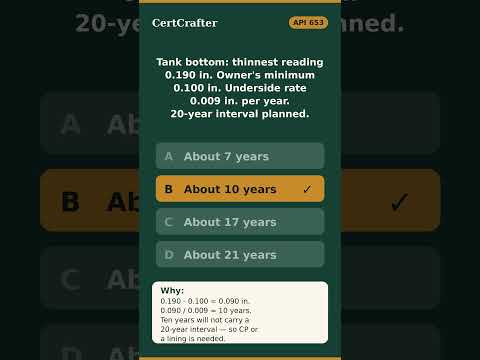 API 653 — Settlement, thickness, interval — one calculation, one number. Watch on YouTube · CertCrafter
The channel’s short on one calculation, one number shows how the thickness to interval chain from API 653 fits together.
Which documents carry the most topics?
API 653 itself, by a distance. Its inspection section alone lists 20 items, from types of tanks and safe working practices to brittle fracture risk and the condition of anchor bolts and insulation. The calculation section adds 10 more, and repairs and alterations nine. RP 577 follows with 14.
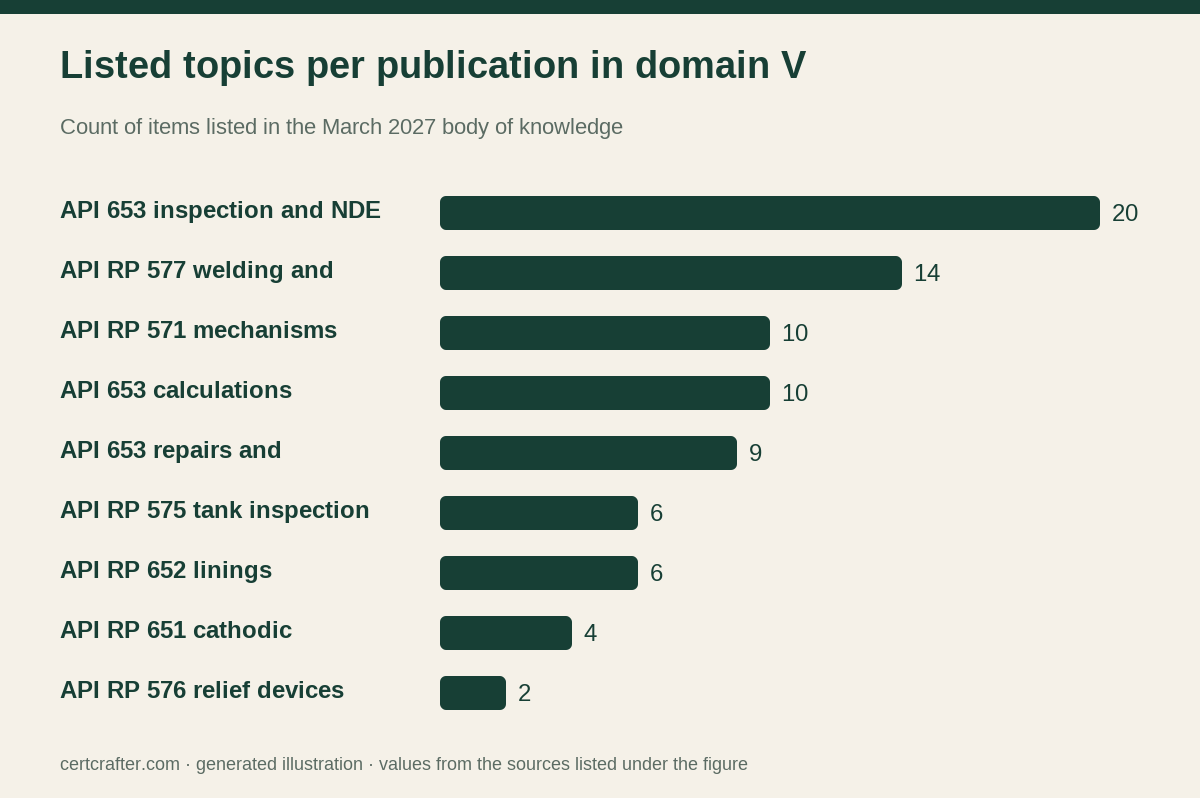
The body of knowledge gives no weighting for the domain, so treat the counts as the size of the reading, not as a share of marks. A short list can still produce a question. RP 576 has two items, and one of them is the testing and setting of weight-loaded pressure and vacuum vents on tanks.
What does the exam take from each reference?
RP 571 is the narrowest. The body of knowledge says test questions are based on listed mechanisms only. They are atmospheric corrosion, brittle fracture, caustic corrosion, caustic stress corrosion cracking, concentration cell corrosion, corrosion under insulation, ethanol stress corrosion cracking, microbiologically influenced corrosion, soil corrosion and sulfuric acid corrosion. You are not asked to memorize the definitions in its terms section, only to know the common terms and find the rest.
RP 575 is the opposite. The whole document applies unless excluded. API warns that it holds many general statements rather than strict requirements, so some questions use phrasing like “it is best to” or “an inspector would normally”. The task is to pick the best answer of those given.
RP 651 is limited to sections 1, 2, 3, 4, 5, 6, 8 and 11. You need to know when cathodic protection is needed, the methods, and how systems are operated and maintained. Design of cathodic protection systems, and interference currents, are excluded. RP 652 asks for practical familiarity with bottom linings: types, why they fail, surface preparation and what affects application.
How do inspectors use these documents on a real tank job?
On site, nobody opens one document and stays there. A tank comes out of service for an internal inspection and the bottom shows pitting. The inspector uses RP 575 to decide what to look at and how, RP 571 to name the likely cause, API 653 to judge whether the plate stays, and RP 651 or RP 652 to talk to the owner about what protects the bottom next time.
That chain is exactly how domain V is built. Each document answers one kind of question, and the field mistake is using the wrong one. Quoting RP 575 as if “normally” meant “shall” will upset a contractor. Treating a general RP 577 statement as an API 653 requirement does the same in the other direction.
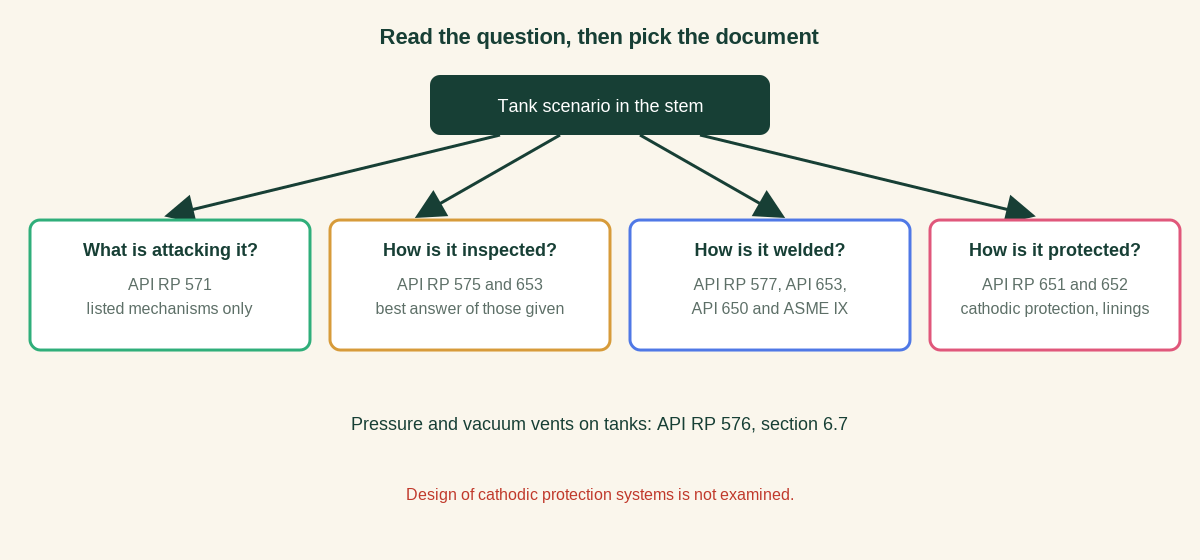
Worked example: reading a domain V stem
Take a stem that describes a tank with wet insulation on a nozzle neck and a stained, pitted shell below it, then asks what the inspector should conclude.
- Name the question type. This one asks for a cause, so RP 571 is the document.
- Check the stem against the listed mechanisms. Corrosion under insulation is on the list, so the answer sits inside the exam’s boundary.
- Strike any option that names a mechanism the body of knowledge does not list.
- Between the options left, choose the one the inspector would normally act on, since that is how RP 575 wording is tested.
Step 3 is the one candidates skip. It removes two options in seconds.
What is excluded from domain V?
The limits are few but they matter. Besides the RP 571 limit and the RP 651 design exclusion, the API 653 section says all of the standard applies unless specifically excluded. That is a heavy default. Where the body of knowledge does not exclude, assume it can be asked.
Two detailed items are easy to miss. New bottoms supported by grillage fall under API 650 Annex I, calculations excluded. Lap-welded patch plates point to a specific paragraph and figure in API 653 section 9.
How does the exam frame a domain V question?
Many are scenarios with a tank tag, a plain problem and four plausible options. Some are labeled open book, and you have the reference PDFs on screen. Others are closed book and test what a working inspector carries in memory. Closed book is the larger part: 110 of the 170 questions, against 60 open book.
Three patterns repeat. The first is the wrong-document option, a correct statement taken from a document that does not govern the case. The second is the strict-sounding option that overreaches, such as condemning a tank when the code allows evaluation. The third is the unlisted mechanism, a plausible cause that the body of knowledge excludes.
Two free sample questions sit below. Notice what each one tests before you read the options.
How should I study domain V?
Start with the list of seven references and cross out what is excluded. Then read RP 571 only for the listed mechanisms, and RP 575 for how it hedges its advice. Spend the rest on API 653 and the related API 650 parts, where most of the items are.
For each topic write one line on which document governs and one on what the inspector decides. A sentence from memory beats a page of highlighted text, because 110 questions are closed book.
The API 653 Complete Exam Kit works more of these under timed conditions, with every answer explained.
For the neighboring domain, API 653 general practical knowledge covers the everyday topics and the 26 exclusions. The tank welding post goes deeper on the welding documents, and tank calculations covers the thickness chain.
The API 653 product page holds the exam facts, the guides hub lists every topic, and the free quiz gives you a graded start. The full practice test bundle is there when you want volume.
Comments
Comments are read by a person before they appear. How we moderate.