My 4 engineering books go FREE on Kindle Fri 6 – Tue 10 Nov (PT). See the books → FREE on Kindle now: all 4 engineering books, until Tue 10 Nov 11:59 pm PT. Ends in . Grab yours → My 4 books: FREE on Kindle Fri 6 – Tue 10 Nov (PT). See → FREE on Kindle now: 4 books, left Grab yours →

API 653 Tank Welding: Terms People Mix Up

By Sandeep Bandyopadhyay, Senior aerospace engineer · PMP, MBA, Six Sigma

TL;DR

Most lost marks in the API 653 welding domain come from swapped terms. The PQR records the values actually used on the test coupon. The WPS gives the ranges a welder works within and must cite its PQR. The WPQ qualifies one welder. Essential and non-essential variables decide what changes need new testing. Name the document first, then judge the weld.

Original questions, not exam dumps. Every CertCrafter question is written from the published body of knowledge and the referenced codes. None is copied from a live exam, and CertCrafter is independent: not affiliated with or endorsed by any awarding body.

An oil well and storage tanks on open ground in North Dakota
Photo: Obenour 2 oil well and tanks - Evanson Place - Arnegard North Dakota - 2013-07-04 (9289996696) by Tim Evanson from Cleveland Heights, Ohio, USA, United States of America (Wikimedia Commons), CC BY-SA 2.0, via Wikimedia Commons.

Most API 653 candidates lose welding marks on swapped words, not on weld technique. The wrong answer is often a true statement about the wrong document.

What does each welding term mean on the exam?

Domain II asks you to review three records: the Welding Procedure Specification (WPS), the Procedure Qualification Record (PQR) and the Welder Performance Qualification (WPQ). Each one answers a different question.

Term Question it answers Where it shows up
PQR What was actually done on the test coupon, and did it pass? Values used, mechanical test results, signed and dated
WPS How may production welding be done? Ranges and variables, cites its PQR
WPQ Can this welder make this weld? One named welder, coupon welded to a qualified WPS
Essential variable Which change forces new qualification testing? Addressed on the WPS and PQR
Non-essential variable Which change only needs the WPS revised? Addressed on the WPS

Two more words belong to the exam’s own fence. Supplementary essential variables are out, and so are Charpy impact requirements. If a question seems to need either, you have misread the question.
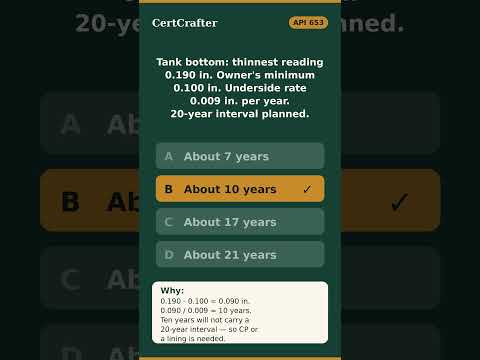
Video: API 653 — Settlement, thickness, interval — one calculation, one number. API 653 — Settlement, thickness, interval — one calculation, one number. Watch on YouTube · CertCrafter
Image: video thumbnail, source: CertCrafter on YouTube (@certcrafters).

The channel’s short on one calculation from settlement to thickness to interval is a useful change of pace from the paperwork side of the exam.

Is a range a PQR thing or a WPS thing?

A WPS thing. This is the swap that costs the most points.

The PQR is evidence. A coupon was welded under one set of conditions and tested, and the record states those conditions as they were. The WPS then tells the welder the limits for production. If a PQR shows a preheat or a thickness as a range, it no longer proves that one specific set of conditions produced a passing coupon.

The free question on a PQR for SMAW on A283 Grade C plate tests this exactly. It shows ranges on the qualification record and asks what the inspector should conclude. The answer is that the record must carry the values actually used, since ranges belong on the specification.
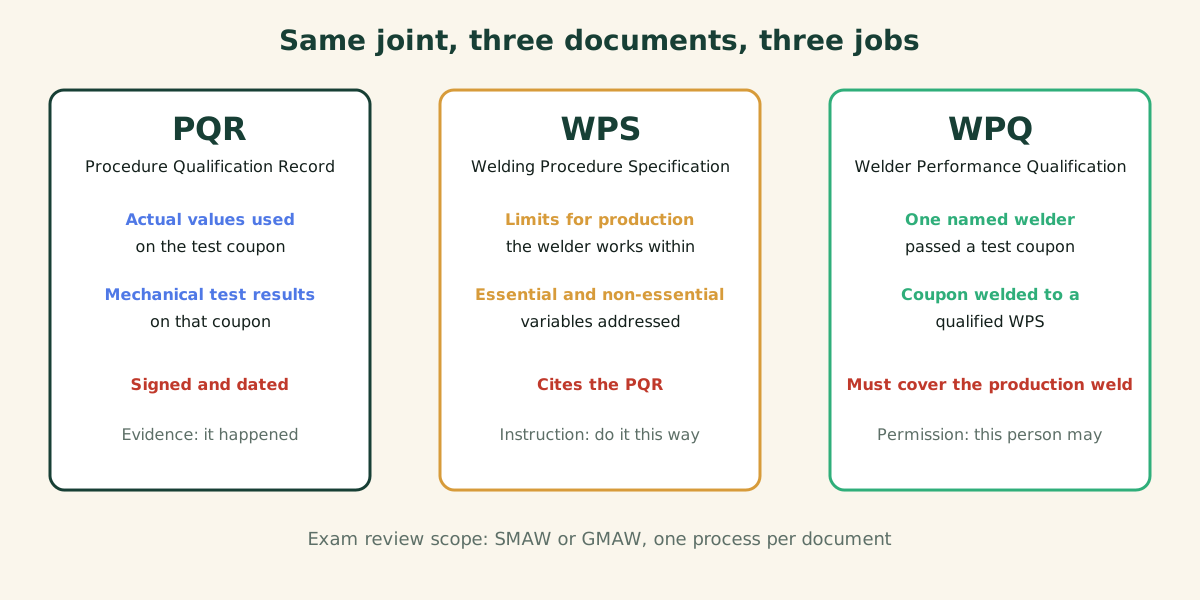
Three columns: the PQR holds actual values and test results, the WPS holds the production ranges and cites the PQR, the WPQ names one welder qualified on a coupon welded to a qualified WPS
Illustration: CertCrafter, from the API 653 body of knowledge. Illustration: CertCrafter, from API 653 Body of Knowledge, March 2027.

Essential or non-essential: which change needs new testing?

An essential variable is one whose change affects the properties of the weld, so a change there calls for a new qualification record and new testing. A non-essential variable can change without that. The WPS is revised and no new coupon is welded.

The body of knowledge asks you to determine whether all required essential and non-essential variables have been properly addressed. Notice the verb. You are not recomputing anything, you are checking that each variable has been dealt with in the right document.

Candidates also read “address” as “match”. A WPS can allow a wider range than one PQR value, as long as the variable is handled the way Section IX allows. Your job is to know which kind of variable you are looking at before you decide what a change does.

How do inspectors use these words on a repair job?

Before work starts on a shell repair, the contractor sends a package. An experienced inspector reads it as three separate questions and refuses to let one document answer for another.

A signed PQR does not qualify a welder. A WPQ does not approve a procedure. A WPS with a nice list of ranges proves nothing if the PQR it cites is missing from the package.

The common field finding is a broken link, not a bad weld: a WPS that cites a PQR number nobody can produce, a welder qualified on a different process, or a record with no signature. Each of those stops the job on paper, whatever the weld might look like later.

Oil storage tanks in a tank farm at Bayonne, New Jersey
Photo: Bayonne tank farm from BB jeh by Jim.henderson (Wikimedia Commons), CC BY-SA 4.0, via Wikimedia Commons.

Worked example: sort the statements into the right record

These items are invented for practice. A package arrives for a shell insert repair. You sort six statements from it, one by one.

  1. “Preheat shown as a range, thickness shown as a range.” That is WPS language. If it sits on the PQR, flag it.
  2. “Coupon tensile and bend results listed.” That is PQR content. Check the tests are the right ones and the results acceptable.
  3. “Welder J. Moreno passed a coupon welded to WPS-14.” That is a WPQ. Check WPS-14 was itself qualified.
  4. “WPS-14 cites PQR-07.” Good, now confirm PQR-07 is in the package and is signed and dated.
  5. “The WPS covers SMAW and GMAW.” Only one process may appear on a single WPS in the exam’s review scope. Stop and re-read.
  6. “Base metal is A283 Grade C.” That is a P-No. 1 plate, the group the review is limited to.

Notice how little arithmetic is involved. The whole exercise is deciding which document each statement belongs to.

The API 653 Complete Exam Kit works more of these under timed conditions, with every answer explained.
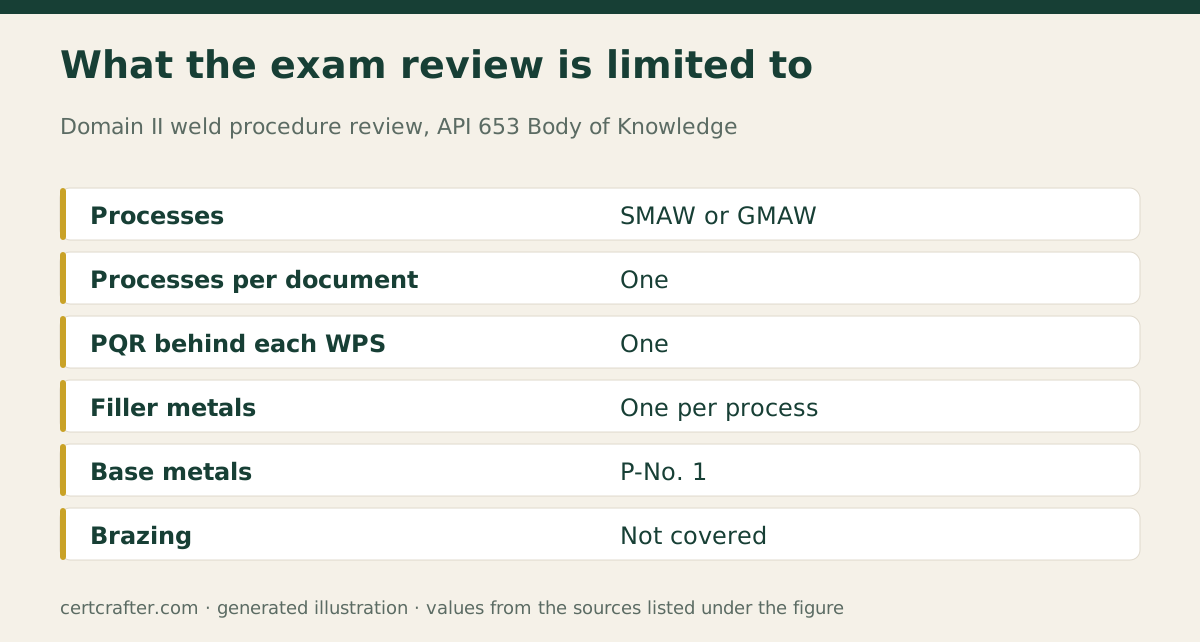
Six limits of the exam's weld procedure review: SMAW or GMAW, one process per document, one PQR behind each WPS, one filler metal per process, P-No. 1 base metals, brazing not covered
The review limits in one place. Illustration: CertCrafter, from API 653 Body of Knowledge, March 2027.

Which consumable terms get confused?

Exposed electrodes are the classic. A low hydrogen electrode such as E7018 is chosen because its coating carries very little moisture. Leave it open overnight in rain and that property is gone, so the electrodes go back for rebaking within the manufacturer’s limits, or into the bin.

Candidates sometimes treat this as cosmetic, or try to fix it with a torch at the joint. Neither works. The free question on electrodes left open beside a tank shows how the scenario hides its answer in one line. Moisture becomes hydrogen in the arc, and the result is porosity or delayed cracking that can appear after the examination is finished. API RP 577 is the reference for welding processes, inspection and metallurgy on the effectivity sheet.

Where do candidates lose marks on these terms?

First, putting a fact on the wrong record. Second, reading the welder’s qualification as permission for any weld. A WPQ coupon was welded to one qualified WPS, and the production weld has to fall within what it covers.

Third, spending study time on excluded material. Dissimilar metal joints, overlay and hard-facing, consumable inserts and heat treatment requirements are all outside the review. The March 2027 effectivity sheet lists ASME BPVC Section IX in its 2025 Edition, welding only, plus API 650 in its 14th Edition and API 653 with Addenda 1 through 4.

Fourth, forgetting that the exam splits closed-book and open-book items. If a welding term question is closed-book, you cannot look anything up, so the definitions above need to be cold.

What should you do next?

Take any weld package you can find, a real one from work or a sample, and label every line WPS, PQR or WPQ before you read it for sense. Say out loud which link would fail.

The API 653 product page holds the exam facts, the full bundle marks items closed-book or open-book as the exam does, and the free quiz is a quick sample. The guides hub lists the rest. For the scope of this domain, read what the welding domain tests, then the common mistakes.

Try these free questions

  1. [Open book] A contractor submits a procedure qualification record for SMAW on A283 Grade C plate in which the preheat and thickness entries are shown as ranges rather than as the values actually used. What should the inspector conclude?

    1. Ranges may be shown on the qualification record provided the welding procedure specification repeats the same ranges.
    2. The actual values used while welding the test coupon must be recorded, since ranges belong on the procedure specification.
    3. Both essential and non-essential variables must appear on the record, each carrying the tolerance band used in production.
    4. The record may simply be reissued under a new date whenever a non-essential variable is changed in production.
    Show the answer and explanation

    Answer: B. A procedure qualification record is a record of what was actually done. It states the values of the essential variables used while the test coupon was welded and the results of the mechanical tests on that coupon, and it is certified by the organisation that did the work. Ranges belong on the welding procedure specification, which tells the welder the limits he may work within; putting ranges on the qualification record destroys the evidence that one specific set of conditions produced acceptable test results. The first option inverts the two documents. The third option adds a requirement that does not exist, since non-essential variables need not appear on the qualification record at all, only on the specification. The fourth option confuses the two kinds of variable: a change in a non-essential variable calls for the specification to be revised without requalification, while a change in an essential variable is what forces a new qualification record and new testing.

  2. A canister of E7018 electrodes sat open on the scaffold overnight beside T-305 during rain, and the welder wants to run them out in the morning on a shell insert repair. What should the inspector direct?

    1. Let the welder use them after a visual check for cracked or flaking coating, since moisture affects only the appearance of the flux and not the deposited weld metal.
    2. Let the welder use them on fillet and attachment welds only, keeping them off the full penetration seams where weld soundness matters most.
    3. Have the electrodes dried with a torch at the joint immediately before striking the arc, which drives off surface moisture and restores the coating.
    4. Take them out of service for rebaking or disposal within the manufacturer's exposure limits, because a low hydrogen coating that has absorbed moisture invites porosity and hydrogen cracking.
    Show the answer and explanation

    Answer: D. The whole point of a low hydrogen electrode is a coating that carries very little moisture, and that property is lost once the coating has been exposed to a wet atmosphere beyond the permitted exposure time. Moisture dissociates in the arc and delivers hydrogen into the weld pool and the heat affected zone, where it produces porosity and, in a restrained shell insert, delayed cracking that may not appear until after the examination is finished. Exposed electrodes must therefore go back for rebaking within the limits the manufacturer and the site procedure allow, or be scrapped. The first option treats moisture pickup as cosmetic. The second confines suspect consumables to fillet welds, as though an attachment weld cracking into the shell were acceptable. The third substitutes a torch for controlled rebaking, which heats the surface without driving moisture from the depth of the coating and can damage the flux while giving false confidence.

Take the full free 10-question sample with scoring →

Frequently asked questions

What is the difference between a WPS and a PQR?

The PQR is the record of a test coupon: the actual values used while it was welded and the mechanical test results. The WPS is the instruction for production welding and gives ranges. The body of knowledge says the WPS must reference the applicable PQR and the PQR must be signed and dated.

Do supplementary essential variables appear on the API 653 exam?

No. The body of knowledge says supplementary essential variables will not be part of the WPS or PQR on the exam. Charpy impact requirements are excluded as well, so those parts of Section IX can wait.

Which welding processes can an API 653 procedure review include?

Only SMAW or GMAW. No more than one process appears on a single WPS, PQR or WPQ, and the WPS under review is supported by a single PQR. Base metals are limited to P-No. 1.

Official sources

  1. API 653 Body of Knowledge, March 2027 — accessed 3 November 2026
  2. API 653 Publications Effectivity Sheet, March 2027 — accessed 3 November 2026
  3. API 653 Aboveground Storage Tank Inspector certification page — accessed 3 November 2026

Exam rules change. Check the awarding body's official page before you apply. CertCrafter is independent and is not affiliated with or endorsed by any awarding body.

Was this helpful?

Comments

    Comments are read by a person before they appear. How we moderate.