Two inspectors can read the same thickness report and argue for ten minutes, and the argument is almost never about the numbers. One says “remaining life” and means the corrosion allowance left. The other says “minimum thickness” and means the lowest reading. Both are using real API 653 terms. Neither is using them the same way.
The exam punishes that. The calculations domain of the body of knowledge lists 15 categories, and the wrong options in a question are usually the right number attached to the wrong term. This page sorts the terms into the ones that measure a thickness, the ones that measure time, and the ones that name a kind of work.
What is the difference between metal loss, corrosion rate and remaining life?
Three words, three units. Get the unit and you get the term.
Metal loss is a thickness: how much steel has gone between two readings at one location. API’s body of knowledge puts it first in the list and notes that it includes corrosion averaging, which is covered in API 653 Section 4. Corrosion rate is that loss spread over time, so it is thickness per year. Remaining life is a time, in years.
Remaining corrosion allowance sits between them and trips people most. It is t actual minus t minimum. That is a thickness, not a time. Divide it by the corrosion rate and only then do you have years.
| Term | What it measures | Unit |
|---|---|---|
| Metal loss | Steel lost at one location between readings | in. or mm |
| Corrosion rate | Loss divided by the years between readings | in. or mm per year |
| Remaining corrosion allowance | t actual minus t minimum | in. or mm |
| Remaining life | Remaining allowance divided by the rate | years |
| Inspection interval | Set by the rules in API 653 Section 6 | years |
The last row is the one that matters on a site. Remaining life is a number you calculate. The inspection interval is a number the standard lets you assign, under its own rules, and it is not simply the same figure.
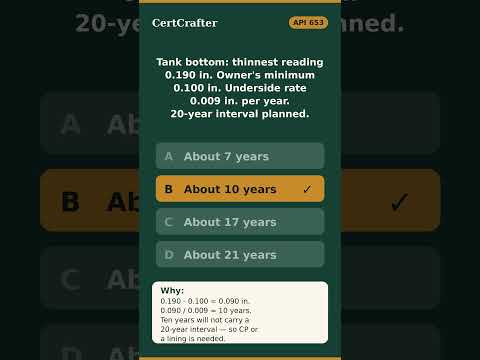 API 653 — Settlement, thickness, interval — one calculation, one number. Watch on YouTube · CertCrafter
The channel has a short that runs one calculation from settlement to thickness to interval, and it shows how the terms hand off to each other.
Which “minimum” do you mean: t min, t2 or t1?
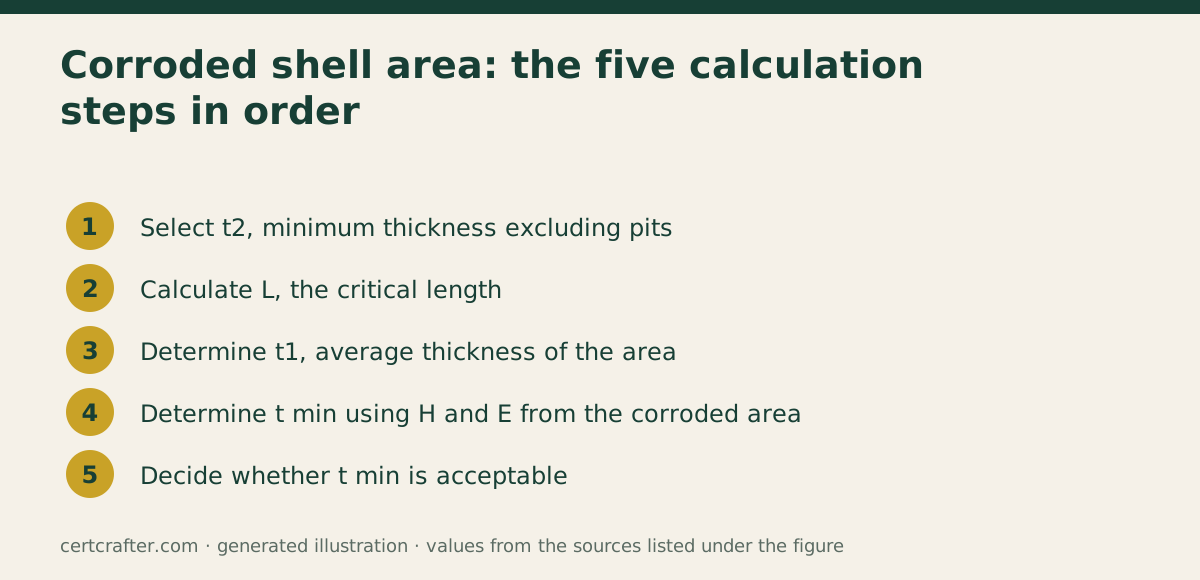
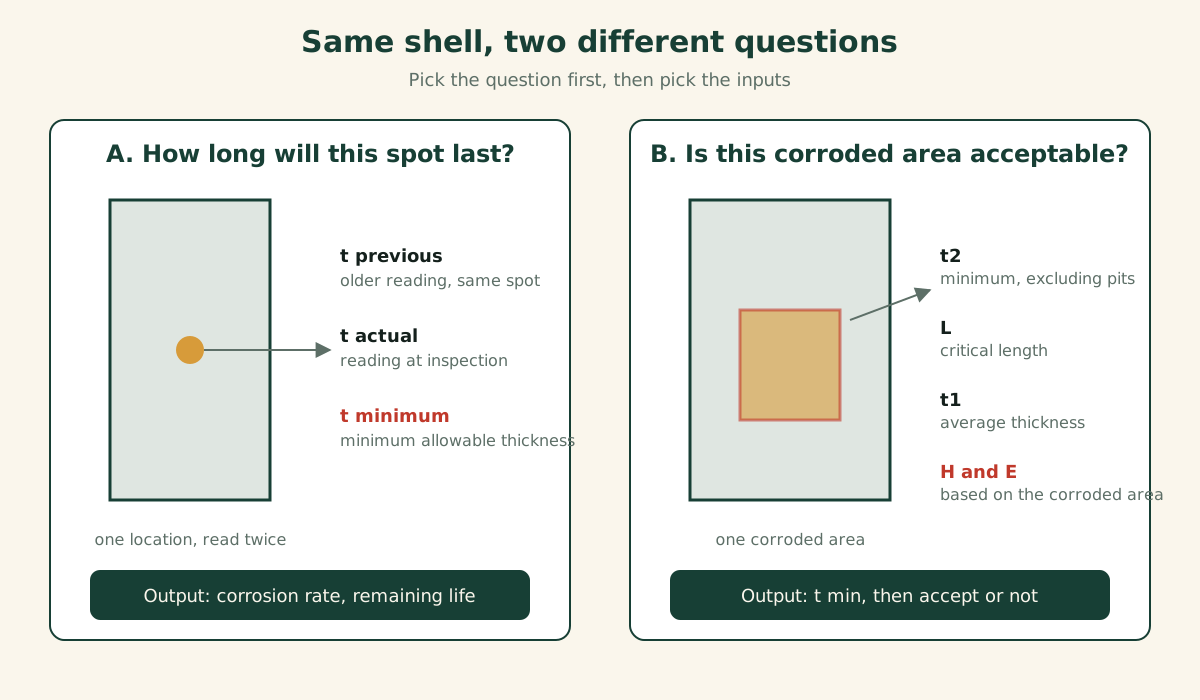
Domain I treats a corroded shell area as its own category, and it uses four symbols that look alike on paper. The body of knowledge lists them in order. You select t2, the minimum thickness of the corroded area, excluding pits. You calculate L, the critical length. You determine t1, the average thickness of the area. Then you determine t min for the corroded area and decide whether it is acceptable.
So t2 is a reading, t1 is an average, L is a length, and t min is a requirement. The first three describe what the steel looks like. The last describes what the steel needs. Acceptance is the comparison between them.
Notice the small clause in the fourth step: H, the liquid height, and E, the joint efficiency, are based on the corroded area. Not on the tank as a whole, and not on the bottom course by habit. A patch high on a shell sees less liquid head than one near the bottom, and that changes the answer.
Pits get their own category. Maximum acceptable pit depth, and the maximum length of pits in any 8 in. (200 mm) vertical length, are separate from general corrosion. Mixing a pit depth into t2 is a classic way to get a clean wrong answer, because t2 excludes pits.
Worked example: rate, allowance and life are three answers
These figures are made up for practice. One location on a shell course read 0.400 in. at the earlier inspection and 0.352 in. now, 8 years apart. The minimum allowable thickness for that location is 0.280 in.
- Metal loss:
0.400 - 0.352 = 0.048in. - Corrosion rate:
0.048 / 8 = 0.006in. per year. - Remaining corrosion allowance:
0.352 - 0.280 = 0.072in. - Remaining life:
0.072 / 0.006 = 12years.
Four steps, four different answers, and a question can ask for any one of them. Offer the allowance as the remaining life and you have the right quantity with the wrong term. Offer the rate and you have answered in inches per year when the question wanted years.
If the problem says to add or subtract a corrosion allowance, the body of knowledge says to do that based on the requirements of the problem. Do it before step 3, not after.
How do inspectors keep the terms straight on a job?
By writing the term and the unit together, every time. An inspection report that gives a bare number for “life” gets queried. One that gives the remaining corrosion allowance in inches, the rate in inches per year and the remaining life in years does not.
The second habit is about location. A rate needs two readings from the same spot, so the reading grid matters before any calculation does. If the grid changed between inspections, the old and new readings are not a pair, and the rate built from them says nothing.
Third, units. Tanks are built in US customary or SI units, and the body of knowledge says candidates must calculate in the unit the question uses. Some tables appear in only one system, API 653 Tables 4.1a and 4.1b among them, so a field log in millimeters can meet a table in inches. Convert the readings to the table’s system and finish the job there. Never mix the two halfway through.
Repair, alteration, reconstruction: which word fits the job?
These three name kinds of work, not measurements, and candidates mix them as often as the thickness terms. The distinction turns on what the work does to the tank.
A repair restores or maintains a tank in a condition suitable for safe operation. Replacing a corroded area of shell with new plate of the same thickness is a repair. An alteration changes the physical dimensions or the configuration of the tank, so cutting a new nozzle into the shell is an alteration, and it brings design, reinforcement and examination requirements with it. Reconstruction involves dismantling and reassembling a tank, usually after relocation.
One question in the free set builds a scenario from exactly this: a new NPS 12 nozzle in course 1 and a 4 ft by 4 ft plate replacement in the same job. The nozzle is an alteration. The plate is a repair. The wrong options call both repairs, both alterations, or both reconstruction.
Where do these terms trip candidates in the exam?
Mostly in options built from the right number and the wrong term. A few patterns repeat.
A question asks for years and one option is the remaining corrosion allowance in inches. A question gives you t2, t1 and a pit depth, and the trap is to treat a pit as part of general loss. A question asks what to do when a shell course no longer meets the thickness needed for the current liquid level, and the tempting options talk about rerating the tank. Another free question covers that case: the route is to re-evaluate the maximum allowable liquid level from the measured thickness of the governing course, not to rerate and not to patch the shell.
The maximum fill height formula is provided in the exam, along with the bottom plate formulas for minimum remaining thickness and maximum period of operation. The inspector is not expected to rearrange the t min formula. So the skill under test is picking the right inputs and the right term, not algebra.
Time is the other squeeze. The exam runs 110 closed-book questions in 2 hours 45 minutes, then 60 open-book questions in 3 hours 45 minutes. A term-sorting question deserves about a minute and a half of thinking in the closed-book block. If you have the unit in your head, you will not need more.
What should you do next?
Make a one-page sheet with each term, its unit and its source paragraph, and quiz yourself on the units alone until they are automatic. Then run corrosion problems where you answer all four of the worked-example outputs, not just the one asked for.
For graded practice, the full API 653 bundle marks calculation items as closed-book or open-book the way the exam splits them, and the free quiz is a quick sample. The API 653 product page lists the exam facts, and the guides hub holds the rest. If you have not read it yet, start with what the calculations domain tests, then the common mistakes.
Comments
Comments are read by a person before they appear. How we moderate.