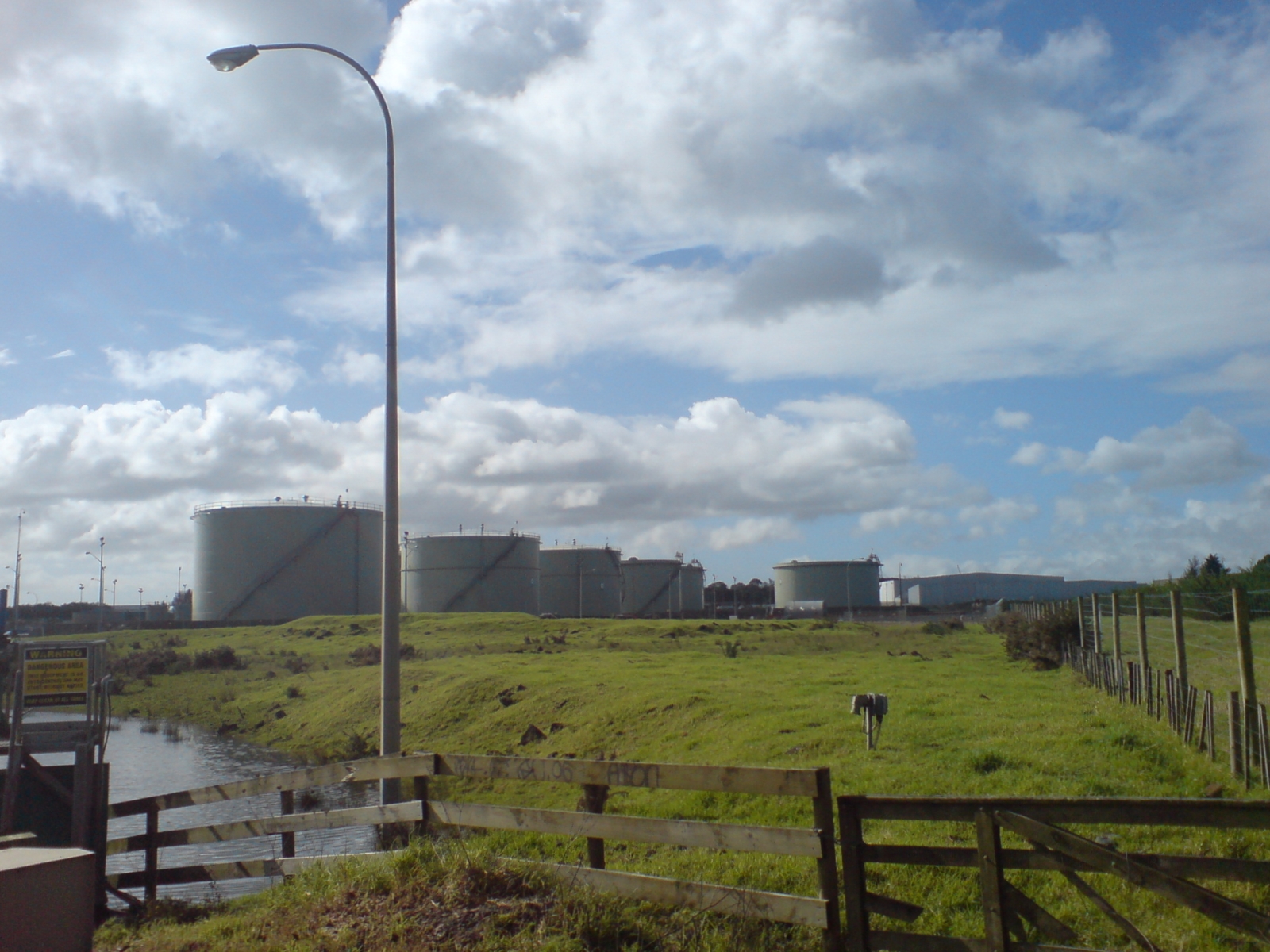
Two formulas carry most of the arithmetic in API 653: corrosion rate and remaining life. Learn them, then practice them on ugly inputs, because the exam rarely hands you tidy ones.
Every number below is made up for practice. The formulas and the rules around them come from API’s body of knowledge.
Which API 653 formulas do you have to know?
The body of knowledge gives them in plain form. Corrosion rate equals t previous minus t actual, divided by the years between the two readings. Remaining life in years equals t actual minus t minimum, divided by the corrosion rate. Here t previous is the thickness recorded at the same location as t actual during an earlier inspection, and t minimum is the minimum allowable thickness for that location or component.
API adds one condition that matters: these formulas, and the rules for setting inspection intervals, may be closed-book. Other formulas are different. The maximum fill height formula, and the bottom plate formulas for minimum remaining thickness at the next inspection and for the maximum period of operation, will be provided in the exam. You are not expected to rearrange the t min formula yourself.
So the plan is simple. Memorize two short formulas. Practice the rest by choosing the right inputs.
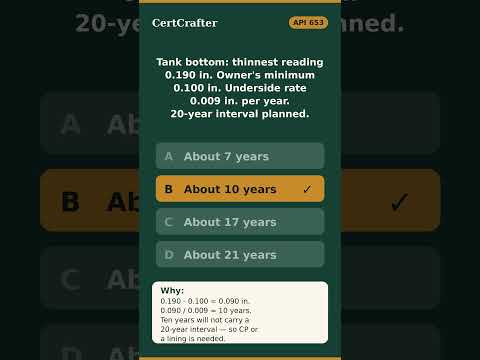 API 653 — Settlement, thickness, interval — one calculation, one number. Watch on YouTube · CertCrafter
A short video on the same idea, one calculation giving one number, is on the channel: API 653 settlement, thickness, interval.
Worked example: two spots on one shell course
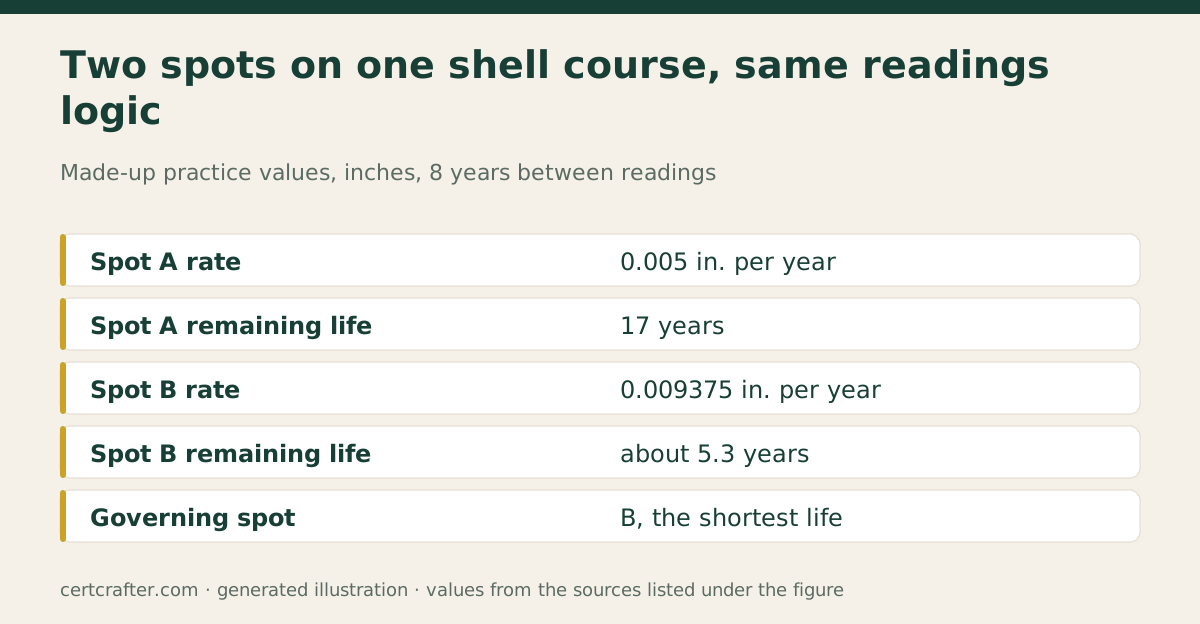
Two thickness readings were taken at each of two spots on the same shell course, 8 years apart. The earlier reading at both spots was 0.375 in. The minimum allowable thickness for the course came out of the shell calculation at 0.250 in. The new readings are 0.335 in. at spot A and 0.300 in. at spot B.
- Metal loss at A:
0.375 - 0.335 = 0.040in. At B:0.375 - 0.300 = 0.075in. - Corrosion rate at A:
0.040 / 8 = 0.005in. per year. At B:0.075 / 8 = 0.009375in. per year. - Remaining corrosion allowance at A:
0.335 - 0.250 = 0.085in. At B:0.300 - 0.250 = 0.050in. - Remaining life at A:
0.085 / 0.005 = 17years. At B:0.050 / 0.009375 = 5.33years.
Spot B governs. It lost nearly twice as much metal and it has less allowance left, so its life is about a third of spot A’s. Averaging the two spots would give a comfortable number that neither spot deserves.
How does the same problem look in SI units?
Same method, different numbers. A tank built to metric dimensions has a shell location that read 9.5 mm five years ago and reads 8.3 mm today. The minimum allowable thickness is 6.0 mm.
- Metal loss:
9.5 - 8.3 = 1.2mm. - Corrosion rate:
1.2 / 5 = 0.24mm per year. - Remaining corrosion allowance:
8.3 - 6.0 = 2.3mm. - Remaining life:
2.3 / 0.24 = 9.58years.
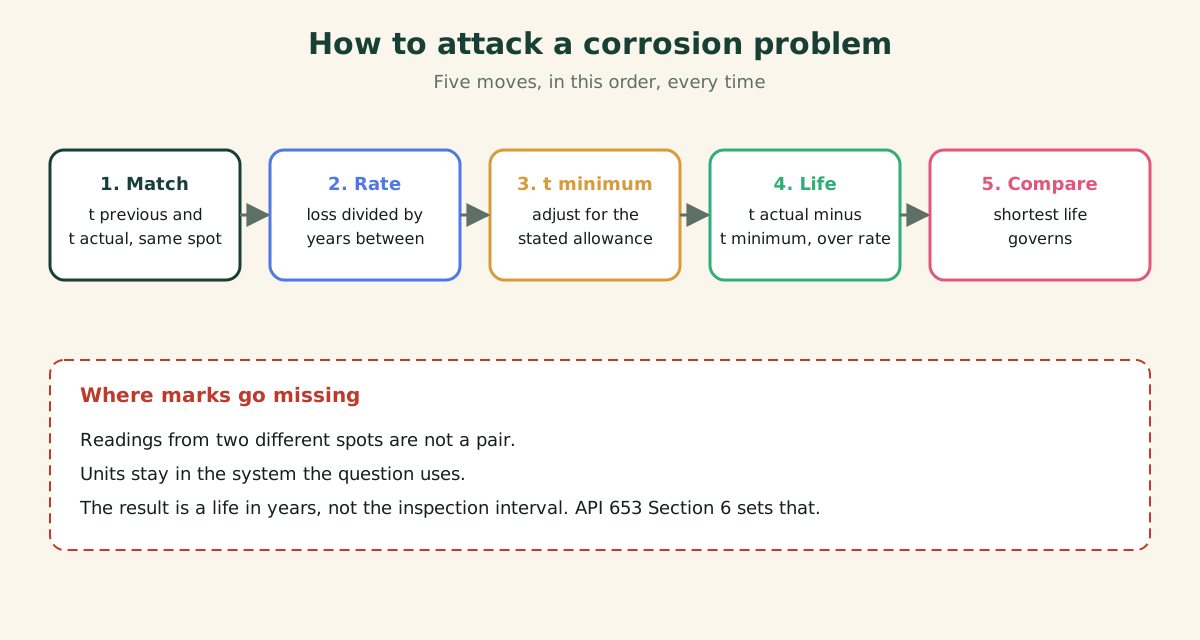
Nothing changed but the unit. The body of knowledge says to work in the unit the question uses, and it warns that some tables exist in only one unit system. When a table is printed in inches and your readings are in millimeters, you convert the readings to the table’s system and finish the entire evaluation there. The US customary and SI values in API standards are parallel sets, not exact conversions of each other, so switching halfway produces an answer that belongs to neither.
What do inspectors do with these numbers on site?
The arithmetic is the small part. A crew shoots ultrasonic thickness readings across shell courses and the bottom, and someone has to decide which readings are comparable. A rate is only as honest as the two readings behind it. If the old grid and the new grid do not line up, you do not have a pair, and a calculated rate from them is noise.
Then comes the judgment the exam squeezes into one question. Which location governs? In the example above the answer was spot B, and in the field it is usually the thin patch, not the course average. A tank with a healthy average and one hot spot still has a short remaining life.
Records matter as much as readings. The previous thickness is only as good as the file it came from, and old tanks often have thin files. When an inspector cannot support a previous reading, the honest move is to say so in the report and set up a new baseline, not to borrow a number from a neighboring plate.
Why is the answer in years not the inspection interval?
This is the most common slip on a calculation question. Fourteen, seventeen or five years of remaining life is a result of your arithmetic. The inspection interval is set by the rules in API 653 Section 6, and the body of knowledge lists the interval as its own category next to remaining life. A question can ask for either, and the distractors are built so a candidate who stops at remaining life picks the wrong option.
Treat the chain as five steps. Match the readings, work out the rate, settle on t minimum, work out the life, then apply the interval rules the question points to.
What changes when a corrosion allowance is in play?
The body of knowledge says the inspector should be able to compensate for the corrosion allowance, adding or subtracting based on requirements from the exam problem. It does not say which way. The problem text does.
Take the first example again, with a location at 0.440 in. now, a rate of 0.010 in. per year, and a shell calculation giving 0.300 in. If the problem tells you to hold back a 0.030 in. allowance, your working t minimum becomes 0.330 in.
- Remaining corrosion allowance:
0.440 - 0.330 = 0.110in. - Remaining life:
0.110 / 0.010 = 11years.
Without the allowance the same location shows 0.140 / 0.010 = 14 years. Three years vanished because of one added line. Read the stem twice before you pick up the calculator.
Where do candidates go wrong in the exam?
Wrong pairing is first. Corrosion rate uses t previous and t actual. Remaining life uses t actual and t minimum. Mix them and you still get a clean number, and the options often include exactly that clean wrong number.
Second is unit mixing, covered above. Third is stopping at remaining life. Fourth is time. The closed-book part gives 110 questions in 2 hours 45 minutes, about a minute and a half each, so you want the shape of the answer before you touch the calculator.
Fifth is studying calculations the exam leaves out. API lists required thickness for wind, earthquake and small internal pressures, nozzle loads, flange calculations, venting, ladders and stairways, grillage bottoms and the variable point method as items you will not be asked to calculate. Skip them.
Two free questions fit this topic. One is a course 1 job on a shell nozzle and a corroded plate replacement. The other is a lap patch for a tank bottom, where the weld and plate details have to be checked against each other.
What should you do next?
Write ten corrosion problems of your own with messy inputs: a millimeter reading against an inch table, an allowance to add, a previous reading taken from the wrong spot. Solve each one in under two minutes. The March 12 to April 2, 2027 window closes for applications on January 7, 2027, so there is time to run it a few times.
For graded practice, the full API 653 bundle marks every calculation item closed-book or open-book as the exam splits them, and the free quiz is a quick sample. The API 653 product page holds the exam facts and the guides hub lists the rest. To see the same formulas in context, read API 653 tank calculations, and for the vocabulary behind them, the tank calculation terms page.
Comments
Comments are read by a person before they appear. How we moderate.