Open the API 653 body of knowledge and the first domain is calculations. It lists 15 types, from corrosion rates to lap patch plates, and it says plainly that the questions are about existing tanks, not new ones. That one sentence cuts the workload. You are not designing a tank. You are checking whether a tank that has been in the ground for thirty years can keep holding product.
This page covers the concept behind the math, how inspectors use it on a site, and where candidates lose marks.
What does the calculations domain of API 653 cover?
It is domain I, titled Calculations and Tabular Evaluations for Evaluating Thickness Measurements, Weld Sizes, and Tank Integrity. API’s list, in its own order:
| Category | What you determine |
|---|---|
| Corrosion rates and inspection intervals | Metal loss, corrosion rate, remaining life, remaining corrosion allowance, interval |
| Joint efficiencies | Joint type, radiography extent, the factor E from the tables |
| Maximum fill height | Hydrostatic test height, localized or whole shell course |
| Weld sizes for shell and roof openings | Sizes and spacing, read from API 650 and API 653 figures and tables |
| Hot tapping | Requirements and minimum spacing to an existing nozzle |
| Settlement evaluation | Edge, near-shell and remote bottom settlement |
| Number of settlement points | Survey points for the settlement check |
| Impact testing | Design metal temperature, material group, whether testing is required, whether values pass |
| Existing shell minimum thickness | Allowable stress, E, liquid height, minimum acceptable thickness |
| Reconstructed shell minimum thickness | Design and hydrostatic test conditions |
| Corroded area | Minimum thickness, critical length, average thickness |
| Pitting | Maximum pit depth, pit length in any 8 in. of vertical length |
| Bottom plate minimum thickness | Minimum remaining thickness, maximum period of operation |
| Replacement plates | Minimum dimensions |
| Lap welded patch plates | Minimum thickness, weld size, allowable patch size |
Notice how many rows are lookups. Joint efficiency, weld sizes, impact testing, settlement points: those are tables and figures, not algebra. The domain is as much a reading test as a math test.
How do corrosion rate and remaining life work?
Start with the idea. Steel thins. If you measured the same spot twice, the difference over the years between the readings tells you how fast it is going. Divide what is left above the minimum allowable thickness by that speed and you have the years remaining.
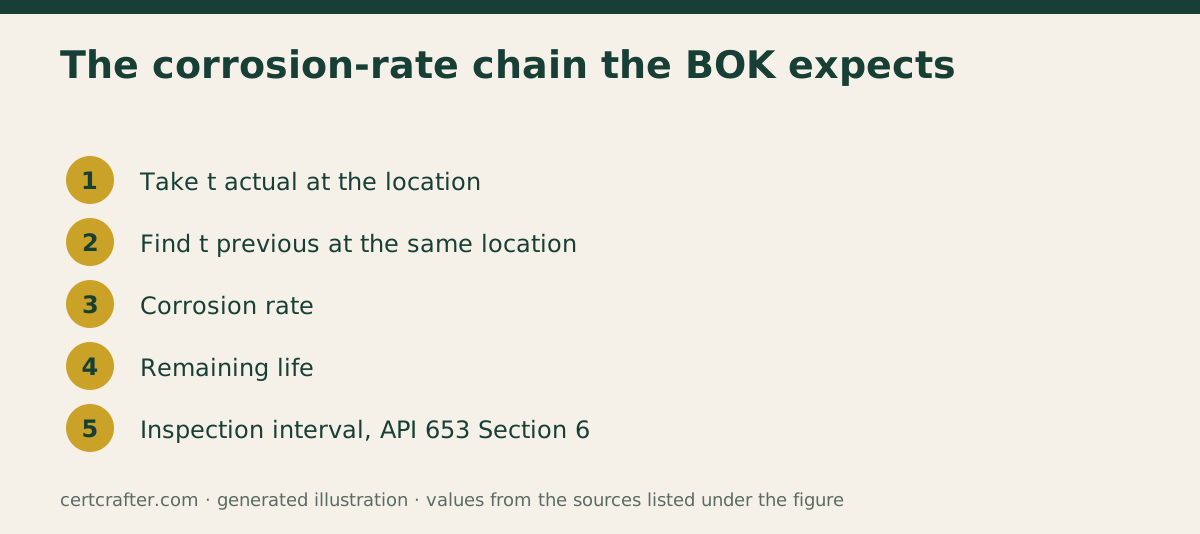
API’s body of knowledge gives the two formulas. Corrosion rate is t previous minus t actual, divided by the years between them. Remaining life is t actual minus t minimum, divided by the corrosion rate. The catch sits in the definition of t previous: it must be the reading taken at the same location as t actual. Two readings from two different spots tell you nothing about a rate.
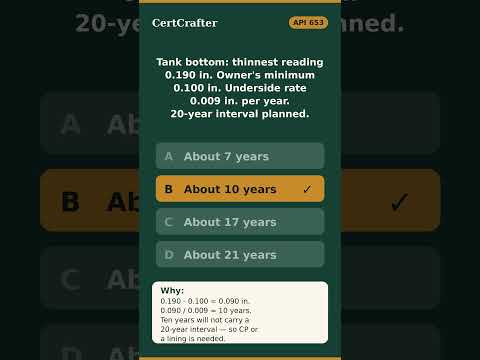 API 653 — Settlement, thickness, interval — one calculation, one number. Watch on YouTube · CertCrafter
If you prefer to watch it done, the channel has a short on the settlement, thickness and interval calculation.
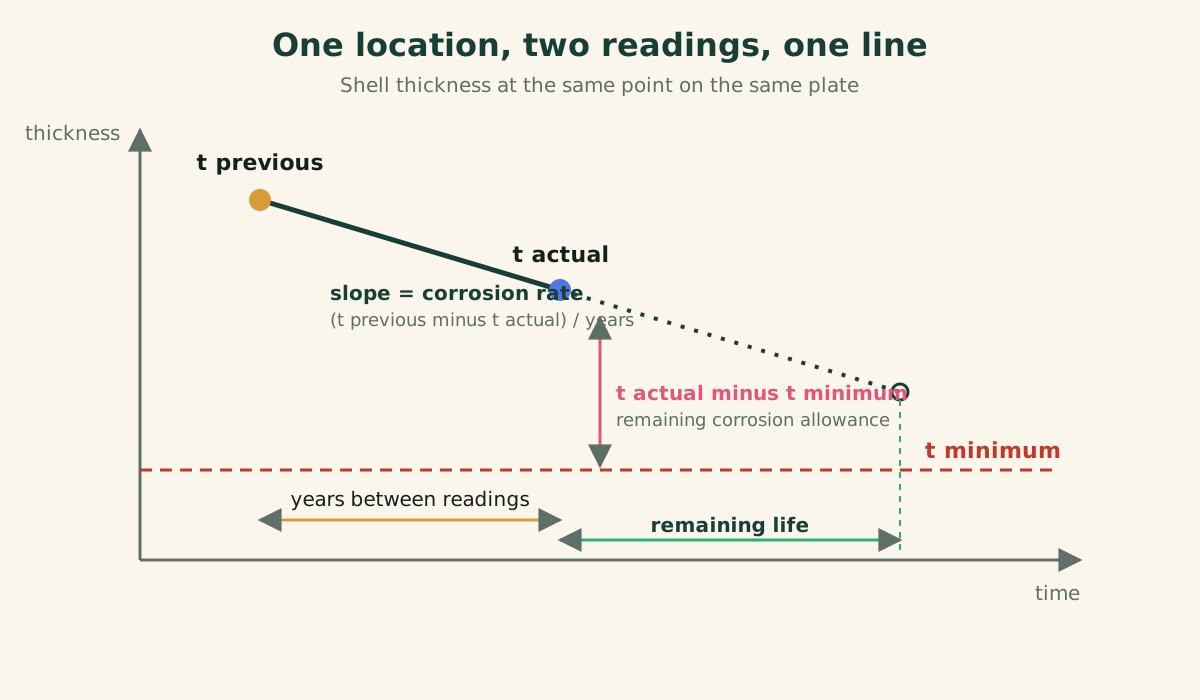
Worked example: remaining life of a shell course
These figures are made up for practice. Take one location on a shell course. The earlier reading was 0.500 in., the new reading is 0.440 in., and the two inspections were 6 years apart. The minimum allowable thickness for that location came out of your shell calculation at 0.300 in.
- Metal loss:
0.500 - 0.440 = 0.060in. - Corrosion rate:
0.060 / 6 = 0.010in. per year. - Remaining corrosion allowance:
0.440 - 0.300 = 0.140in. - Remaining life:
0.140 / 0.010 = 14years.
The arithmetic took ten seconds. What the exam checks is the setup. A question might hand you five readings and two thicknesses and ask which pair belongs in the formula. Another may give a corrosion allowance and ask you to add or subtract it before you start, which the body of knowledge says to do “based on requirements from the exam problem.”
And fourteen years is not the interval. API 653 Section 6 sets the rules for inspection intervals, and those rules, not your division, decide when the tank gets looked at again.
What do inspectors actually do with these numbers?
On a site, the math starts weeks before anyone opens a book. A crew takes ultrasonic thickness readings across the shell courses and the bottom. Somebody has to decide which readings are comparable, because a rate is only as honest as the two points behind it. A reading taken on a new grid next to a reading on the old grid is not a pair.
Then comes the part the exam compresses into one question: the inspector picks the governing location. A shell course with plenty of metal on average can still fail on one thin patch, and the patch decides the outcome. That is why the corroded area category asks for t2, the critical length, and the average thickness t1 of the area, and why the pitting category treats pits separately from general loss.
Joint efficiency is the field detail most likely to be skipped. The factor E depends on the joint type and the extent of radiography done when the tank was built. If the file is missing, as in the old tanks many owners run, the inspector has to establish what can be supported from the records rather than assume the best. The free bottom lap patch question in the sample set tests a related field call, where two separate findings are rejectable.
Which formulas does the exam give you?
The body of knowledge is specific. The maximum fill height formula, for a localized corroded area or an entire shell course, will be provided, and the inspector is not expected to rearrange the t min formula to get it. The bottom plate formulas for minimum remaining thickness at the next inspection and for maximum period of operation are provided too.
Corrosion rate and remaining life are the two to know cold; API says the formulas and the interval rules “may be closed-book.” The API 653 tables marked with an asterisk, among them the joint efficiency tables 4.2a and 4.2b and the bottom thickness tables, must be answerable without the documents.
So split your study. Memorize two short formulas and the starred tables. Practice the rest on screen, where the references appear as PDFs, because the exam is 110 closed-book questions followed by 60 open-book ones, and the open-book half is where table and figure lookups live.
Where do candidates lose marks on tank calculations?
Units come first. The body of knowledge notes that tanks are built in US customary or SI units, that you must work in the unit the question uses, and that some tables are printed in only one of them, API 653 Tables 4.1a and 4.1b among them. The two sets are parallel, not exact conversions of each other. One of the free questions turns this into a scenario: field readings in millimeters, a table in inches. The answer is to convert to the table’s unit and finish the whole job in that system.
Second, the wrong input. Remaining life uses t actual and t minimum. Corrosion rate uses t previous and t actual. Put t minimum into the rate formula and you get a clean number that is wrong, and the distractor options are usually built from exactly that slip.
Third, studying the wrong standard. API 653 leans on API 650 for construction details, and the March 2027 sheet lists API 650 in its 14th Edition. Notes written for API 510 will send you to ASME Section VIII calculations that are not on this exam.
Fourth, time. At 110 questions in 2 hours 45 minutes, a closed-book calculation gets a minute and a half. Know the shape of the answer before you pick up the calculator.
What should you study first?
Work through the eight exclusions so you stop worrying about wind loads and venting. Then take the two formulas and do ten corrosion problems with deliberately messy inputs: mixed units, a corrosion allowance to add, a previous reading from the wrong spot. After that, rehearse the lookups: joint efficiency, impact testing, settlement points.
When you want a graded check, the full API 653 bundle has the calculation items marked closed-book or open-book as the exam splits them, and the free quiz is a quick sample. The API 653 product page holds the exam facts, and the guides hub lists the rest. For the editions your calculations must match, read the March 2027 changes and the free practice questions.
Comments
Comments are read by a person before they appear. How we moderate.