Most API 653 mistakes are not about hard physics. They are about reading the wrong page, using the wrong number, or studying the wrong book. Here are ten, each with the fix, and each tied back to what API itself says about the exam.
Some are exam habits. Some are things tank inspectors get wrong on a site, and the exam copies them because it is built from the same body of knowledge.
Why do notes written for API 510 or API 570 hurt you here?
This is mistake one, and it is the costly one. The effectivity sheet lists the publications behind the API 653 exam: RP 571 (only ten named mechanisms), RP 575, RP 576 (two sections), RP 577, API 650, RP 651, RP 652, API 653 itself, and ASME Section V and Section IX. ASME Section VIII is not on the list.
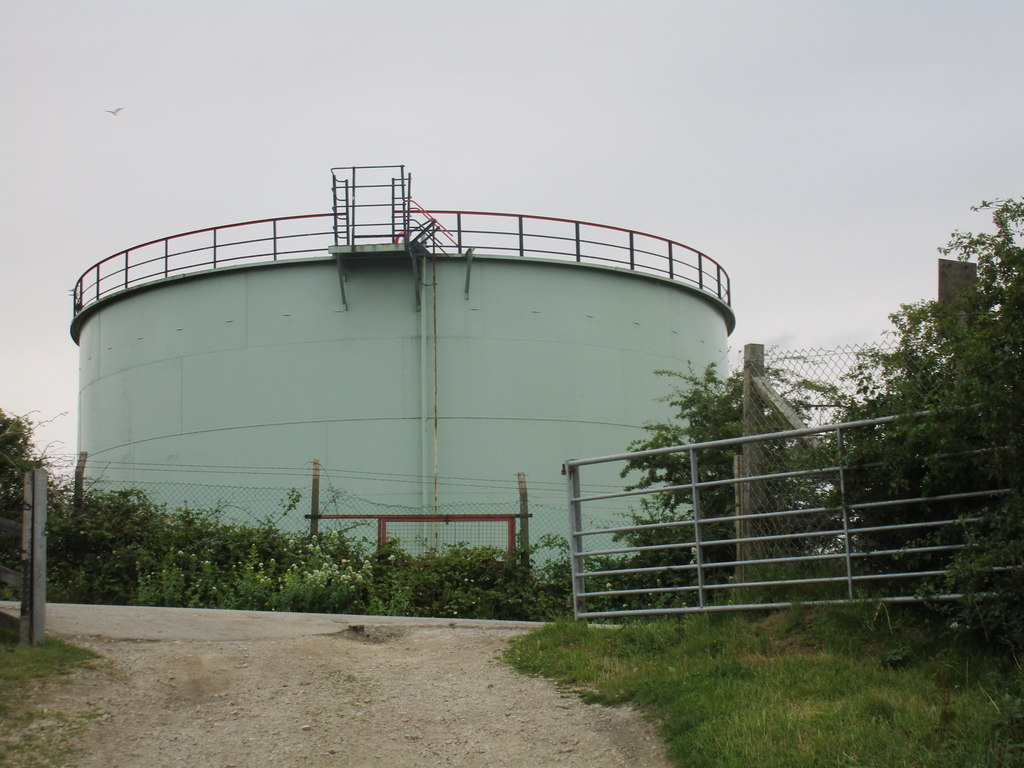
On a site, a pressure vessel inspector and a tank inspector look at different things. A vessel lives by design pressure and Section VIII. A tank is atmospheric or low-pressure, built to API 650, and judged on shell courses, bottoms, settlement and roofs. Notes from the other exams send you to calculations the tank exam never asks.
The fix: build your reading list from the sheet, line by line, and delete everything else.
Which edition does the exam use?
Mistake two is trusting the edition you work with every day. The body of knowledge says some organizations and jurisdictions operate on other documents or editions, and then states flatly that the exam is based on the editions in the effectivity sheet.
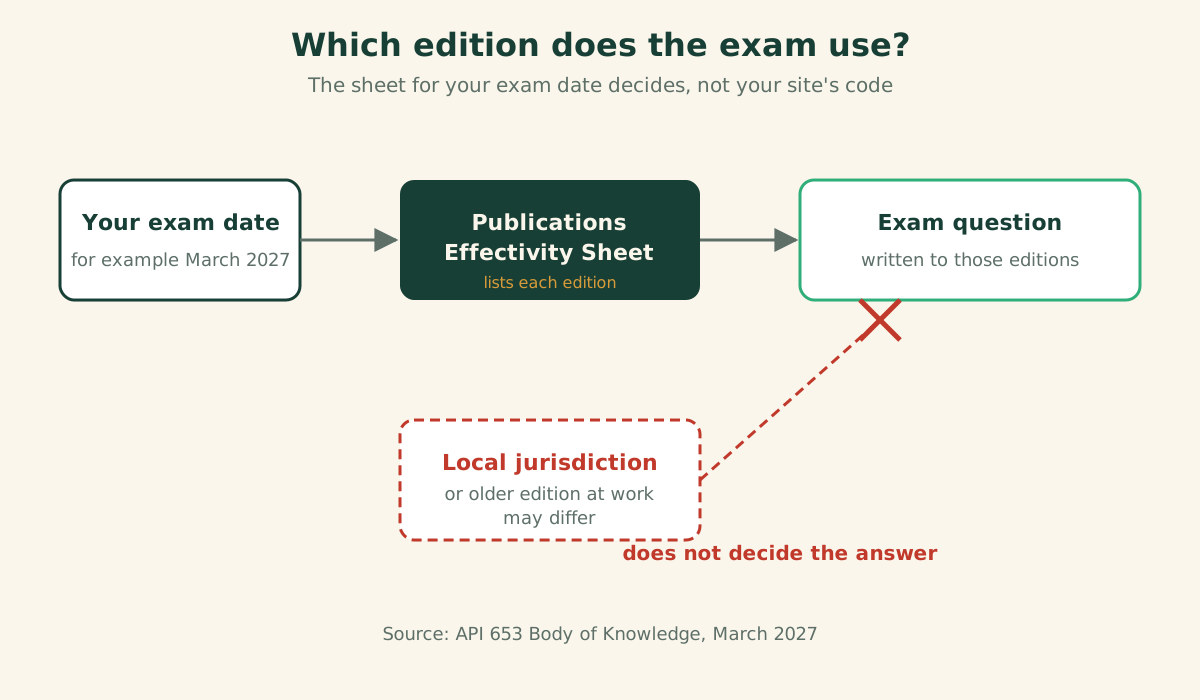
For windows from March 2027, the sheet lists API 650 in its 14th Edition of August 2025 and API 653 with Addenda 1 to 4. A tank inspector who still works from an older API 650 at the plant will feel the difference on the table lookups. Do the study from the sheet and keep your plant habits for the plant.
Is there a percentage you must reach?
Mistake three: chasing a number API does not publish. The product data for this exam records the pass standard as a scaled 400 on a 200 to 500 scale. The most recent pass rate there is the November 2025 administration, 503 candidates at 60.8%.
Forums throw out 70% and 80% as if they were rules. They are guesses. Aim for strength in every domain rather than a cut line you cannot verify. A weak domain I, calculations, is the quickest way to sink a score.
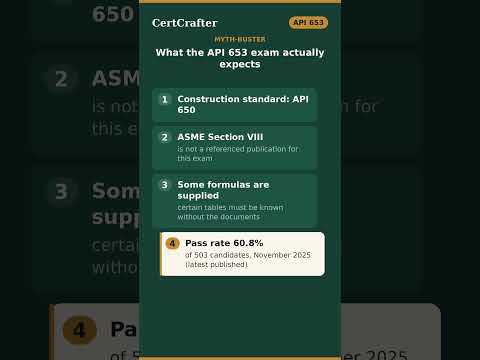 API 653 — Myth: API 653 is only for crude oil storage. Watch on YouTube · CertCrafter
If you want a quick reset on a common myth, the channel has a short on the belief that API 653 is only for crude oil storage.
Why do two thickness readings from different spots give a wrong answer?
Mistake four sits inside the first formula in the body of knowledge. Corrosion rate is t previous minus t actual, divided by the years between them, and t previous must be the reading at the same location as t actual. Remaining life is t actual minus t minimum, divided by that rate.
On a job, thickness grids get redone. A new grid next to the old one tempts you to pair the nearest numbers. The exam writes distractors from exactly that slip.
Worked example: the wrong pair adds eight years
These figures are made up for practice. Point 1 reads 0.420 in. today. Six years ago the same point read 0.480 in., while a neighboring point, point 2, read 0.455 in. The minimum thickness at point 1 is 0.300 in.
- Correct rate:
(0.480 - 0.420) / 6 = 0.010in. per year. - Correct remaining life:
(0.420 - 0.300) / 0.010 = 12years. - Wrong rate, using point 2 as t previous:
(0.455 - 0.420) / 6 = 0.0058in. per year. - Wrong remaining life:
0.120 / 0.0058is about20.6years.
A pairing slip turned 12 years into almost 21. In the field that error means a tank stays in service past its safe life. On the exam it is just the wrong option, and it is always on the list.
Do you work in the unit the question uses?
Mistake five. The body of knowledge says tanks are built in US customary or SI units, and you must calculate in the unit the question references. Some tables appear in only one unit, and Tables 4.1a and 4.1b are named as an example. Where possible the question gives both units, but not always.
Pick the unit at the start, convert every input once, and finish in that system. Converting halfway through is how a clean answer lands two options away from the right one.
Are you studying topics the exam leaves out?
Mistake six is wasted hours. The body of knowledge lists calculations candidates will not be expected to know: wind, earthquake and small internal pressure thickness; nozzle calculations for external loads; flange calculations; brazing; venting; ladders and stairways; bottoms supported by grillage; variable point method. It also excludes whole annexes of API 650, including Annexes D, E, F and J.
Inspectors do meet these items on a site. The exam says you will not be asked. Spend those hours on the five domains and on the starred tables, which the body of knowledge says you may need without the documents.
What goes wrong with welding records?
Mistake seven. Weld procedure review in this exam is limited to SMAW or GMAW, one process per document, one filler metal per process, and P-No. 1 base metals. Within that scope you must know that a procedure qualification record states the values actually used on the test coupon, while ranges belong on the welding procedure specification. The free question on a record showing ranges tests exactly that confusion.
The second welding trap is consumables. Low-hydrogen electrodes such as E7018 take on moisture in the open, and that shows up as porosity and delayed cracking. The other free question here sets it on a tank shell plate replacement. A radiograph that looks clean on the day does not prove the cracking is absent. Read both explanations before you decide you know this domain.
Do you treat RP 575 like a rulebook?
Mistake eight. The body of knowledge warns that API RP 575 contains many general statements that are not strict requirements, with phrases such as “it is best to” or “an inspector would normally.” Questions drawn from it ask for the best answer among those given.
Candidates trained on codes with “shall” look for the hard rule and distrust the softer option. On these items the softer, practical choice is often the answer. Practice choosing the most sensible inspector action, not the strictest.
Can you spend your time well on a split exam?
Mistake nine is poor pacing. API describes a 7.5 hour day: 110 closed-book questions in 2.75 hours, a 45-minute lunch break, then 60 open-book questions in 3.75 hours. Of the 170 questions, 140 are scored and 30 are pretest.
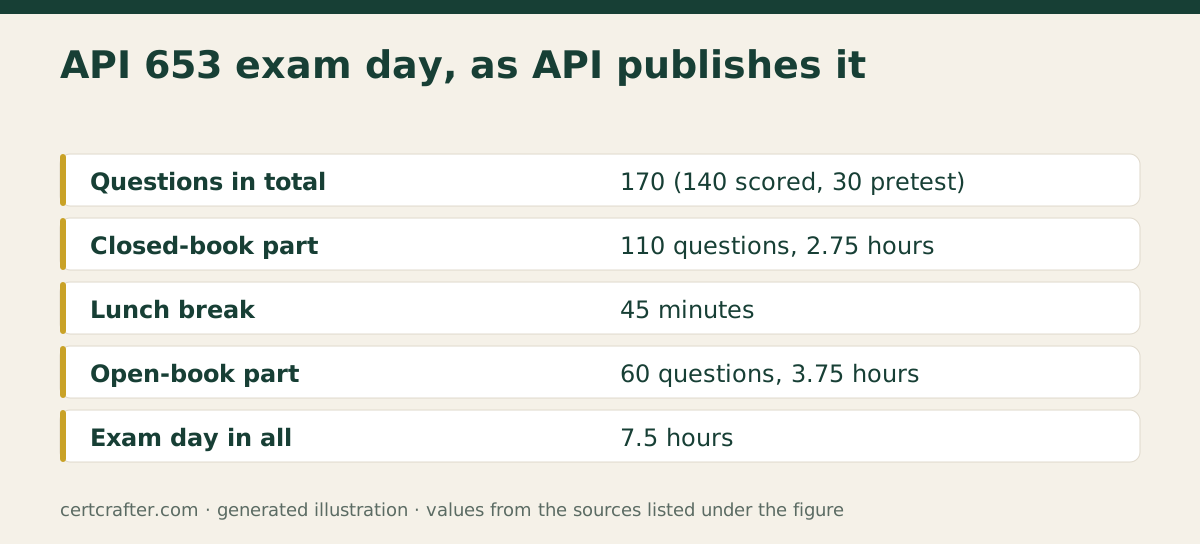
Pretest items are not marked, so answer all of them. The closed-book part leaves about a minute and a half a question. Do not burn five minutes on one hard calculation there. Save the long lookups for the open-book part, and practice them on screen, since the documents appear as PDFs and paper books are not allowed in the center.
Have you checked eligibility and deadlines?
Mistake ten has nothing to do with tanks. The experience must be documented on the application, gained in the last 10 years, and verified afterward. A bachelor’s degree in engineering or technology needs 1 year in supervision or performance of inspection activities. A high school diploma needs 3 years in tank work, including one in inspection.
Then the calendar. The March 2027 window runs March 12 to April 2, with an application deadline of January 7, 2027. The July 2027 window closes for applications on May 6, 2027. Initial certification for 653 is $890 for API members and $1,140 for non-members in the 2027 fee schedule, a reschedule costs $350, and a late application adds $200. Missing a deadline by a day can cost you a full window.
Once certified, the term is three years. Renewal needs at least 20% of your time on tank inspection work and 24 hours of continued professional development.
What should you do next?
Take the ten mistakes and mark the ones you have already made, in practice or on the job. Fix the reading list first, then the unit habit, then the pairing check. After that, run a timed set and see where the minutes go.
The API 653 product page holds the exam facts, and the guides hub lists every topic. For a graded check, use the full practice test bundle or the free quiz. To tighten the calculations, read API 653 tank calculations, and for the editions, the March 2027 changes.
Comments
Comments are read by a person before they appear. How we moderate.