API 653 Practice Questions, Set 2 (Free)

By Sandeep Bandyopadhyay, Senior aerospace engineer · PMP, MBA, Six Sigma

TL;DR

Set 2 gives you three free API 653 sample questions with full explanations: a procedure qualification record that shows ranges, an image quality indicator placed on the film side, and an old tank with a thin file. Each is about paperwork an inspector must refuse or rebuild. The exam has 170 questions, 140 scored, split 110 closed-book and 60 open-book. March 2027 runs March 12 to April 2.

Original questions, not exam dumps. Every CertCrafter question is written from the published body of knowledge and the referenced codes. None is copied from a live exam, and CertCrafter is independent: not affiliated with or endorsed by any awarding body.

Most inspectors don’t lose a tank file to a bad calculation. They lose it to a document that looked fine, a film that was missing one small marking, or a gap nobody wrote down. Set 2 is built around that.

The three questions further down this page are original and come with full explanations behind a toggle. Commit to an answer before you open one. If you want the exam structure and the code editions first, Set 1 covers them in API 653 Practice Questions (Free, With Explanations), so this page doesn’t repeat it.

What is an inspector actually checking in a weld procedure package?

Three documents, and they do different jobs. The welding procedure specification, the WPS, tells the welder what he may do: ranges for the variables, the process, the filler. The procedure qualification record, the PQR, is the evidence that one particular set of conditions produced a sound test coupon. The welder performance qualification, the WPQ, shows that a named welder can make that weld.

The body of knowledge states what you must be able to do with them. You must judge whether the procedure and qualification records comply with ASME Section IX and any extra API 653 rules. You check that the essential and non-essential variables are addressed. The mechanical tests on the PQR have to be the right ones, with acceptable results. And the welder has to be qualified to make a production weld to the WPS. And know that the WPS must reference its PQR, and that the PQR must be signed and dated.

On site this is a desk review that takes ten minutes and prevents a repair from being cut out later. The usual mistake in the field is accepting a package because the contractor’s QA stamp is on it. The stamp tells you someone read it. It doesn’t tell you the values are the ones used on the coupon, and a record reissued under a new date proves nothing new.
Oil storage tanks standing in a row at a terminal, seen from a nearby road
Photo: Oil storage tanks - geograph.org.uk - 2184845 by Hugh Venables (Wikimedia Commons), CC BY-SA 2.0, via Wikimedia Commons.

Why can’t a PQR show ranges?

Because it’s a record of what happened, not a permission. If the coupon was welded at one preheat and one thickness, the record has to say so, along with the test results. A range on the record erases the link between those results and the conditions that produced them.
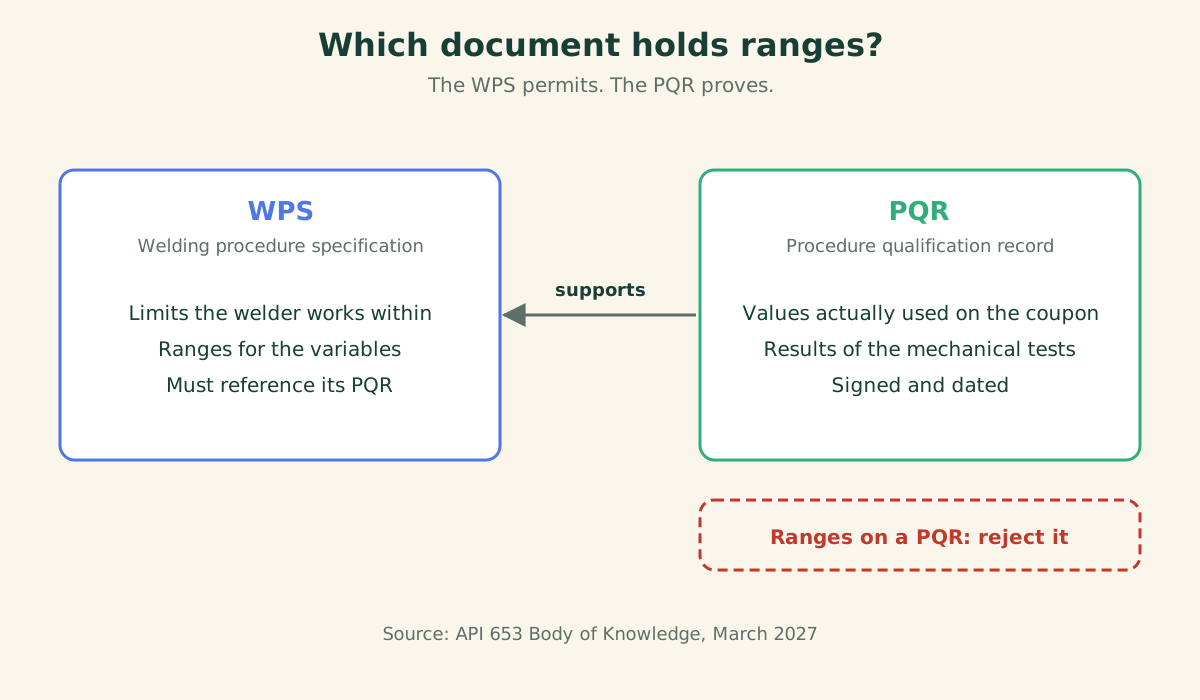
Two boxes: the WPS holds ranges the welder works within and references its PQR; the PQR holds the values actually used on the coupon, the mechanical test results, and a signature and date; a PQR showing ranges is rejected
Which document holds ranges, and which holds the actual values. Illustration: CertCrafter, from API 653 Body of Knowledge, March 2027.

The exam-day trap is the answer that sounds tidy: repeat the same ranges on both documents. It reads like consistency. It is the wrong way round. Another trap is mixing up the two kinds of variable. A change in a non-essential variable means the WPS gets revised. A change in an essential variable is what forces new qualification and new testing.

One boundary helps you study, and it saves hours. The exam’s weld procedure review covers only SMAW or GMAW, one process per document, one PQR supporting the WPS, and base metals limited to P-No. 1. Dissimilar metal joints, overlays, special processes, heat treatment entries and Charpy requirements are excluded. Time is better spent on the closed-book ground, where 110 of the 170 questions sit.
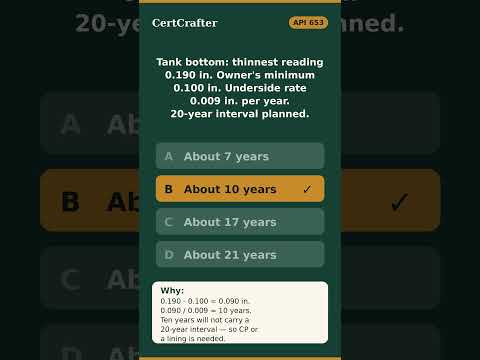
Video: API 653 — Settlement, thickness, interval — one calculation, one number. API 653 — Settlement, thickness, interval — one calculation, one number. Watch on YouTube · CertCrafter
Image: video thumbnail, source: CertCrafter on YouTube (@certcrafters).

What does the inspector look for on a radiograph?

Section V, Article 2 is where radiography sits, and the body of knowledge points at the rules as typically applied to butt-welded tank seams: required marking, the type, selection, number and placement of image quality indicators, allowable density, control of backscatter, location markers, and records.

The wording of the exam question matters here, because the answer options are written to sound reasonable to someone who has seen a film but never reviewed one. Here is the plain version. An image quality indicator, the IQI, is the piece of wire or plaque on the film that shows the technique was sensitive enough to see what matters. Normally it sits on the source side. On a tank shell you can’t always get inside, so the IQI goes on the film side, and the film has to say so. A lead letter F next to the indicator declares it. Without that, the person reviewing the film doesn’t know which sensitivity basis applies.

Candidates mix this up with the lead letter B. That one is the backscatter check on the back of the cassette, a different test with a different purpose. Learn the pair together: F tells the reviewer where the IQI was, B tells the reviewer whether scatter from behind is fogging the film.
Two oil storage tanks on a fenced pad in open prairie
Photo: Bernice 1 and 2 oil tanks - Arnegard North Dakota - 2013-07-04 by Tim Evanson (Wikimedia Commons), CC BY-SA 2.0, via Wikimedia Commons.

Which NDE articles are on the exam, and what else do they ask?

Five articles of ASME Section V, and each has a stated scope in the body of knowledge. The ultrasonic one is only the thickness-measurement standard, and the magnetic particle one is only yoke and prod techniques.
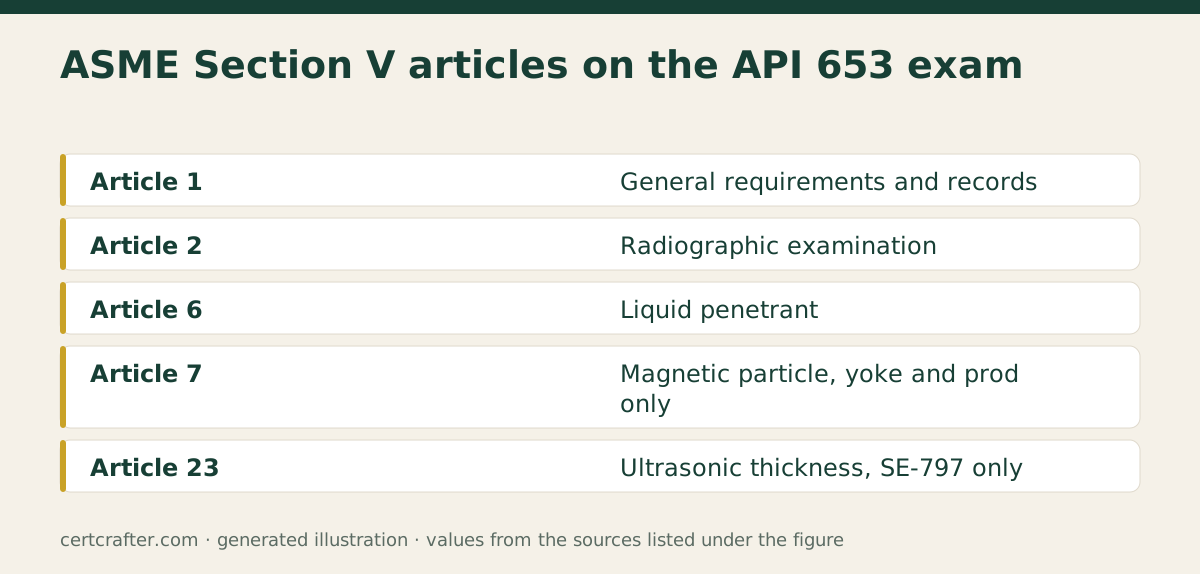
The five ASME Section V articles on the API 653 exam: Article 1 general requirements and records, Article 2 radiographic examination, Article 6 liquid penetrant, Article 7 magnetic particle yoke and prod only, Article 23 ultrasonic thickness SE-797 only
The Section V articles named in the body of knowledge. Illustration: CertCrafter, from API 653 Body of Knowledge, March 2027.

Liquid penetrant questions run on procedures, contaminants, technique, interpretation and documentation. Magnetic particle questions add calibration. Thickness questions follow the manual pulse-echo contact method. Each article also lists records among the things you must understand. That is the common thread of this set. NDE on a tank is only as good as the paper that says what was done, by whom, to which procedure.

What do you do when the tank file is thin?

Old tanks arrive with gaps. A tank built decades ago with no original drawings, no mill certificates and two recent reports is not unusual, and the question asks what the inspector should do about it.

Practice and exam agree on the direction. The owner or operator holds records for construction, inspection history and every repair or alteration, kept for the life of the tank. Where they’re missing, you don’t condemn the tank on paperwork alone and you don’t invent a grandfather clause. You rebuild the record: measure thicknesses, establish material properties by test or by documented assumption where testing isn’t practical, and write down the basis. The next inspector then has something traceable.

In practice the hard part is the discipline of writing the assumption down. A stamped nameplate with assumed data looks more complete than an honest gap, and that is exactly why it’s worse.

When is the next API 653 exam, and what does it cost?

Short version, from API’s schedule. The exam has 170 questions, of which 140 are scored, and the split is 110 closed-book and 60 open-book. For 2027:

Exam window Application deadline
March 12 - April 2, 2027 January 07, 2027
July 09 - 30, 2027 May 06, 2027
November 05 - 26, 2027 September 02, 2027

Initial certification in 2027 is $890 for API members and $1,140 for non-members, and a late application adds $200. Check the API 653 certification page and the schedules and fees page before you book.

How should you use Set 2?

Read the explanation for all three, including the one you got right. Then log each miss by section and by what went wrong: the document, the marking, or the record. Three questions can’t measure readiness, but they show a habit, and the habit of accepting paperwork at face value is the one this set is designed to catch.

For the working side of the job, the API 653 tank calculations guide and the March 2027 changes guide are the next reads. The free API 653 quiz gives you a scored ten-question sample, and the API 653 guide lays out a phased plan. When you’re ready for timed, full-length work, the practice test bundle has six tests in real exam order.

Try these free questions

  1. [Open book] A contractor submits a procedure qualification record for SMAW on A283 Grade C plate in which the preheat and thickness entries are shown as ranges rather than as the values actually used. What should the inspector conclude?

    1. Ranges may be shown on the qualification record provided the welding procedure specification repeats the same ranges.
    2. The actual values used while welding the test coupon must be recorded, since ranges belong on the procedure specification.
    3. Both essential and non-essential variables must appear on the record, each carrying the tolerance band used in production.
    4. The record may simply be reissued under a new date whenever a non-essential variable is changed in production.
    Show the answer and explanation

    Answer: B. A procedure qualification record is a record of what was actually done. It states the values of the essential variables used while the test coupon was welded and the results of the mechanical tests on that coupon, and it is certified by the organisation that did the work. Ranges belong on the welding procedure specification, which tells the welder the limits he may work within; putting ranges on the qualification record destroys the evidence that one specific set of conditions produced acceptable test results. The first option inverts the two documents. The third option adds a requirement that does not exist, since non-essential variables need not appear on the qualification record at all, only on the specification. The fourth option confuses the two kinds of variable: a change in a non-essential variable calls for the specification to be revised without requalification, while a change in an essential variable is what forces a new qualification record and new testing.

  2. [Open book] Radiographs of a butt welded replacement shell plate on T-411 were shot with the image quality indicator on the film side because the inside was not accessible. What must appear before the inspector accepts them?

    1. A lead letter B of the required size, since film side placement is verified through backscatter.
    2. Nothing further, because film side placement is assumed whenever the source side is inaccessible.
    3. A written waiver from the owner, after which the indicator may be omitted from that exposure.
    4. A lead letter F on or beside the indicator, with the indicator identity and essential hole or wire visible.
    Show the answer and explanation

    Answer: D. Film side placement of an image quality indicator is allowed where the source side is not accessible, but it has to be declared on the radiograph itself. A lead letter F, at least as large as the indicator identification numbers, is placed on or next to the indicator, the indicator identity and the essential hole or wire must both be visible on the film, and the technique record states the placement so the reviewer knows which sensitivity basis applies. The first option uses the letter B, which is the backscatter marker fixed to the back of the cassette and read as a light image when backscatter is present, a different check entirely. The second option assumes the placement is self-evident from geometry and leaves the film reviewer guessing. The third option offers an owner waiver, but nobody may waive the indicator, since without it there is no evidence of the required sensitivity. The films are rejected until the marking appears.

  3. The tank file for T-1075, built in 1968, has no original construction drawings, no mill certificates and only two inspection reports from the last decade. The owner asks whether the tank can stay in service without them. What should the inspector do?

    1. Condemn the tank, because a tank whose original construction records are missing cannot be evaluated for continued service and may not be refilled under any circumstance.
    2. Accept the gap and carry on, since the record keeping requirement reaches only tanks built after the construction standard was first issued in the form used today.
    3. Have the owner fit a replacement nameplate stamped with assumed design data, which then stands in place of the missing construction record for all later evaluations.
    4. Rebuild the record from what can be established, measuring thicknesses, sampling material properties where needed and documenting every assumption used, then keep that file for the life of the tank.
    Show the answer and explanation

    Answer: D. API 653 expects the owner or operator to hold records covering the tank's construction, its inspection history and every repair or alteration, and to keep them for as long as the tank is in service. Older tanks often arrive with gaps, and the accepted route is to reconstruct what is missing: establish current thicknesses by measurement, establish material properties by test or by documented assumption where testing is impractical, and record the basis so later evaluations rest on something traceable. The first option treats missing paperwork as a condemnation, which no part of the standard supports. The second invents a grandfather clause for older tanks and would leave a 1968 tank permanently outside the records requirement. The third option produces a nameplate that asserts data nobody has verified, which is worse than an admitted gap because it hides the uncertainty from the next inspector rather than documenting it.

Take the full free 10-question sample with scoring →

Frequently asked questions

What do the three questions in Set 2 cover?

They sit in three sections of the body of knowledge: welding on atmospheric tanks, nondestructive examination, and general practical knowledge. One asks what a procedure qualification record must show, one asks what must appear on a radiograph shot with the indicator on the film side, and one asks what to do about a tank with missing construction records.

Are these free API 653 sample questions different from Set 1?

Yes. Set 1 used three different questions and spent its text on exam structure and code editions. Set 2 uses three new ones and spends its text on the record-checking side of the job, which is where the welding and NDE sections of the exam concentrate.

Does API 653 test welding and NDE in depth?

It tests review, not performance. The body of knowledge asks the inspector to review a welding procedure specification, a procedure qualification record and a welder qualification, and to know the general rules of ASME Section V articles 1, 2, 6, 7 and 23. Weld procedure review is limited to SMAW or GMAW on P-No. 1 base metals.

Official sources

  1. API 653 Aboveground Storage Tank Inspector certification page — accessed 22 October 2026
  2. API ICP Schedules & Fees — accessed 22 October 2026
  3. API 653 Body of Knowledge, March 2027 — accessed 22 October 2026

Exam rules change. Check the awarding body's official page before you apply. CertCrafter is independent and is not affiliated with or endorsed by any awarding body.

Was this helpful?

Comments

    Comments are read by a person before they appear. How we moderate.