Most API 653 candidates start with the thickest document, read it front to back, and reach the open-book material with three weeks left and no practice at finding anything on a screen.
What does the API 653 exam ask of you, and in what order?
The fix is order. API built the exam from a body of knowledge with five domains and two sessions, and a plan that follows that structure wastes less of your evenings.
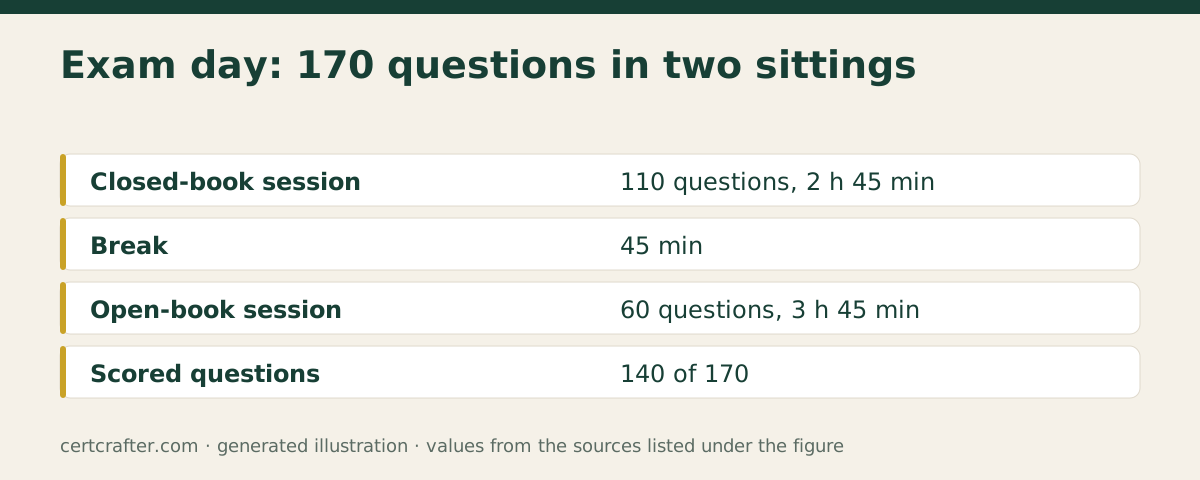
There are 170 questions, of which 140 are scored and 30 are pretest items. You will not know which is which.
| Session | Questions | Time |
|---|---|---|
| Closed-book | 110 | 2 hours 45 minutes |
| Lunch break | none | 45 minutes |
| Open-book | 60 | 3 hours 45 minutes |
Nothing can be looked up in the larger, closed-book half. The open-book session gives you about 3.75 minutes per question against about 1.5. The references appear as PDFs on your computer at the Prometric test center. Your tabbed paper copy of API 653 will not be there.
Which documents are you actually studying?
The March 2027 sheet lists API 571 (ten mechanisms only), RP 575, RP 576 (two sections only), RP 577, API 650 14th Edition, RP 651, RP 652, API 653 with its addenda, and ASME Section V and Section IX. The November 2026 window is the last one on the older sheet, so check which sheet your window uses before you buy anything.
The body of knowledge also tells you what to skip: wind, earthquake and small internal pressure thickness calculations, flange calculations, and structural calculations such as ladders and stairways. That is hours you can give back to something else.
Phase 1: how do you build the closed-book ground?
Start with the working knowledge an inspector carries around: inspection types, deterioration, repairs and alterations, reconstruction, records and reports. On a site, this is the conversation before the work. Is the plate replacement a repair, or does the new nozzle make it an alteration? Who signs the record?
Read RP 575 first, and read it for judgment. API says some questions use phrases such as “it is best to” or “an inspector would normally”, and in those you pick the best of the answers given. Candidates who study calculations first, because calculations feel like progress, meet 110 closed-book questions that are mostly judgment and definition.
Phase 2: what does the exam give you?
Before drilling any algebra, find out what you will not need to memorize. The body of knowledge states that the maximum fill height formula and the bottom plate formulas will be provided. The corrosion rate and remaining life formulas may be closed-book, so those two are yours to learn.
What the exam asks you to carry is the judgment around them. Is this reading t actual or t minimum? Does this rate govern, or another? You also need the tables marked with an asterisk, such as Table 6.1 on inspection frequencies, without the documents.
Our guide to what the calculations domain tests covers this phase in more detail, and the terms people mix up sorts the vocabulary.
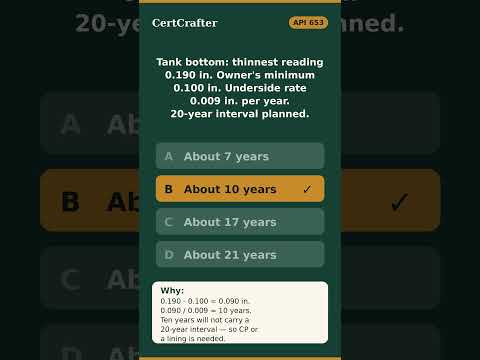 API 653 — Settlement, thickness, interval — one calculation, one number. Watch on YouTube · CertCrafter
The channel has a short that runs one calculation from settlement to thickness to interval.
Phase 3: how do you rehearse the open-book session?
Open-book does not mean easy. The question assumes you can find a requirement in a large document in a few minutes and apply it correctly. Work the lookups the body of knowledge names, such as the one-foot method and the Annex B settlement procedures, until you know which document and roughly which part to open.
Practise on screen, with search and bookmarks, and time yourself. An open-book question that takes eight minutes because you were hunting is a question you borrowed from the next ten.
What does a week-by-week plan look like?
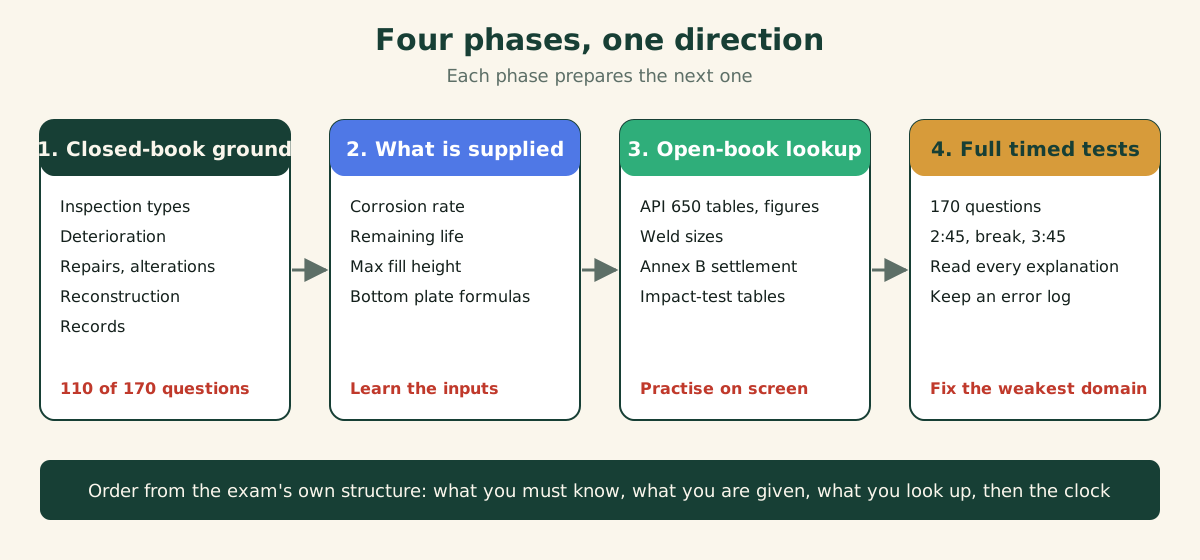
This is a suggested shape, not an API requirement. Count twelve weeks back from your window. Give roughly the first quarter to the closed-book ground, a short block to formulas and tables, then welding, NDE and open-book navigation. Keep the last two weeks for timed tests and for repairing whatever the error log shows.
If you also hold API 510 or 570, trim the opening phase, but remember that ASME Section VIII is not on this sheet. The API 653 Complete Exam Kit turns this shape into a 30-day plan and readiness tracker saved to your account.
Phase 4: how do you use timed tests and an error log?
Start timed tests earlier than feels comfortable. A full run teaches pacing in a way no reading can.
Keep an error log from the first test. For each miss, write the domain and the reason: a calculation slip, a requirement you did not know, or a field decision you called wrongly. After two tests the log shows a pattern. Review the questions you got right, too. A right answer reached by a lucky guess is a wrong answer waiting for the exam.
When should you apply, and who qualifies?
Application deadlines fall roughly two months before the window opens. For the March 12 to April 2, 2027 window, API’s schedule lists January 7, 2027.
With a BS or higher in engineering or technology you need one year of inspection experience as described in API 653. With no formal education you need five or more years.
What is a realistic target?
Passing is a scaled score of 400 on a 200 to 500 scale. API does not publish a raw percentage, so a plan built around “I need 70%” is built on a guess. The most recent published result is November 2025: 503 candidates at 60.8%.
What should you do next?
Pick your window, subtract twelve weeks, and write the dates down. Read the exam format and scoring guide, then start Phase 1 with RP 575.
In the timed phase, the full API 653 bundle marks questions closed-book or open-book, and the free quiz checks your starting level. The API 653 product page lists the exam facts, and the guides hub holds the rest.
Comments
Comments are read by a person before they appear. How we moderate.