Most API 653 candidates treat NDE as a memory test of three-letter methods. The exam writes it as a paperwork test: what must be on the film, the procedure or the record before the inspector accepts the work.
What does domain III of the API 653 exam actually cover?
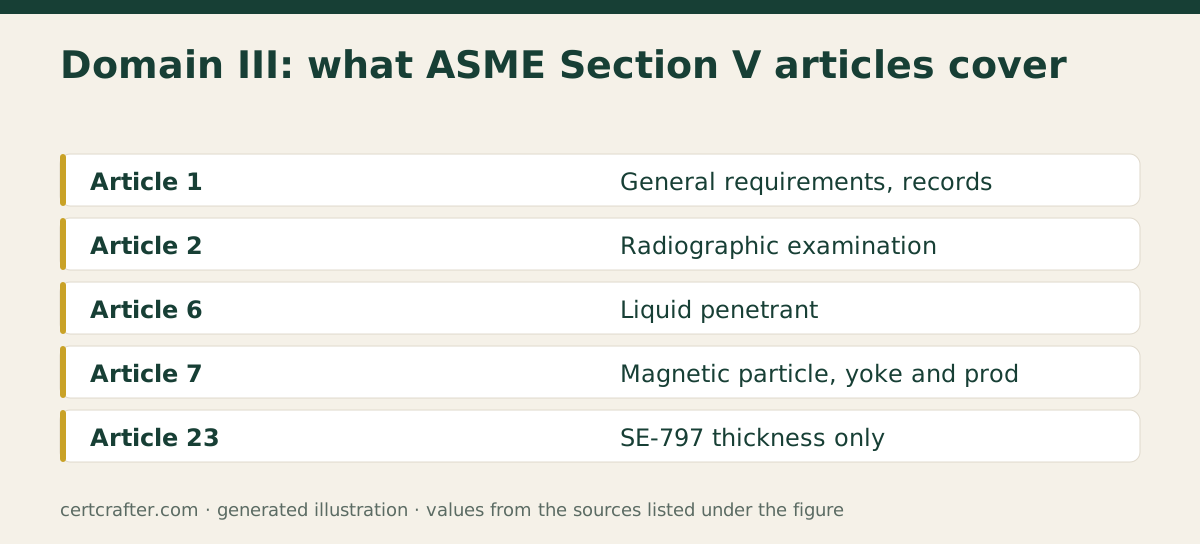
Domain III is nondestructive examination, and the body of knowledge names its sources precisely. Five articles of ASME Section V, only the main body of each, then the general NDE rules in API 650 Section 8 and API 653 Section 12.
That list is shorter than it looks. Article 1 covers general requirements, including calibration and record keeping. Radiography sits in Article 2, as typically applied on butt welded tank horizontal and vertical seams. Liquid penetrant is Article 6, with Mandatory Appendix II. Magnetic particle, yoke and prod techniques only, is Article 7, and Article 23 gives Section SE-797 only, which is manual ultrasonic thickness measurement.
Nothing here asks you to perform an examination. You review one. The body of knowledge keeps using the phrase “familiar with and understand”, and that is the level of the questions.
What does the inspector actually do on a tank NDE job?
Think about a replacement shell plate or a bottom repair. The contractor brings a written procedure, an examiner and a plan. Your job is to check the chain, not to run the probe.
The chain has five links, and each maps to a line in the body of knowledge: a written procedure, a demonstration where one is called for, the examination itself, interpretation of the results and the records. For liquid penetrant the body of knowledge lists exactly those headings: procedures, contaminants, techniques, examination, interpretation, documentation and record keeping.
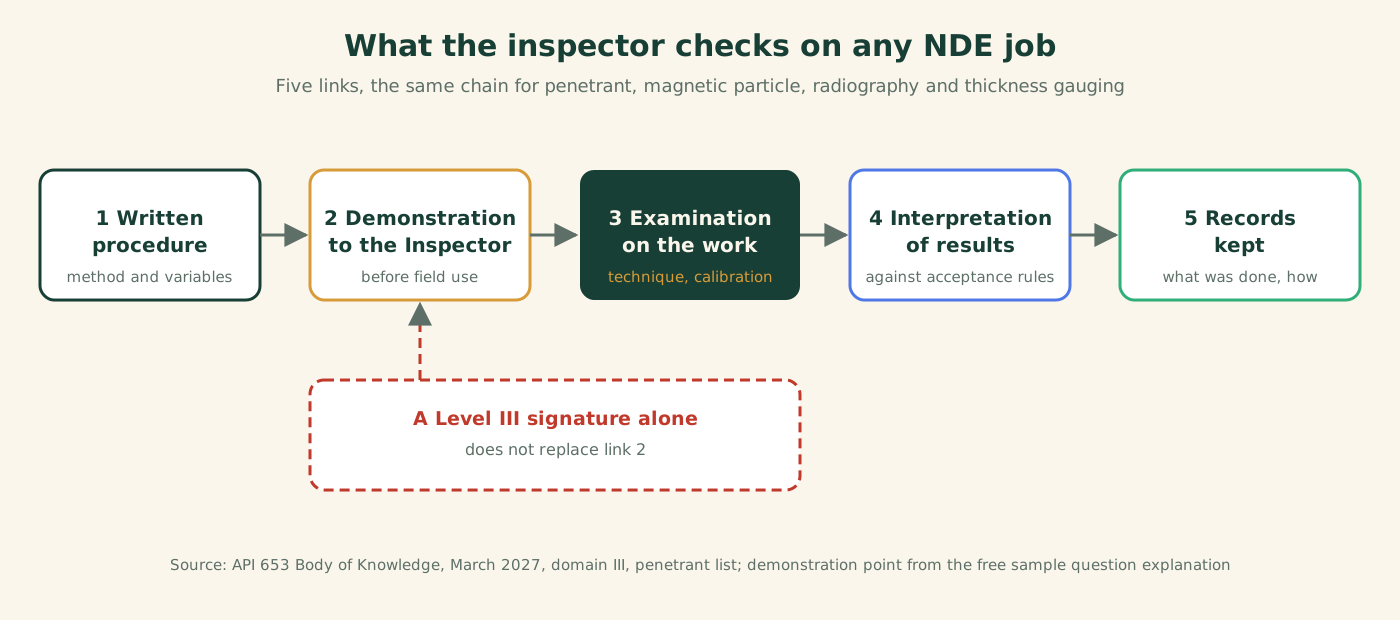
The procedure link is where the exam likes to trap you. A written penetrant procedure signed by a Level III has been technically reviewed. It has not necessarily been shown to work on a comparable joint. In the free sample question on exactly this, the answer is that the procedure must be demonstrated to the Inspector’s satisfaction before field use, and the Level III signature does not stand in for that.
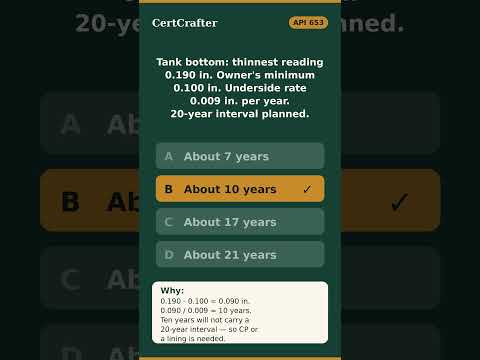 API 653 — Settlement, thickness, interval — one calculation, one number. Watch on YouTube · CertCrafter
The channel’s short on one calculation, one number is a good ten-second reminder that thickness work ends in a figure someone signs.
How does radiography show up in questions?
Radiography is the method with the most to check on paper. The body of knowledge lists required marking, the type, selection, number and placement of image quality indicators, allowable density, control of backscatter radiation, location markers and records.
Take the second free question. Radiographs of a butt welded replacement shell plate were shot with the indicator on the film side because the inside was not accessible. The answer is a lead letter F on or beside the indicator, with the indicator identity and the essential hole or wire visible. The distractor is the letter B, which is the backscatter check, a different thing entirely.
That pattern repeats. A question describes a field shortcut, and the options offer a waiver, an assumption or a marker from the wrong check. The right answer asks for the evidence to appear on the film or the record.
What about penetrant, magnetic particle and thickness gauging?
Penetrant questions lean on the procedure and on what contaminates the surface. Magnetic particle questions are narrower than they sound, because the body of knowledge restricts you to yoke and prod, so a question about a method outside those two is a sign you are overthinking it.
Ultrasonic thickness is the one method that feeds straight into domain I. SE-797 paragraph 7 gives the specific procedures, and a thickness reading is only as good as the technique behind it. That is why one bad pairing of readings can wreck a remaining life figure.
Worked example: a reading, a rate and a life
These figures are made up for practice. A shell plate reads 0.375 in. today at a point where it read 0.435 in. five years ago. The minimum thickness there is 0.300 in.
- Metal loss:
0.435 - 0.375 = 0.060in. - Corrosion rate:
0.060 / 5 = 0.012in. per year. - Remaining life:
(0.375 - 0.300) / 0.012 = 6.25years.
The body of knowledge states the same pairing rule for both readings: the previous thickness must be from the same location as the actual one. If the inspector accepts a reading taken with a poor technique, the whole chain inherits the error. The API 653 Complete Exam Kit works more of these under timed conditions, with every answer explained.
Where do API 653 candidates lose marks on NDE?
Three places show up when you read the body of knowledge against the questions.
First, scope creep. Candidates study every magnetic particle technique and every ultrasonic method, though the exam is limited to yoke and prod and to thickness gauging under SE-797. Second, the closed-book trap. The body of knowledge says some items test everyday working knowledge without the documents, so marker letters and basic requirements need to be in your head. Third, the open-book trap. Questions marked open book expect you to find the clause on screen quickly. Practice finding Article 2 or Article 6 requirements in the on-screen references, since API states that papers and books are not allowed in the test center.
For a sense of the day: 170 questions, 140 scored, 110 closed book in 2 hours 45 minutes and 60 open book in 3 hours 45 minutes. NDE questions are spread across both parts.
What should you do next?
Read Article 2 and Article 6 once with the body of knowledge list beside you, and write down only the items that must appear on a film or a procedure. Then try a timed set.
The API 653 product page holds the exam facts and the guides hub lists every topic. For a graded check, use the full practice test bundle or the free quiz. The calculation side sits in API 653 tank calculations, and the welding side in API 653 tank welding.
Comments
Comments are read by a person before they appear. How we moderate.