Most API 653 applications that stall do so on paper, not in the exam room: the years are real, but they are the wrong kind of years or they are older than ten.
Who is eligible to take the API 653 exam?
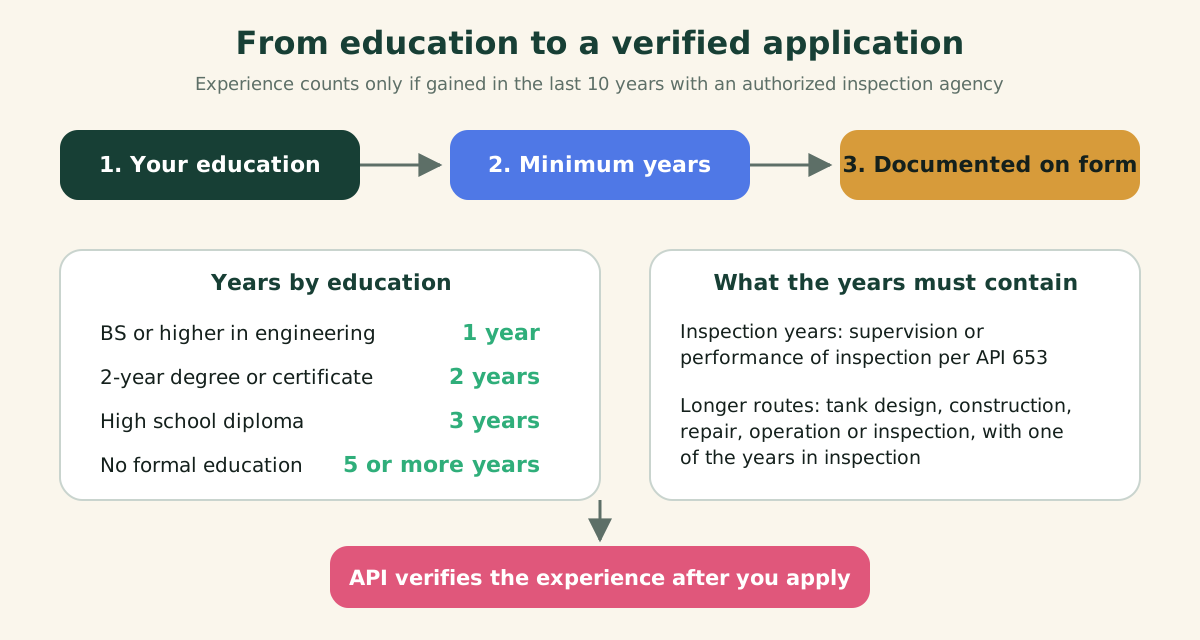
API ties eligibility to Annex D of API 653 itself. The rule is a combination of education and experience related to aboveground storage tanks, and the experience has to be recent: within the last 10 years, while employed by or under contract with an authorized inspection agency as API 653 defines that term.
 API 653 — Myth: API 653 is only for crude oil storage. Watch on YouTube · CertCrafter
One more point from API: the minimum experience must be documented on your application, and it is verified after you submit. Plan for someone to check it. Our channel also has a short video on the myth that API 653 is only for crude oil storage, worth a minute if you work with other products.
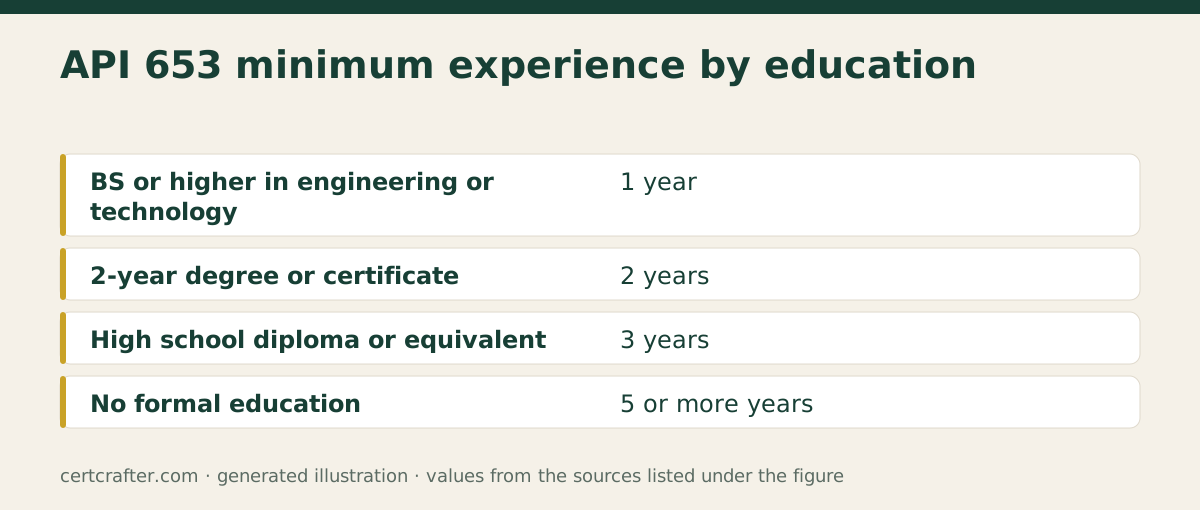
How many years of experience does each education level need?
The table below is API’s own, shortened to the minimum years.
| Education | Minimum experience |
|---|---|
| BS or higher in engineering or technology, or 3+ years of military service in a technical role | 1 year |
| 2-year degree or certificate in engineering or technology, or 2 years of military service in a technical role | 2 years |
| High school diploma or equivalent | 3 years |
| No formal education | 5 or more years |
The first row asks for one year of supervising or performing inspection activities as described in API 653. The other three rows ask for experience in design, construction, repair, operation or inspection of aboveground storage tanks, and one year of the total must be supervision or performance of inspection.
That last clause is where people trip. Years in tank design or operations help, but they never replace the inspection year.
What counts as qualifying experience on a real tank job?
API’s wording is “supervision or performance of inspection activities as described in API 653”. On a site that means the work the standard describes: external and internal tank inspections, thickness readings, bottom and settlement checks, and judging repairs against the code. A person who reviews inspection results and signs off on the plan is supervising. A person who walks the shell with a UT gauge is performing.
Work that sits around tanks without touching the inspection process is thinner ground. Scheduling shutdowns, buying materials or running a tank farm shift can all be tank experience of the longer kind, but only when your application case allows that route, and never as the one inspection year.
Worked example: checking your own eligibility
Take a candidate with a 2-year technology certificate who has worked 4 years at a terminal.
- Education row: the 2-year degree or certificate row applies, so the minimum is 2 years.
- Recency: all 4 years fall within the last 10 years, so all 4 are in play.
- Agency: the employer must be an authorized inspection agency as API 653 defines it. If the terminal’s tank work was done under contract by one, the contract counts.
- Inspection year: of the 4 years, at least 1 must be supervising or performing API 653 inspection activities. If only 6 months were, the application fails even though the total looks generous.
The candidate qualifies only if step 4 holds. Counting calendar years alone is the mistake.
The API 653 Complete Exam Kit cannot fix a short inspection year, but it does work the exam side once you are in.
How do you apply, and by when?
Application deadlines fall about two months before each exam window opens. The next three windows after today are March 12 to April 2, 2027, July 9 to 30, 2027 and November 5 to 26, 2027, with application deadlines of January 7, May 6 and September 2, 2027. The November 2026 window already ran with a September 4, 2026 deadline.
Expect these charges. The 2027 initial certification fee for API 510, 570 and 653 is $890 for API members and $1,140 for non-members. A late application fee of $200 applies to all programs, and rescheduling costs $350.
The exam itself is 170 questions, 140 of them scored, in person at designated test centers, with 110 closed-book questions and 60 open-book questions. API states that questions are drawn from the publications on the effectivity sheet for your window, so check the sheet before you book. The March 2027 changes post lists what moved.
What are the common application mistakes?
Four come up again and again.
- Counting experience older than 10 years.
- Counting years that were not with an authorized inspection agency.
- Having no inspection year, or one that cannot be shown on paper.
- Missing the deadline and paying the late fee, or the window altogether.
Keep dates, employers and supervisors in a simple log while you work, because the verification step is where a gap shows up. It is far easier to write down a job when you finish it than to rebuild it from memory two years later.
What happens after you pass?
API 653 certification is valid for a three-year term. To recertify you apply up to 90 days before expiry, with a 90-day grace period after, and API asks for at least 20 percent of your time over the cycle spent on aboveground tank inspection work plus 24 hours of continuing professional development. An open-book webquiz is required every six years.
So eligibility is not a one-time gate. The same inspection work that qualifies you has to continue.
What to do next
Check your own years against the table, then pull your dates together before you open the application. When you are ready to study, the API 653 study plan works backward from your window, and the certification guide covers the exam. Try the ten-question sample, read the other API 653 posts, and when a window is booked, the practice tests give you the timed rehearsal.
Comments
Comments are read by a person before they appear. How we moderate.