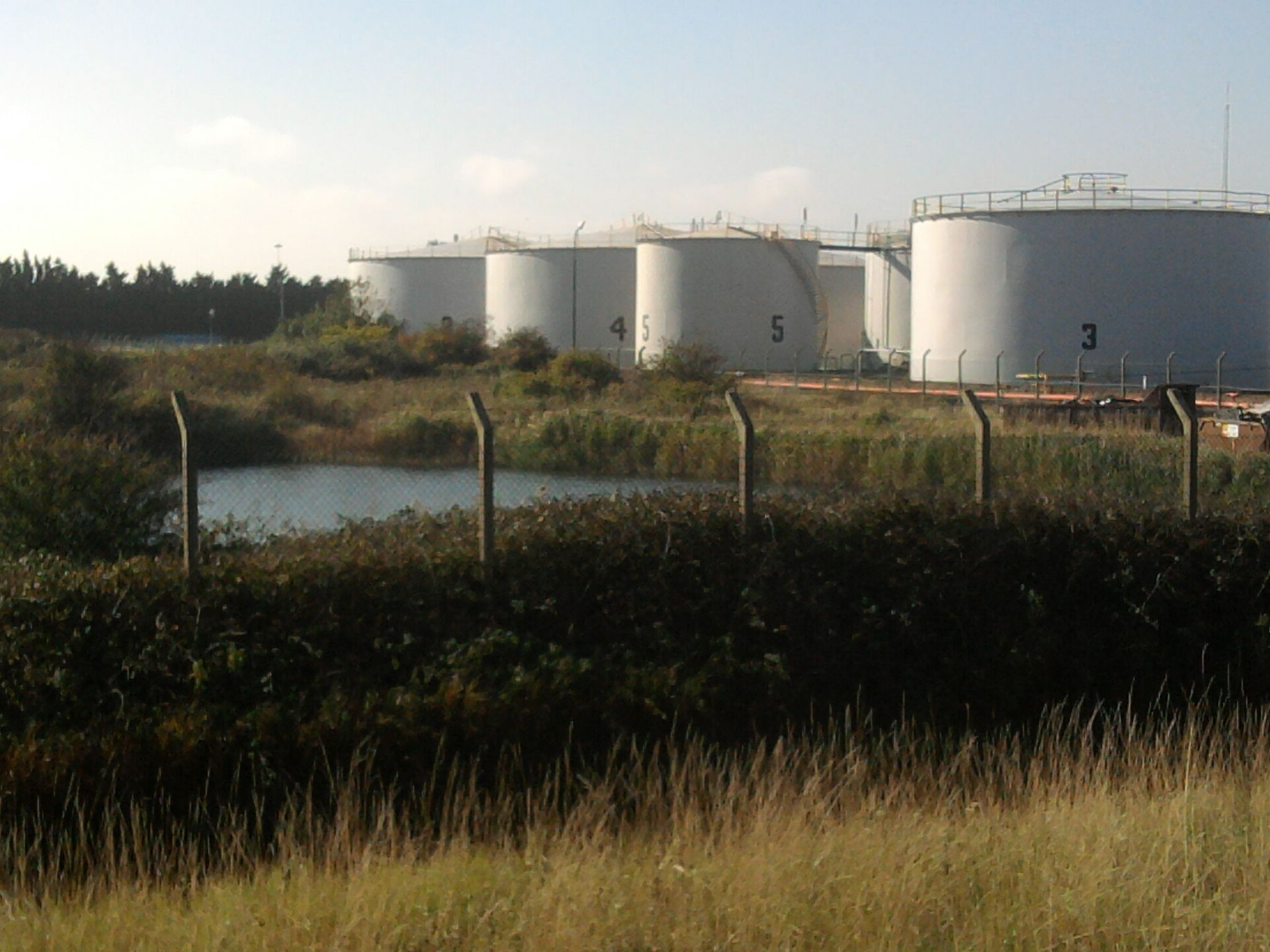
Most API 653 candidates read domain IV as a list of things they already know from work. Then the exam asks which term applies, which record is missing, or which job needs more paperwork, and the working habit and the exam answer part ways.
What is “Practical Knowledge, General” in the API 653 exam?
It is the fourth domain in the body of knowledge, and the most general one. The API document says the closed-book part of the exam tests “knowledge and tasks requiring everyday working knowledge” of API 653 and its reference documents. Domain IV is where that everyday knowledge is listed.
The list has 16 topics. Some are subjects with their own domain, like welding, NDE and thickness evaluation. Others only live here: organization and certification requirements, types and definitions of inspections, types of corrosion and deterioration, materials and fabrication problems, inspection safety, records and reports.
Domain V then goes document by document. Think of domain IV as the job description and domain V as the reading list.
Which topics in domain IV carry the most weight?
API does not publish a weighting for domain IV, so any percentage you see quoted is a guess. What the body of knowledge does give you is the topic list, and the useful way to read it is by how often a working inspector touches each item.
Four cluster together because they feed one decision. Corrosion and minimum thickness evaluation gives you a corrosion rate. Estimated remaining life turns that rate into years. Inspection interval determination turns those years into a date. The fourth, issues affecting intervals, is where judgment enters. A question that looks like a calculation is often really asking which of these four steps you are on.
Records and reports are the quiet cluster. Nameplate requirements, record keeping and reports for inspections, repairs and alterations all appear in the body of knowledge. They do not feel like engineering, which is why candidates under-study them.
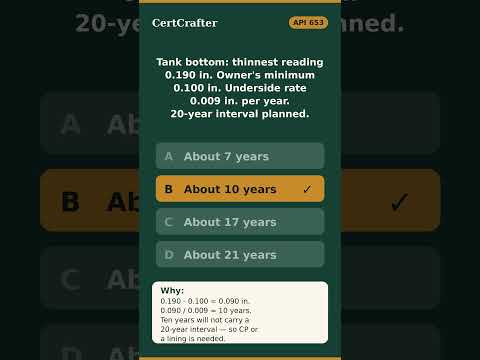 API 653 — Settlement, thickness, interval — one calculation, one number. Watch on YouTube · CertCrafter
The channel’s short on one calculation, one number shows the thickness to interval chain in under a minute.
How do inspectors use these topics on a real tank job?
On site, the topics arrive as a sequence. The owner hands you a tank file. You decide what kind of inspection is due. You walk the shell, roof and bottom, measure, and compare against what the file says. You find something, and now the question is whether the fix is a repair or an alteration, who signs, and what gets recorded.
Two habits separate good field practice from exam-ready practice.
First, a missing record is a finding, not a verdict. Old tanks arrive with gaps. Nobody condemns a tank because the original mill certificates are gone. You rebuild the picture from measurement and document your assumptions, so the next inspector can see where the data came from.
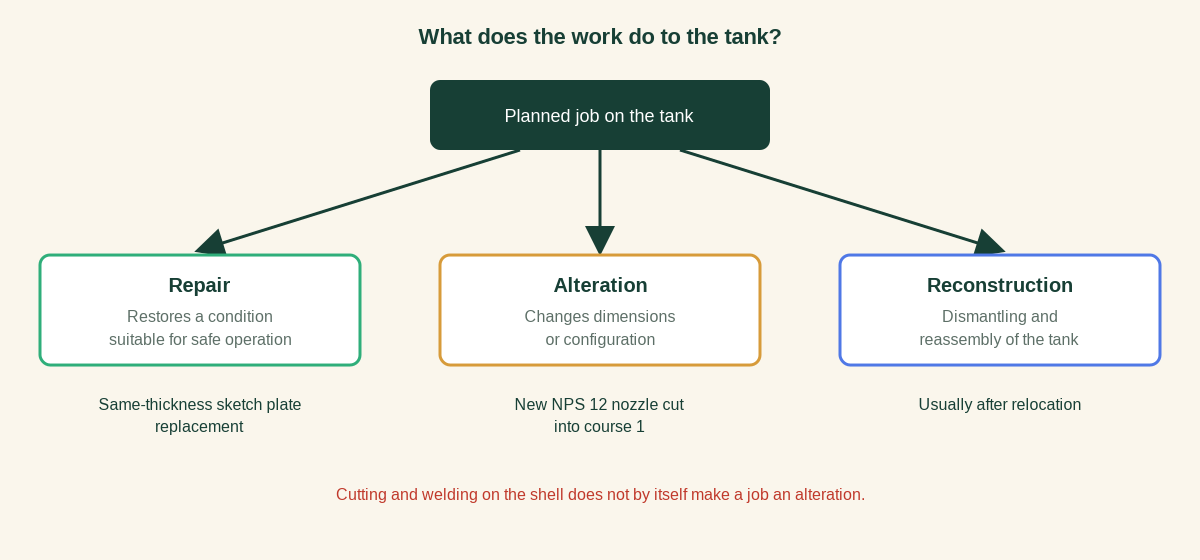
Second, the classification of work drives everything after it. Whether a job is a repair, an alteration or reconstruction decides what design, examination and testing follow it. Contractors sometimes label work loosely. The inspector’s label is the one that matters.
Worked example: rebuilding the record for an old tank
Take an older tank whose file holds no construction drawings, no mill certificates and only two inspection reports from the last ten years. The owner asks whether it can stay in service.
- Treat the gap as a finding to be closed, not as grounds to condemn the tank.
- Measure current thicknesses across the shell, bottom and roof so the present condition rests on data.
- Establish material properties by test where practical, or by a documented assumption where it is not.
- Write down every assumption and where it came from.
- Keep the rebuilt file for as long as the tank stays in service.
The step candidates skip is the fourth. A stamped nameplate with assumed data and no basis hides the uncertainty from the next person. A documented gap does not.
What is not on the exam?
This is the half of domain IV most candidates never read. The body of knowledge lists 26 code requirements you will not be expected to know. They include thickness calculations for wind, earthquake and small internal pressures, nozzle calculations for external loads, flange calculations, brazing, venting calculations, ladder and stairway structural calculations, and technical interpretations of codes. Welding is limited to shielded metal arc and gas metal arc.
The rest of the list is a run of API 650 annexes, several of them excluded except for one or two clauses.
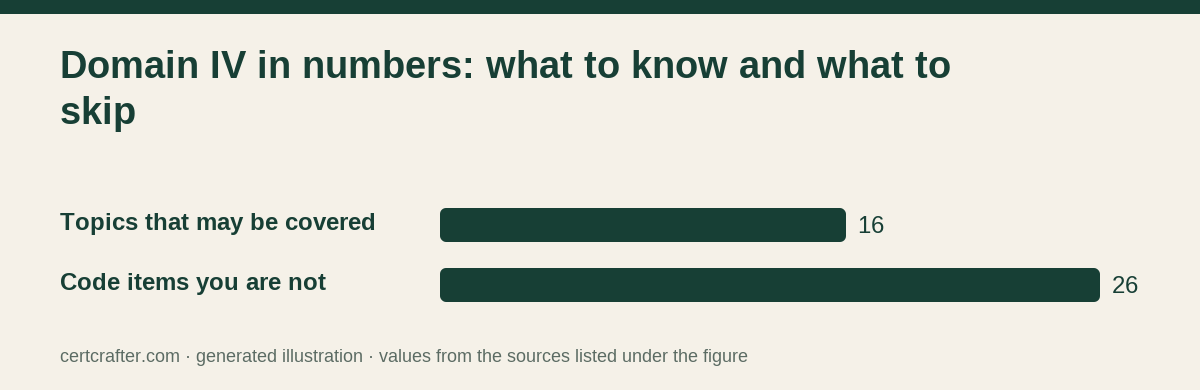
Reading the exclusion list saves real time. An engineer who comes from design work often drills wind girder checks or flange sizing, because that is how the tank was built. The exam does not go there. It goes to how the tank is kept, checked and repaired.
The Body of Knowledge also says that questions come only from the documents and editions on the effectivity sheet. For the March 2027 sheet, that means API 650 in its 14th Edition of August 2025 and API 653 in its 5th Edition with Addendum 4 of July 2025. Windows from March 2027 onward use that sheet.
How does the exam frame a domain IV question?
Domain IV questions are usually short scenarios with a tank number, a plain problem and four plausible answers. The API body of knowledge adds a hint about the closed-book half: many items test what an inspector would normally do, and API RP 575 uses phrases like “it is best to” and “an inspector would normally”. In those cases the exam wants the best answer of those given, not the only technically defensible one.
Three patterns come up again and again.
A definition in disguise. The question describes a job and asks you to name it. The trap is the option that sounds strict, such as “both are alterations because both involve cutting and welding”. The definition turns on what the work does to the tank.
A record in disguise. The question describes missing or doubtful paperwork and asks what the inspector does. The wrong options condemn the tank, ignore the gap, or paper over it. The right one rebuilds the record from evidence.
A calculation chain in disguise. The question gives thickness readings and asks about an interval or remaining life. Decide which of the four steps you are on before you pick up a calculator.
How should I study domain IV?
Start with the two lists. Read the 16 topics and mark the ones you could not explain to a new colleague in two minutes. Then read the 26 exclusions once and cross them out of your plan.
Spend your time on the definitions, because the exam turns them into traps. Practice by writing, for each topic, one sentence on what the inspector decides and one on what gets recorded. Of the 170 questions, 110 are closed book, so these sentences have to come from memory.
The API 653 Complete Exam Kit works more of these under timed conditions, with every answer explained.
For the calculation side of the chain, see API 653 tank calculations. For the welding questions that overlap with this domain, API 653 tank welding goes deeper, and the March 2027 changes post lists which editions moved.
The API 653 product page holds the exam facts, the guides hub lists every topic, and the free quiz gives you a graded start. The full practice test bundle is there when you want volume.
Comments
Comments are read by a person before they appear. How we moderate.