API 570 Welding Qualification: What the Exam Tests

Take the free API 570 diagnostic: 25 questions, about 40 minutes, your score by topic and where to start.

By Sandeep Bandyopadhyay, Engineer and founder of CertCrafter · PMP, MBA

TL;DR

The welding section of the API 570 exam asks you to review a welding package the way an inspector does: check the WPS against its PQR, confirm the essential and non-essential variables are addressed, confirm the mechanical tests are the right ones, and confirm the welder is qualified for the production weld. It rests on ASME Section IX, the welding rules in ASME B31.3 and API 570, and API RP 577.

Original questions, not exam dumps. Every CertCrafter question is written from the published body of knowledge and the referenced codes. None is copied from a live exam, and CertCrafter is independent: not affiliated with or endorsed by any awarding body.

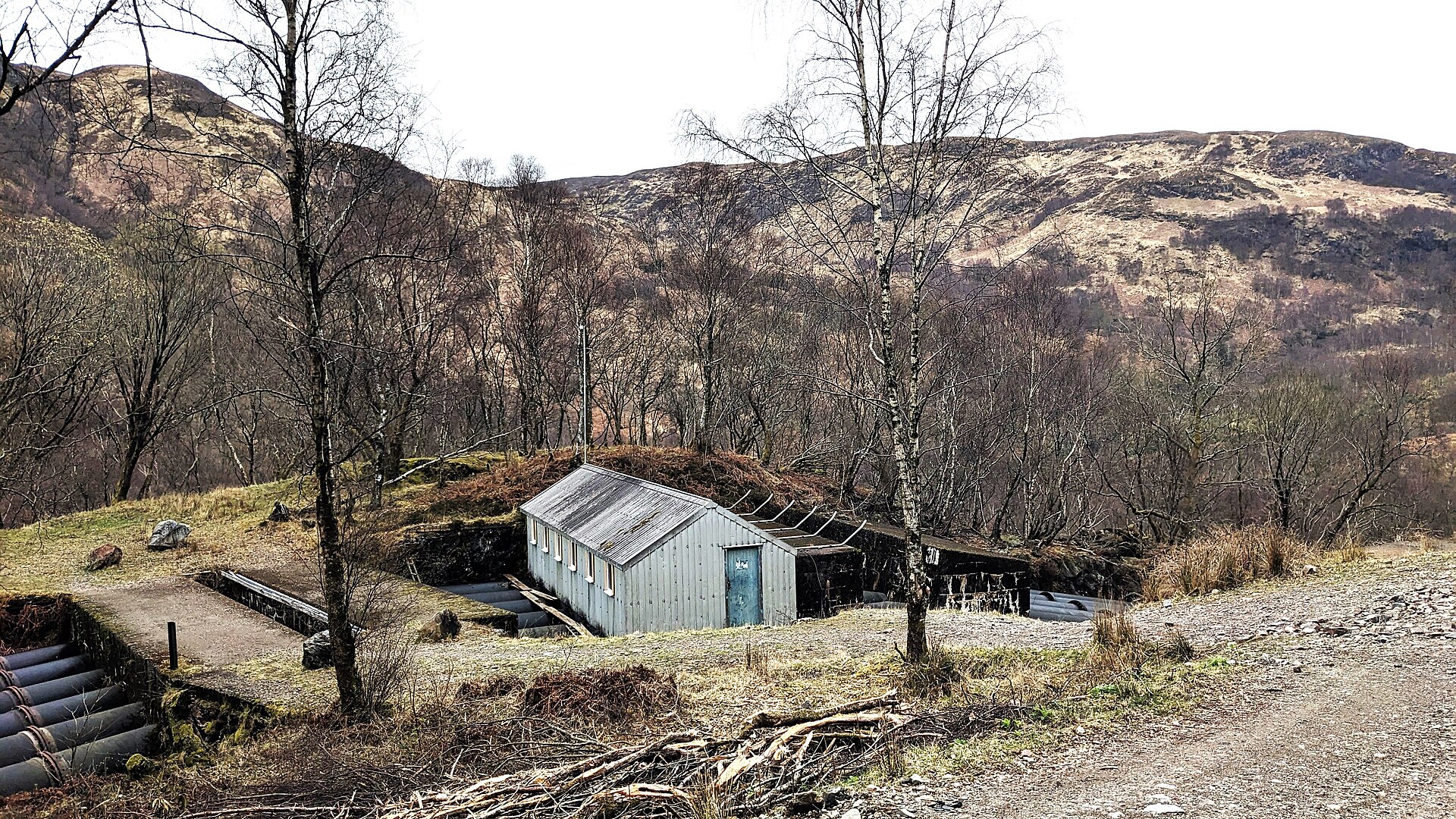
A small pipeline valve house beside a pipeline
Photo: A valve house on the pipeline - geograph.org.uk - 8023922 by David Medcalf (Wikimedia Commons), CC BY-SA 2.0, via Wikimedia Commons.

Most API 570 candidates can say what a WPS is. They lose marks when a question hands them three documents and asks whether this welder may make this weld.

What does the welding section cover?

It is section II of API’s Body of Knowledge, and its first source is ASME Section IX. Candidates need the basic requirements for qualifying procedures and welding personnel. Brazing is not covered.

Two more sources sit beside it. The inspector should know the general welding rules in ASME B31.3, Chapter V: typical joints and definitions, weld sizes, restrictions on joints, maximum allowable reinforcement, inspection requirements, and preheating and heat treatment. And the inspector should know the welding rules in API 570. Where API 570 and the ASME rules cover the same area, API 570 wins.

The section also names API RP 577 on welding processes, inspection and metallurgy, and the effectivity sheet for 2027 lists it at the 3rd Edition, October 2020. The Section IX edition is the 2023 Edition, and B31.3 is the 2024 Edition.
Video: API 570 Exam Prep: 23 Worked Questions, Fully Explained API 570 Exam Prep: 23 Worked Questions, Fully Explained Watch on YouTube · CertCrafter
Image: video thumbnail, source: CertCrafter on YouTube (@certcrafters).

What is an inspector actually asked to review?

Three documents. The Welding Procedure Specification says how to weld. The Procedure Qualification Record holds the test evidence behind it. The Welder Performance Qualification shows a welder has demonstrated the skill on a coupon. The Body of Knowledge wants you to review all three and decide four things: whether the records comply with the code and any extra API 570 requirements, whether the essential and non-essential variables are addressed, whether the mechanical tests on the PQR are the right ones with acceptable results, and whether the welder is qualified for the production weld under that WPS.

The exam draws a box around the problem so it stays manageable. One process per document. One filler metal per process. The PQR is the one that supports the WPS, and the WPQ coupon was welded to a qualified WPS. Base metals are P-No. 1, 3, 4, 5 and 8, with no dissimilar metal joints, no dissimilar thicknesses, and no corrosion-resistant or hard-facing overlay.
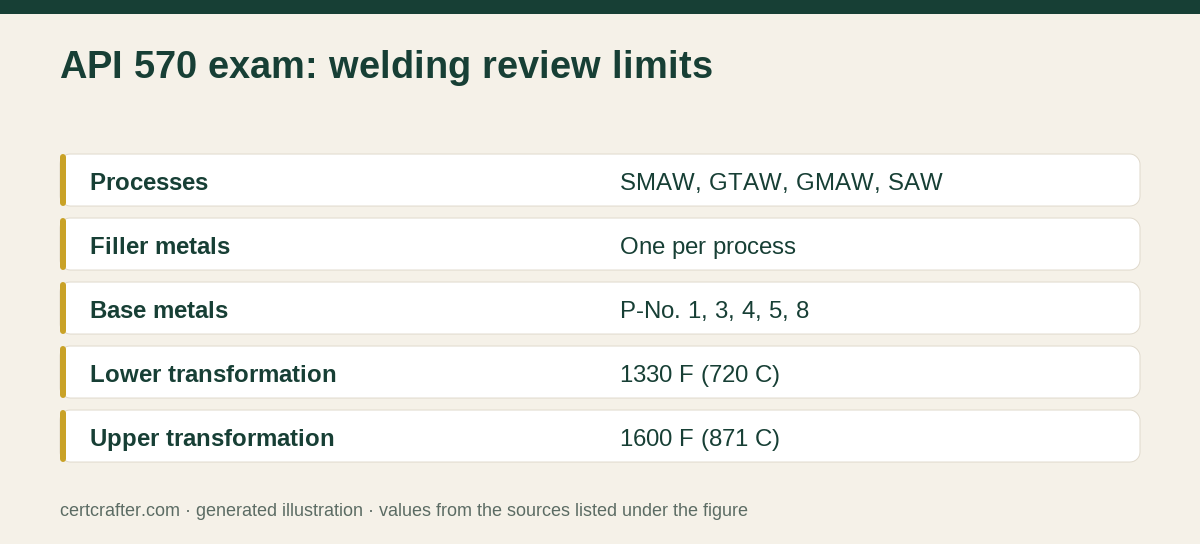
API 570 welding review limits: SMAW, GTAW, GMAW and SAW; one filler metal per process; P-No. 1, 3, 4, 5 and 8; lower transformation temperature 1330 F (720 C) and upper 1600 F (871 C)
Illustration: CertCrafter, from the API 570 Body of Knowledge. Illustration: CertCrafter, from API 570 Body of Knowledge, February 2027 and June 2027.

One number matters here. For P-No. 1, 3, 4 and 5 the exam sets the lower transformation temperature at 1330 °F (720 °C) and the upper at 1600 °F (871 °C). Questions that turn on heat treatment relative to those temperatures use these values, not the ones from your plant’s metallurgist.

How do inspectors use this on a plant?

On a unit, the review happens before the welder strikes an arc, not after. A repair contractor submits a package for a pressure-containing weld. The inspector reads the WPS and finds the PQR it cites. Then the inspector checks that the PQR really supports the WPS and that the welder’s qualification covers the process and the position.

The failure in the field is almost always a gap between documents, not a missing document. A WPS revised after the PQR was written. A welder qualified on one process asked to weld with another. A package signed by everyone and supported by nothing. The Body of Knowledge says the inspector should know that the PQR and the WPQ must be signed and dated. It excludes editorial items such as the WPS revision level, company name, WPS number and date, and the testing lab’s name, so the exam does not turn on them.
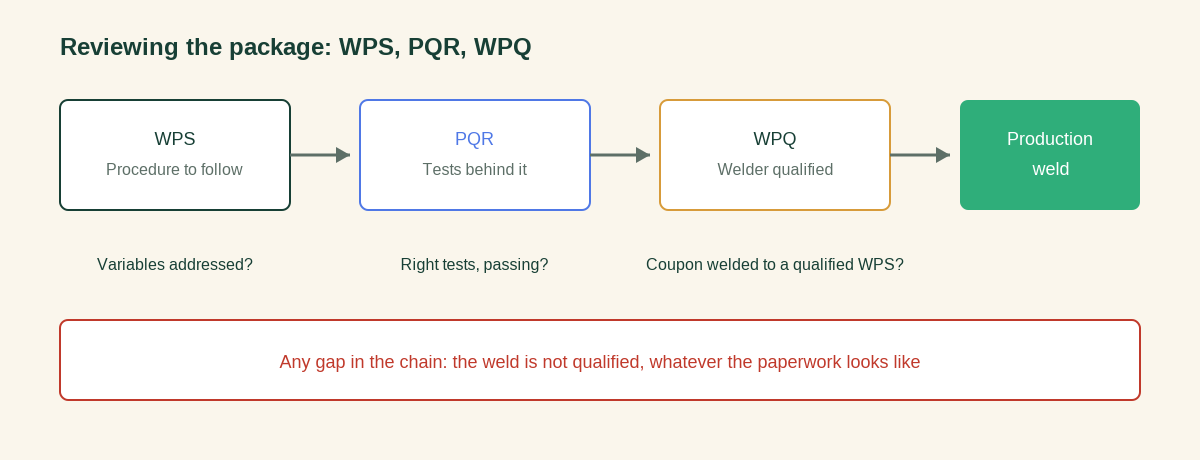
Chain from WPS to PQR to WPQ to production weld, with the three checks beneath each document and a warning that any gap means the weld is not qualified
Illustration: CertCrafter, from the API 570 Body of Knowledge. Illustration: CertCrafter, from API 570 Body of Knowledge, February 2027 and June 2027.

How are welding questions framed on the exam?

Usually as a change or a proposal. A contractor wants to drop a preheat. A procedure was qualified one way and the job needs another. A welder qualified on one WPS is assigned to a different one. The answer depends on whether the change touches an essential variable, a non-essential one, or nothing at all.

Worked example: can this welder make this weld?

Take a package for a carbon steel butt weld repair, one process, one filler metal. Work it in five steps.

  1. Find the PQR the WPS cites, and confirm it is the supporting record for this WPS.
  2. Compare the WPS with the PQR variable by variable. An essential variable outside the qualified range means the WPS is not supported. A non-essential variable can change without new testing.
  3. Check that the mechanical tests listed on the PQR are the proper ones for the joint, and that the results are acceptable.
  4. Read the welder’s WPQ: same process, and a coupon welded to a qualified WPS.
  5. Confirm the PQR and the WPQ are signed and dated.

If step 2 fails, nothing after it matters. I’d work the free questions below with that order in mind. The first asks what to do when the heat treatment condition changes between qualification and production. The second asks what an inspector requires when a contractor lowers a minimum preheat on P-No. 4 material. Both come down to the same test: does the change touch an essential variable?

The API 570 Piping Inspector Complete Exam Kit works more of these under timed conditions, with every answer explained.
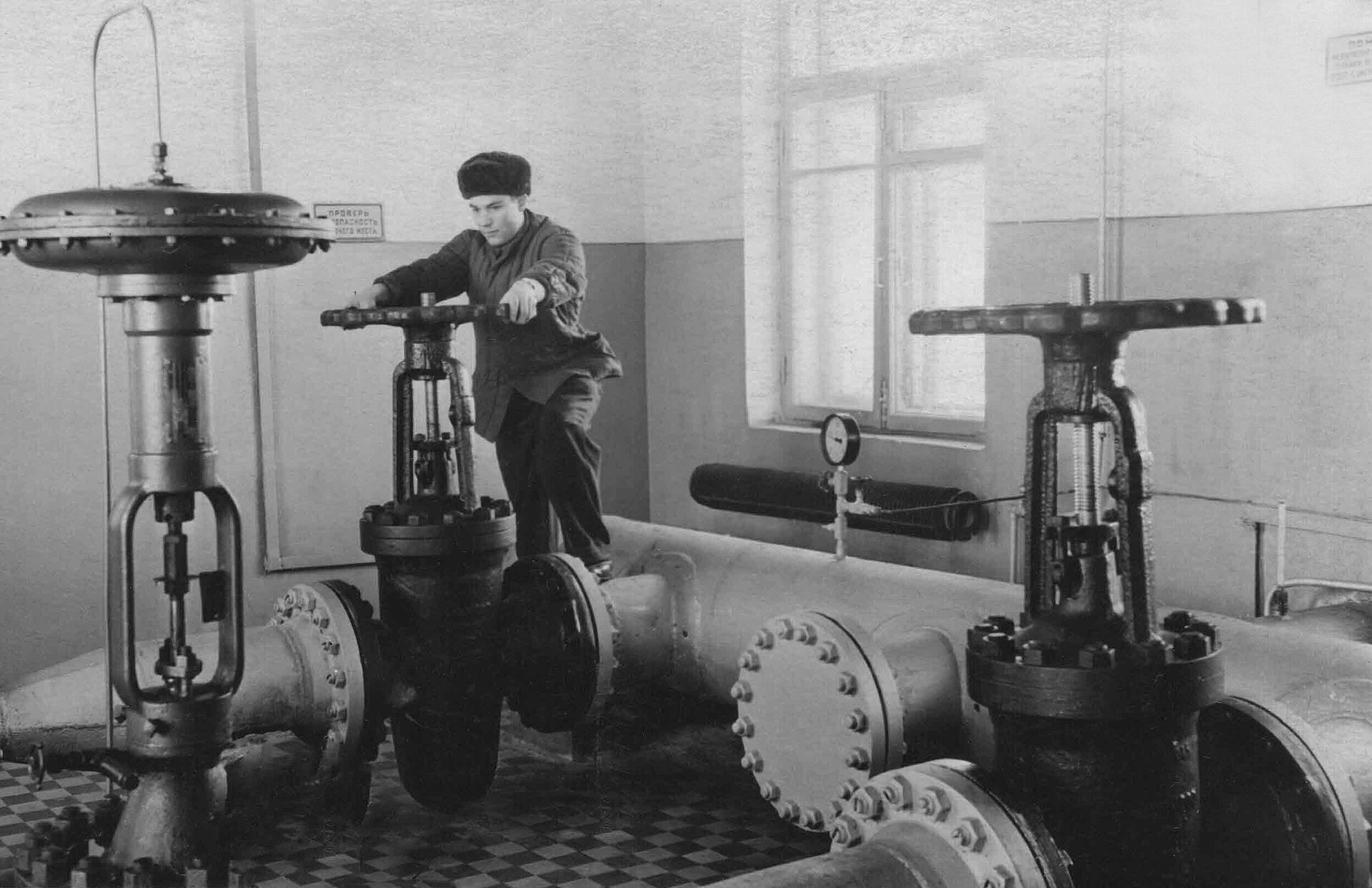
The end of a gas pipeline with pipe sections and valves
Photo: End of gaz pipeline Stavropol-Moscow by Главархив Москвы (Wikimedia Commons), CC BY 4.0, via Wikimedia Commons.

Where do candidates lose marks in this section?

Three places turn up again and again.

  1. They treat a signature as proof. A welding engineer can sign a revision, but a signature does not turn an essential variable change into a non-essential one.
  2. They answer from the plant’s habit instead of the code. In the field, a welder who has welded the joint a hundred times is trusted. On the exam, only the qualification record counts.
  3. They forget the precedence rule. If API 570 states a welding rule, it overrides the ASME and B31.3 rule on the same point, and a distractor often offers the other one.

Candidates also lose time by hunting through Section IX without a plan. The exam has 110 closed-book questions and 60 open-book questions, and welding questions in the open-book part reward knowing which part of the document answers the question before you open it.

How should you study it?

Take one real WPS and its PQR, if your employer lets you, and practice the five steps until they are automatic. Then read B31.3 Chapter V against the six topics the Body of Knowledge lists. Our guides on the 2027 effectivity sheet and the piping NDE section cover the neighboring ground, and the certification guide has the full list of domains.

What to do next

Open API’s API 570 page, read section II of the Body of Knowledge, and write down the four things the inspector must decide about a welding package.

Then try the free ten-question sample and browse the other API 570 posts.

Try these free questions

  1. [Open book] A P-No. 1 spool on the crude unit overhead needs a butt weld repair, and the repair plan calls for postweld heat treatment. The contractor offers WPS-118, qualified in the as-welded condition, and would heat treat the production weld anyway. The owner allows no weld outside a matching qualification. What is acceptable?

    1. Qualify a new coupon carrying the same postweld heat treatment as production, then write the production procedure from that record.
    2. Use WPS-118 as written, on the reasoning that heat treatment the procedure never called for can only add margin to the joint.
    3. Amend WPS-118 to add the heat treatment, treat the change as a nonessential variable, and reissue the procedure without new testing.
    4. Run the weld to WPS-118 and record the heat treatment on the weld map as a deviation signed off by the welding foreman.
    Show the answer and explanation

    Answer: A. ASME Section IX treats the postweld heat treatment condition as an essential variable for the common arc processes. Moving a procedure from the as-welded condition into a heat treated condition, or the reverse, changes the mechanical properties the qualification demonstrated, so the procedure has to be requalified on a coupon that carries the same thermal history the production weld will see. The owner's constraint removes any route that leaves production running outside a matching record, which leaves qualification of a new coupon as the only acceptable course. Using WPS-118 unchanged rests on the field belief that extra heat treatment is always conservative, but tempering also lowers strength and the qualification never measured the result. Calling the change nonessential misreads the variable list, since a nonessential change may be made by revision without testing and this one may not. A foreman's deviation note has no standing under Section IX; a deviation cannot substitute for the mechanical testing that supports a procedure.

  2. [Open book] A contractor submits a WPS revision dropping the minimum preheat on P-No. 4 material from 300 degrees F (149 degrees C) to 150 degrees F (66 degrees C), citing schedule pressure. Under ASME Section IX, what should the inspector require?

    1. Acceptance once the contractor's welding engineer signs the revision, since minimum preheat is a nonessential variable on this procedure
    2. Rejection until a new procedure qualification record supports the lower preheat, since that decrease is an essential variable
    3. Acceptance provided impact testing is added to the qualification, since preheat is a supplementary essential variable only
    4. Acceptance once each welder assigned to the job requalifies at the reduced preheat temperature
    Show the answer and explanation

    Answer: B. ASME Section IX treats a decrease in preheat temperature of more than a set margin below the qualified value as an essential variable for the common arc processes, and an essential variable change means the procedure has to be requalified with new test coupons and a new procedure qualification record. Dropping the minimum from 300 degrees F to 150 degrees F on P-No. 4 low alloy material is a decrease far beyond that margin, and P-No. 4 is exactly the material group where preheat controls the cooling rate and the risk of hydrogen assisted cracking. The inspector therefore cannot accept the revision on paper. A welding engineer's signature handles nonessential variables, which are revised on the procedure without retesting, and preheat in this direction is not one of them. Maximum interpass temperature is the variable tied to supplementary essential status and impact testing. Requalifying welders does nothing about the procedure.

Take the full free 10-question sample with scoring →

Frequently asked questions

Which documents does the API 570 welding section cover?

ASME BPVC Section IX for procedures and welder qualification, the general welding rules in ASME B31.3 Chapter V, the welding rules in API 570 itself, and API RP 577. Brazing is not covered.

Which welding processes and base metals can the exam use?

Reviews may involve SMAW, GTAW, GMAW or SAW, one process per WPS, with base metals limited to P-No. 1, 3, 4, 5 and 8. Dissimilar metal joints and special overlay processes are excluded.

What if API 570 and B31.3 disagree on a welding rule?

API's Body of Knowledge says that any welding rule in API 570 takes precedence over the ASME and B31.3 rules covering the same area.

Official sources

  1. API 570 Piping Inspector, exam information — accessed 19 November 2026
  2. API 570 Publications Effectivity Sheet, February 2027 and June 2027 — accessed 19 November 2026
  3. API 570 Body of Knowledge, February 2027 and June 2027 — accessed 19 November 2026

Exam rules change. Check the awarding body's official page before you apply. CertCrafter is independent and is not affiliated with or endorsed by any awarding body.

Was this helpful?

Comments

    Comments are read by a person before they appear. How we moderate.