
A remaining life of six years does not mean the next inspection is in six years. Candidates stop at the life, and plant files are full of dates counted from the wrong day.
What does API ask you to calculate here?
Two things, one after the other. The Body of Knowledge says calculation questions are about existing in-service piping, and its first category covers corrosion rates and inspection intervals. The inspector must be able to calculate a corrosion rate (API 570, 7.1.2), a remaining life (the paragraph that follows the corrosion rate) and an inspection interval (6.3.3 and Table 1).
It adds a warning that matters on exam day: the formulas for those calculations and the rules for setting intervals may be closed book. The closed-book session is 110 questions in 2 hours 45 minutes. You will not have the code open.
 API 570 Exam Prep: 23 Worked Questions, Fully Explained Watch on YouTube · CertCrafter
If you want to hear questions like this talked through, we have API 570 Exam Prep: 23 Worked Questions, Fully Explained on the channel.
How do you work remaining life and the next inspection date?
Start with the wall as a budget. What you had, what is left, and a floor you may not go below. The rate says how fast the budget is spent. The date has to be placed on a calendar, and that is where the second step lives.
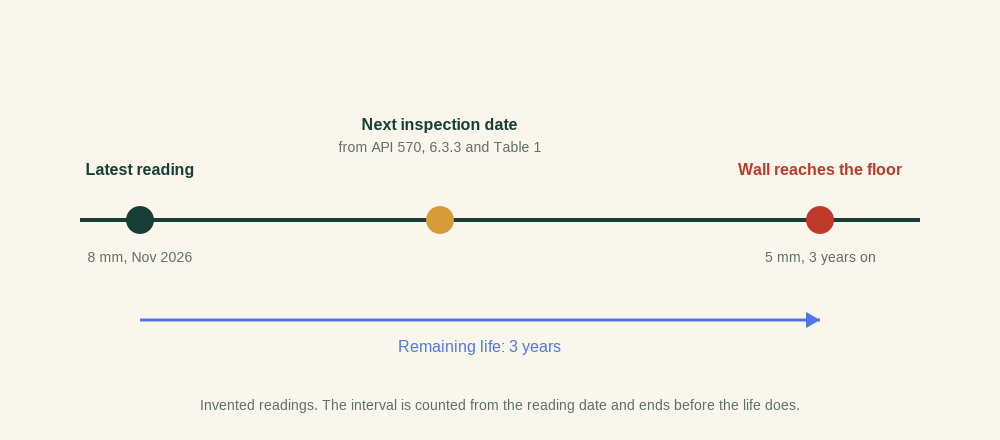
Worked example: one reading pair, in inches
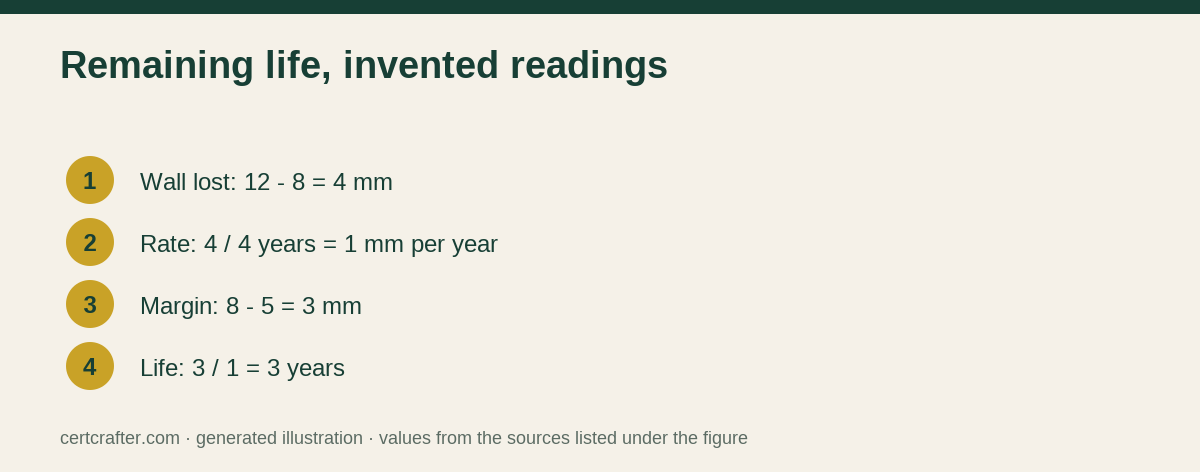
Invented numbers for a carbon steel line, same location, same gauge. The first reading was 12 mm in November 2022. The latest is 8 mm in November 2026. The minimum required thickness for this line is 5 mm.
- Wall lost: 12 minus 8 is 4 mm.
- Corrosion rate: 4 divided by 4 years is 1 mm per year.
- Margin left: 8 minus 5 is 3 mm.
- Remaining life: 3 divided by 1 is 3 years.
- End of life: three years after the November 2026 reading.
Now the date. The interval you take from 6.3.3 and Table 1 is counted forward from the November 2026 reading, not from the day you did the sums, and it must land before those three years are up. Whatever number the book gives you, check it against the end date. If it overshoots, the life wins.
The API 570 Complete Exam Kit works more of these under timed conditions, with every answer explained.
How do inspectors choose the date on a real plant?
They rarely set it from one pair of readings. A circuit has many thickness points, and the worst one governs. If a single location corrodes faster than the rest, its life sets the date for the whole circuit, and that is the number that goes on the schedule.
Then comes the planning. A date on paper still has to meet a turnaround, a scaffold booking and a crew. Inspectors often pull a date earlier to fit a shutdown rather than let it slip past the end of life. Pulling earlier is cheap. A line that outruns its date is a finding, and nobody wants to write that report on a Friday.
Data quality comes first, and it is where most disputes over a date start. A reading with no date, no location and no instrument noted cannot give a rate. A reading higher than the last one points at the gauge, the surface or the scan position, not at healing steel. Check those before you trust either number.
What does the exam do with remaining life questions?
It hides the trap in the input. The question gives you a nominal wall, a design thickness and a minimum required thickness, and only one of them is the floor. It gives you an installation year and two reading dates, and only the gap between the readings is the time.
The second trap is the unit. The Body of Knowledge expects both US customary and SI, so a question may hand you millimeters and years or inches and months. Convert before you divide, and write the unit beside every number so a slip shows up before the answer does.
The third is stopping early. A question that asks for the date wants the life applied to the interval rules, with the interval counted from the latest reading. Answering with the life alone is the usual wrong option, and it sits among the choices on purpose. Read the last line of the question twice before you pick.
Where do candidates lose marks?
The same five slips turn up again and again. Using the nominal wall as the floor, using the age of the line as the time, and looking for the formula in a closed-book session. Also mixing units, and counting the interval from the wrong day.
Do not spend your hours on the wrong material either. The 2027 effectivity sheet is the edition reference. If your site binder holds an older code, answer from the sheet, as API’s own note says the exam is based on it.
What should you do next?
Work the example above again in inches, closed book, with a timer. Then try the free sample quiz, which has calculation questions in the exam’s framing, and compare your working with each explanation line by line before you move on.
For the wider calculations picture, read API 570 formulas with worked examples and API 570 piping calculations: what the exam tests. The product page is API 570 Piping Inspector, the practice tests are in the API 570 bundle, and more posts are in the API 570 hub.
Comments
Comments are read by a person before they appear. How we moderate.