Practical Knowledge General is the section of the API 570 exam that reads like a day on the job. Nobody asks you to derive anything. You are asked what an inspector does when thickness readings come back, a weld leaks, or a line needs a different rating.
It sits in section IV of API’s Body of Knowledge, as a plain list of nineteen topics. Short list, wide reach.
What does Practical Knowledge General actually list?
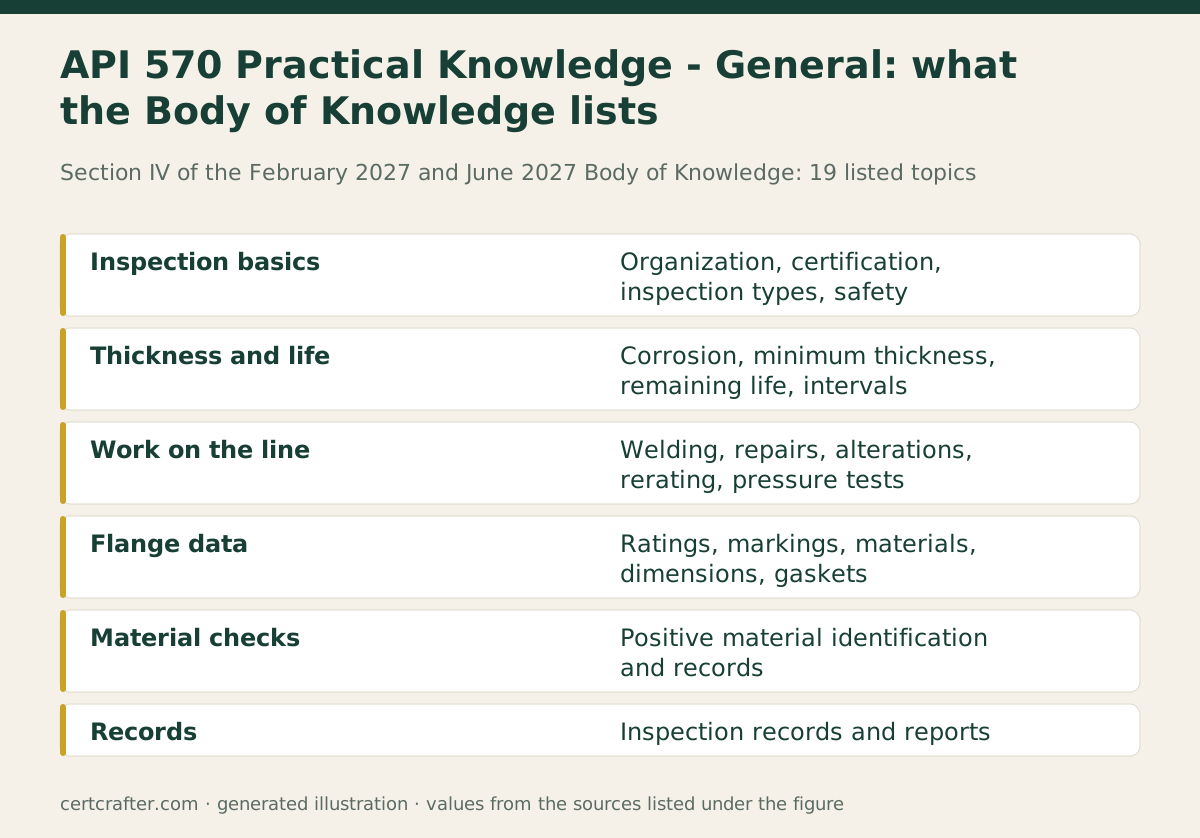
Section IV opens with “The following topics may be covered” and then gives nineteen items. The first eleven are the inspector’s own work: organization and certification requirements, types and definitions of maintenance inspections, welding on piping, corrosion and minimum thickness evaluation, estimated remaining life, inspection interval determination and the issues that affect it, maintenance inspection safety practices, inspection records and reports, repairs, alterations and reratings, rerating piping, and pressure testing after repairs, alterations or rerating.
The last eight are the ASME B16.5 flange topics (pressure temperature ratings, markings, materials, dimensions, test, limiting dimensions of gaskets and the methods for establishing ratings) plus methods of performing positive material identification and the record keeping that goes with it.
 API 570 Exam Prep: 23 Worked Questions, Fully Explained Watch on YouTube · CertCrafter
The Body of Knowledge adds that the detail for each category sits in section V, where every reference document is listed with what may be tested. So section IV tells you the subject, and section V tells you where in the library the answer lives. Our channel has a long walk through worked questions that touch many of these topics: API 570 Exam Prep, 23 Worked Questions, Fully Explained.
Why is the thickness, life and interval chain the heart of it?
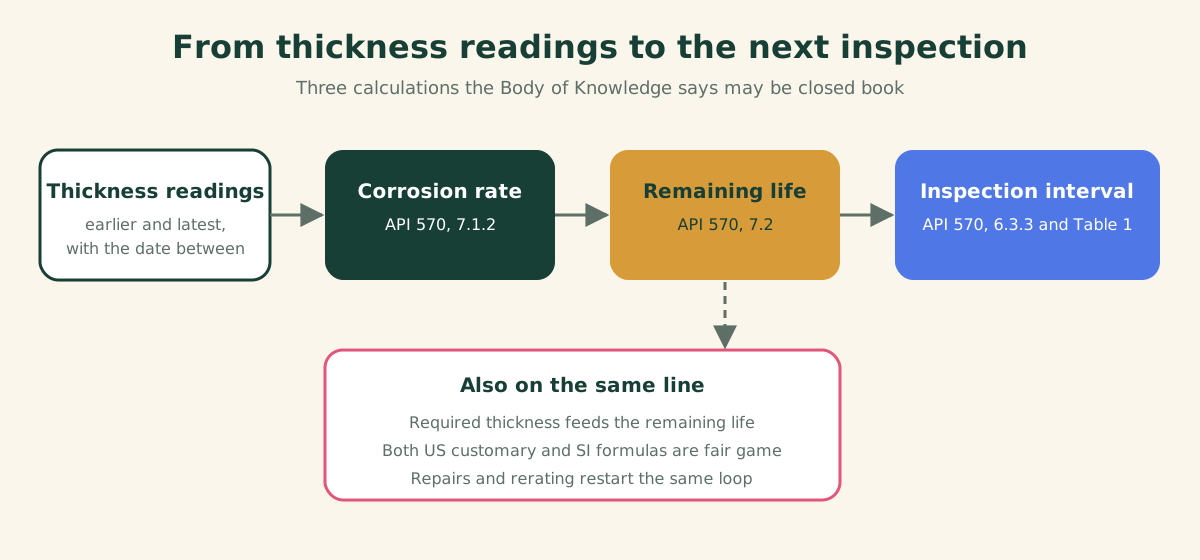
Three of the nineteen topics are really one chain. You measure the wall. You work out how fast it is going. You decide how long it can stay in service and when to look again.
The Body of Knowledge ties the pieces to paragraphs in API 570: corrosion rate in 7.1.2, remaining life in the paragraph right after it, and the inspection interval in 6.3.3 and Table 1. It says the formulas, and the rules for setting intervals, may be asked closed book. It also says candidates are expected to use both US customary and SI formulas.
That is the whole reason the topic matters. A piping inspector who gets the rate wrong has a wrong life, and a wrong life gives a wrong interval. One bad number travels all the way to the next outage plan.
Worked example: from two readings to a remaining life
Take two readings from the same spot on a carbon steel line, taken some years apart. The steps are the same whatever the numbers, and they are the ones to rehearse closed book.
- Wall lost: earlier reading minus latest reading.
- Corrosion rate: wall lost divided by the time between the two readings, in inches per year or millimeters per year.
- Margin left: latest reading minus the minimum required thickness for that line.
- Remaining life: margin left divided by the corrosion rate.
- Interval: the life is then set against the limits in API 570 Table 1 and paragraph 6.3.3, which is where the inspector stops calculating and starts applying rules.
Notice what the exam takes from this. The arithmetic is easy. The trap is the inputs: use the minimum required thickness, not the nominal wall, and use the time between the two readings, not the age of the line. Run it once with inches and once with millimeters, because the Body of Knowledge expects both.
How is this done on a real plant?
On site, the chain is never one pair of readings. It is a set of locations on a circuit, read at different times, with some noisy and some clearly wrong. A reading that jumps up by a few thousandths between visits tells you about the gauge or the surface, not about the pipe.
Inspectors compare, trend and then decide how much to trust a rate. A short run of readings can overstate or understate the loss. Experienced people look at the readings beside each other, ask what service the line is in, and check the damage mechanism before committing to a life.
Other topics in the list show up in the same walkround. Safety practices decide how you get to the line at all. Records and reports are what the next inspector, and an auditor, will rely on. If it is not written down with a date, a location and a method, the reading may as well not exist.

What does the exam do with local thinning?
One of the free sample questions on our site puts a thinned patch about 3 in. long on a 10 in. line, with scattered pitting around it. It asks how API 570 has the inspector evaluate the patch when judging the line for continued service.
The explanation turns on two duties the wall performs. Pressure containment is carried over a length of wall, so the code lets readings be averaged across a defined length when checking hoop stress, and that length is tied to the pipe diameter. The structural duty, weight, span and longitudinal load, needs the minimum thickness at a point to hold on its own. Both checks have to pass.
That is typical of this section. The question looks like a measurement problem, and it is really a test of whether you know which rule applies to which duty.
How do repairs, alterations and pressure tests get asked?
Another free sample question describes a leaking weld on a process line that was excavated and rewelded during the run. The superintendent wants the line back without a hydrotest.
The point API 570 makes is the split between a repair and an alteration. An alteration normally calls for a pressure test. For a repair, suitable nondestructive examination can be substituted where a test is not practical, accepted by the inspector. The question wants you to see that rewelding a leak is a repair, so a route exists, and it runs through documented NDE rather than through the schedule.
The reverse trap works just as well. Some candidates choose the answer that every weld on in-service piping must be hydrotested, which is too absolute, because it would make most on-stream repair work impossible.
Where do candidates go wrong in this section?
A few patterns come up again and again.
They treat the whole section as memory. Some of it is, the formulas especially. But the rest is rules that sit in API 570, and API 570 is, in the Body of Knowledge’s words, entirely subject to testing. Reading it once is not the same as being able to find a paragraph in it.
They answer from plant habit. A site might hydrotest everything, or inspect on a calendar interval that suits the shutdown plan. The exam answer is what API 570 says, not what your plant does.
They skip the flange and material identification items because they feel minor. They are in the list on purpose. RP 578 is tested in its entirety, and the B16.5 topics (ratings, markings, materials, dimensions, test, gaskets) are named one by one.
They mix up the two halves of the day. The closed-book part has 110 questions and the open-book part has 60, so the formulas and basic rules need to be in your head before you ever open a document.
How should you study it?
Start with the nineteen items and write one line of your own beside each, then find the paragraph that backs it. Gaps show up quickly.
Then drill the chain until you can do it on paper in both unit systems. After that, practice finding things in the on-screen reference set, which is the only format the exam supplies. Our guides on the 2027 effectivity sheet and the exam format, scoring and dates show what to load and when the windows fall.
What to do next
Open the Body of Knowledge from API’s API 570 page, go to section IV and tick off the nineteen topics you can already explain without a book.
Then try the free ten-question sample, read the certification guide, and browse the other API 570 posts. The four practice tests follow the closed-book and open-book split.
Comments
Comments are read by a person before they appear. How we moderate.