The effectivity sheet is one page. It tells you which edition of each document the exam is written from, and which parts of three of those documents you can ignore. Read it before you buy or open anything else.
Candidates skip it. They study from whatever edition is on the shelf at work, and a code that changed since then teaches rules the exam no longer asks about.
What does the 2027 API 570 effectivity sheet list?
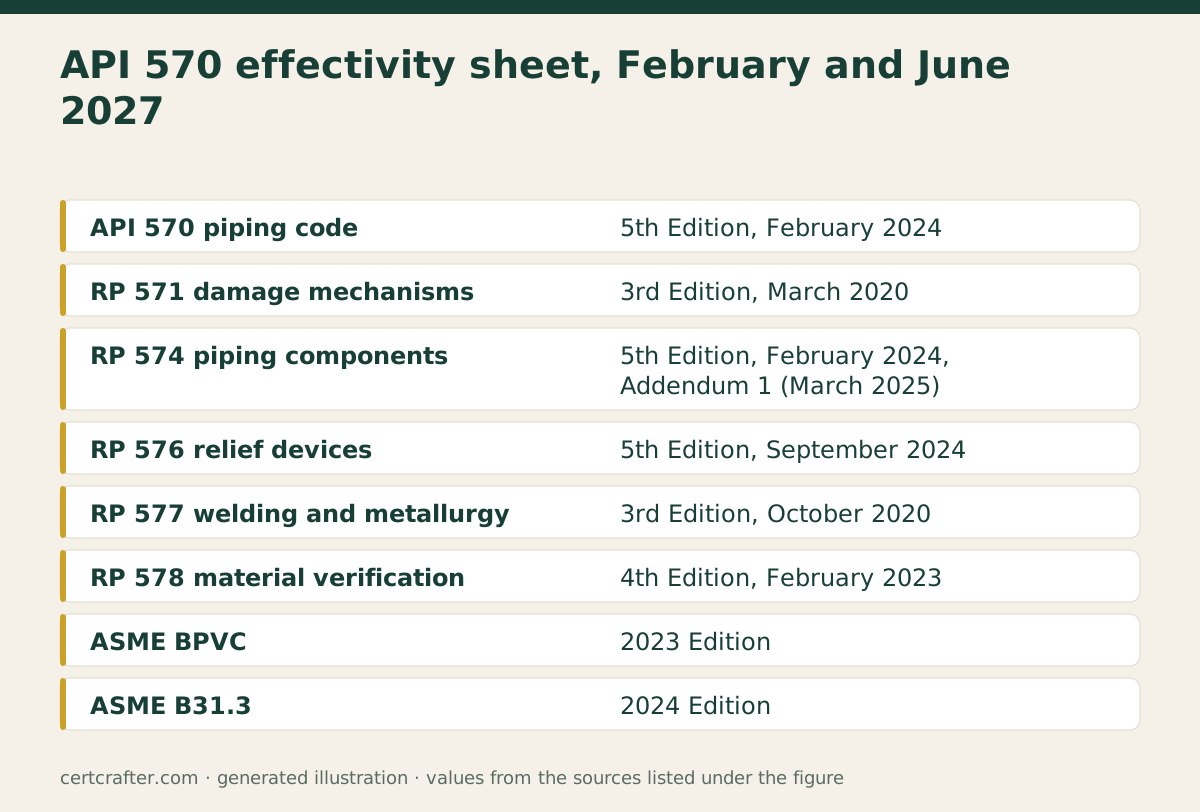
API publishes a separate sheet for each exam period. This one is headed for February 2027 and June 2027, and API’s Body of Knowledge for the same windows says it replaces 2026. The editions are below exactly as printed.
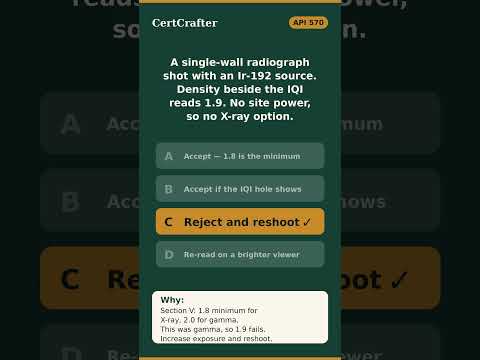 API 570 — Three of these four answers look right. Only one survives the code. Watch on YouTube · CertCrafter
API 570 itself is the 5th Edition, February 2024. RP 574 is the 5th Edition, February 2024, with Addendum 1 of March 2025, so the addendum counts too. RP 576 is the 5th Edition, September 2024. RP 577 is the 3rd Edition, October 2020, and RP 578 is the 4th Edition, February 2023. RP 571 is the oldest on the list, the 3rd Edition of March 2020.
ASME arrives as the Boiler and Pressure Vessel Code, 2023 Edition, plus B16.5 (2020 Edition, issued January 2021), B31.3 (2024 Edition, issued December 2024) and PCC-2 (2022).
A short video on our channel works through the four-answer habit that this sheet trains, where three options look right and only one survives the code: API 570, three of these four answers look right.
Which documents are examinable only in part?
Three. This is where the sheet saves you the most time, and where a keen reader wastes the most.
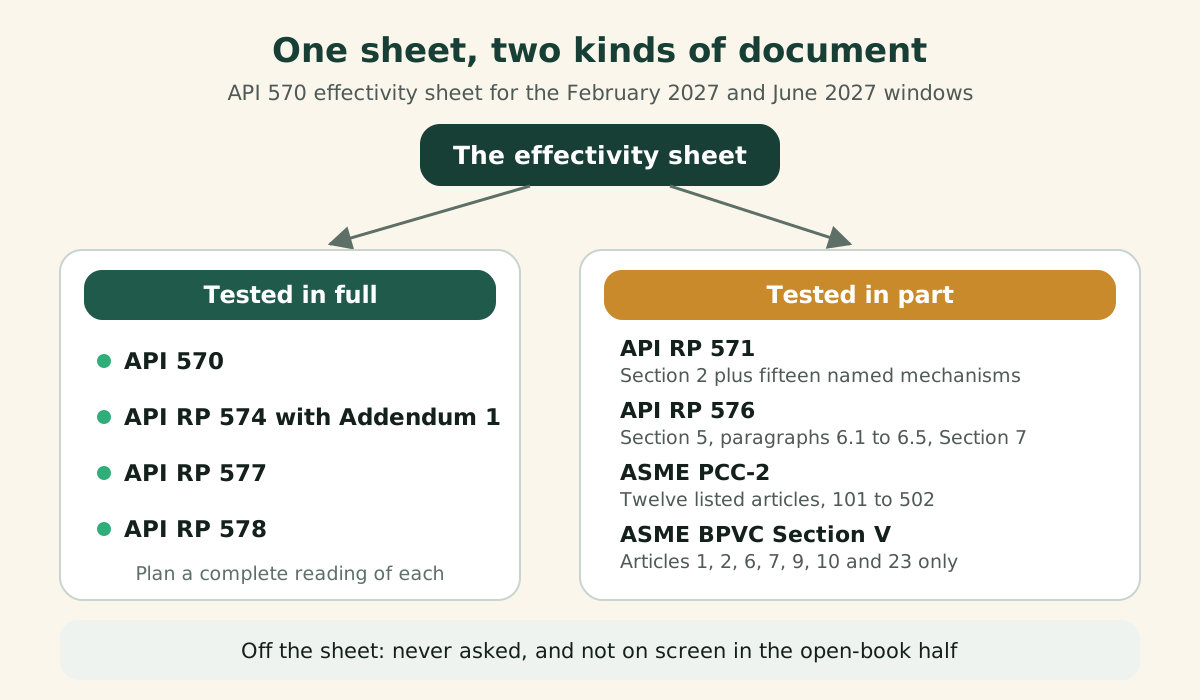
RP 571 is limited to Section 2, Definitions, and fifteen mechanisms: amine stress corrosion cracking, atmospheric corrosion, boiler water and steam condensate corrosion, caustic corrosion, caustic stress corrosion cracking, chloride stress corrosion cracking, corrosion under insulation, erosion and erosion corrosion, galvanic corrosion, hydrochloric acid corrosion, mechanical fatigue including vibration-induced fatigue, microbiologically influenced corrosion, soil corrosion, sour water corrosion (acidic) and sulfidation. Anything else in the document is outside the exam.
RP 576 is Section 5, paragraphs 6.1 to 6.5, and Section 7. That is all.
PCC-2 is listed article by article: 101, 201, 206, 209, 210, 211, 212, 304, 305, 306, 501 and 502. The sheet says the exam covers each of those articles and its appendices.
Section V of the ASME code is trimmed too: Articles 1, 2, 6, 7, 9, 10 and 23, with Article 23 narrowed to SE-797. Section IX is welding only. The Body of Knowledge adds that brazing is not covered.
The other documents are listed without a cut. API’s Body of Knowledge says API 570, RP 574, RP 577 and RP 578 are each subject to testing in their entirety.
What do these limits mean on a real job?
On a unit, nobody tells you which damage mechanisms to worry about. You walk the line, see wet insulation, and think about corrosion under insulation. You see a vibrating small-bore connection and think fatigue. Field judgment is wide, and the exam is deliberately narrower.
That mismatch bites in both directions. A strong inspector with ten years on hydrocrackers may know high temperature hydrogen attack cold and still meet no question on it, because it is not among the fifteen. A newer inspector who has read RP 571 front to back has spent hours on pages that cannot be asked.
PCC-2 shows the same gap. The articles on the sheet are the repairs a piping inspector actually signs off: a full encirclement sleeve (206), a mechanical clamp (306), a fillet welded patch (212), flaw excavation and weld repair (304), flange repair (305), and testing choices after the repair (501 and 502). A repair method that is common in your plant but has no article on the sheet is a shop skill, not an exam topic.
How is the sheet connected to the open-book half?
API’s page on the exam is plain about it. Only the specific sections of publications listed on the effectivity sheet are available to you during the open-book portion. The PDFs appear on your computer, in English, and papers, notes and books are not allowed in Prometric centers.
So the sheet sets two limits at once. It sets what questions can be written from, and it sets what you can open on screen. A requirement hidden in a section outside the sheet is not something you can look up, and not something you will be asked to look up.
One question in the free sample shows the pattern. A new nitrogen header cannot be hydrotested because it must stay dry, so the owner picks a pneumatic leak test under B31.3. The arithmetic is short, but only if you know which clause and which edition to open.
Worked example: turning the sheet into a reading list
- Print the sheet and the Body of Knowledge side by side. Write each edition next to the copy you actually own.
- Mark every document that is examinable in part. For RP 571, circle the fifteen mechanisms and cross out the rest of the table of contents. For RP 576, mark Section 5, 6.1 to 6.5 and Section 7.
- For the four documents tested in full (API 570, RP 574, RP 577, RP 578), plan complete readings. These carry the weight, so read them first.
- Match each Body of Knowledge calculation category to its clause. Corrosion rates sit in API 570 7.1.2, remaining life in the same section, inspection interval in 6.3.3 and Table 1. Minimum thickness for internal pressure sits in B31.3 304.1.1 and 304.1.2, pressure testing in 345.4 and 345.5.
- Note which formulas the Body of Knowledge says may be closed book: corrosion rate, remaining life and inspection interval, plus the rules for setting the intervals. Those go on flash cards, not in a bookmark.
- Fix any mismatch. If your PCC-2 is an older edition than the sheet’s 2022, or your copy of RP 574 lacks Addendum 1, replace it before you annotate anything.
Where do candidates go wrong with the sheet?
Four habits show up again and again.
The first is studying the edition you own. Jurisdictions and owner-users often work to older documents, and the Body of Knowledge says so itself: some organizations operate to other editions, but the exam is based on the editions in the effectivity sheet. Your site’s practice and the exam can both be right and still disagree.
The second is treating the Body of Knowledge exclusions as a hint. They are not. The B31.3 list excludes branch connections in 304.3, closures in 304.4, flexibility analysis in 319.4 and the whole of Chapter IX, among others. Time spent there is time taken from corrosion rates and weld joint quality factors.
The third is using one sheet for every window. This sheet names February 2027 and June 2027. It does not mention October 2027, so look up the sheet for your own window before you commit to a study plan.
The fourth is skipping the units note. The Body of Knowledge expects both US customary and SI, with both sets of formulas. A candidate who only trains in inches and psi loses minutes on conversions in the closed-book half.
Now look at how a question on a repair choice reads. A leaking weld on a process line was excavated and rewelded during the run, and the unit superintendent wants the line back in service without a hydrotest. The question asks what decides whether the pressure test can be omitted. The reasoning runs through API 570 and PCC-2 Article 502, both on the sheet, and the trap is a confident answer that every weld demands a test.
How do you use the sheet over the weeks before your window?
Use it three times. At the start, to buy and tab the right documents. Halfway, to audit your notes: for each line of your notes, can you point to a document and section on the sheet? And in the last week, to cut. Anything your notes cover that the sheet does not list can go.
Dates sit beside it. API’s schedules page lists the January 29 to February 19, 2027 window with an application deadline of November 26, 2026, and the June 4 to 25, 2027 window with a deadline of April 1, 2027. Both fall under this sheet.
What to do next
Download the sheet and the Body of Knowledge from API’s API 570 page today and compare each edition with the copy you own.
Then see how the dates and format fit together in API 570 exam format, scoring and dates. The certification guide covers eligibility and the Body of Knowledge, and the free ten-question sample shows how these editions get tested. More API 570 posts cover each section, and the four practice tests are built around the closed-book and open-book split.
Comments
Comments are read by a person before they appear. How we moderate.