Two words that sound alike on a plant can send you to different paragraphs of the code. Practical Knowledge General is full of them.
This post is a short glossary of the pairs that cost candidates marks. Each one gets the difference, the document that settles it, and the way the question is usually framed.
Which term pairs do API 570 candidates confuse most?
Here are the ones worth fixing in your head first. The right-hand column says where the answer lives, using the references API’s Body of Knowledge names.
| Pair | What separates them | Where to look |
|---|---|---|
| Repair and alteration | Whether a pressure test is normally required, or NDE may stand in | API 570, ASME PCC-2 Article 502 |
| WPS and PQR | The procedure written down, and the test record behind it | ASME Section IX |
| Essential and nonessential variable | Whether a change forces new test coupons | ASME Section IX |
| Pressure design and minimum required thickness | The allowances added on top | ASME B31.3 304.1 |
| Pneumatic and hydrostatic leak test | The multiplier on design pressure | ASME B31.3 345.4 and 345.5 |
| Weld joint and casting quality factor | Ej for a longitudinal weld, Ec for a casting | ASME B31.3 302.3.3 and 302.3.4 |
| Closed book and open book | What must live in your head | The Body of Knowledge |
None of these asks you to be clever. They ask you to know which word belongs to which rule.
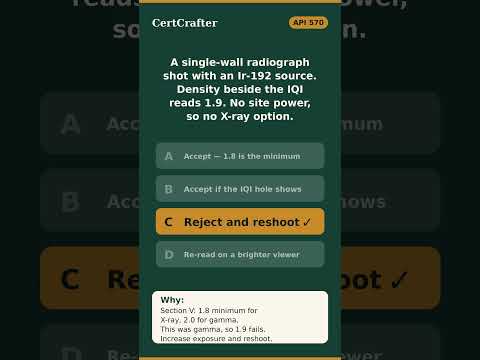 API 570 — Three of these four answers look right. Only one survives the code. Watch on YouTube · CertCrafter
If you like seeing this pressure in action, our channel has a short on the same habit: Three of these four answers look right. Only one survives the code. Wrong options on this exam are rarely absurd. They are real rules applied to the wrong word.
What is the difference between a repair and an alteration?
On a plant, people say “we fixed the line” for both. The code does not.
API 570 treats an alteration as work that normally calls for a pressure test afterward. For a repair, appropriate nondestructive examination can be substituted where a test is not practical, and the inspector has to accept the substitution. The Body of Knowledge points at ASME PCC-2 Article 502, nondestructive examination in lieu of pressure testing, and lists it among the PCC-2 articles that are examinable.
One of our free sample questions shows the trap. A leaking weld on a process line is cut out and rewelded during the run, and the unit superintendent wants the line back without a hydrotest. The correct reading is that rewelding a leak is a repair, so a route to omitting the test exists, and it runs through documented NDE, not through the schedule. The wrong options are the absolutes: every weld needs a hydrotest, or no test is needed after any repair.
On a real job the same mix-up shows up in paperwork. A work pack labelled “repair” that quietly changes the pipe’s rating or configuration has stopped being a repair, and the person signing it needs to notice.
Is pressure design thickness the same as minimum required thickness?
No, and this is the quiet killer of calculation questions.
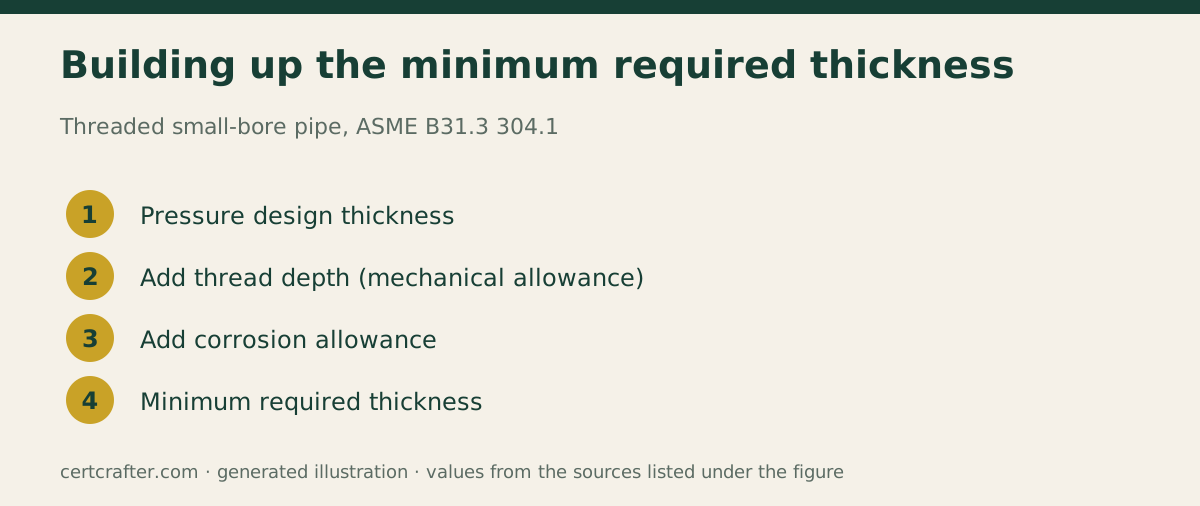
The Body of Knowledge asks the inspector to find the minimum required thickness of straight pipe for internal pressure using ASME B31.3, 304.1.1 and 304.1.2. It adds that the inspector should compensate for the corrosion allowance, adding or subtracting as the problem requires. Read the last clause twice. The exam is telling you the allowance is a moving part.
Worked example: a threaded connection
Take a threaded small-bore connection on a process line. The numbers change from question to question, the order of the steps does not.
- Pressure design thickness: pressure times outside diameter, divided by twice the sum of the allowable stress times E times W, plus pressure times Y. This is the number for pressure alone.
- Add the thread depth. It counts as a mechanical allowance because threading removes metal from the wall.
- Add the corrosion allowance, or subtract it if the problem says so.
- The result is the minimum required thickness, before mill tolerance.
One of our free sample questions runs exactly this case. The distractors map to the term mix-up: one option forgets the corrosion allowance, one forgets the thread depth, and a third divides by a mill tolerance factor, which is a step used afterward to pick a nominal wall to order, so it answers a different question. Read the last line of the stem, the one that says “before mill tolerance”, and stop where it stops.
What is the difference between a WPS, a PQR and a WPQ?
Three documents, three jobs, and the Body of Knowledge expects you to review all three.
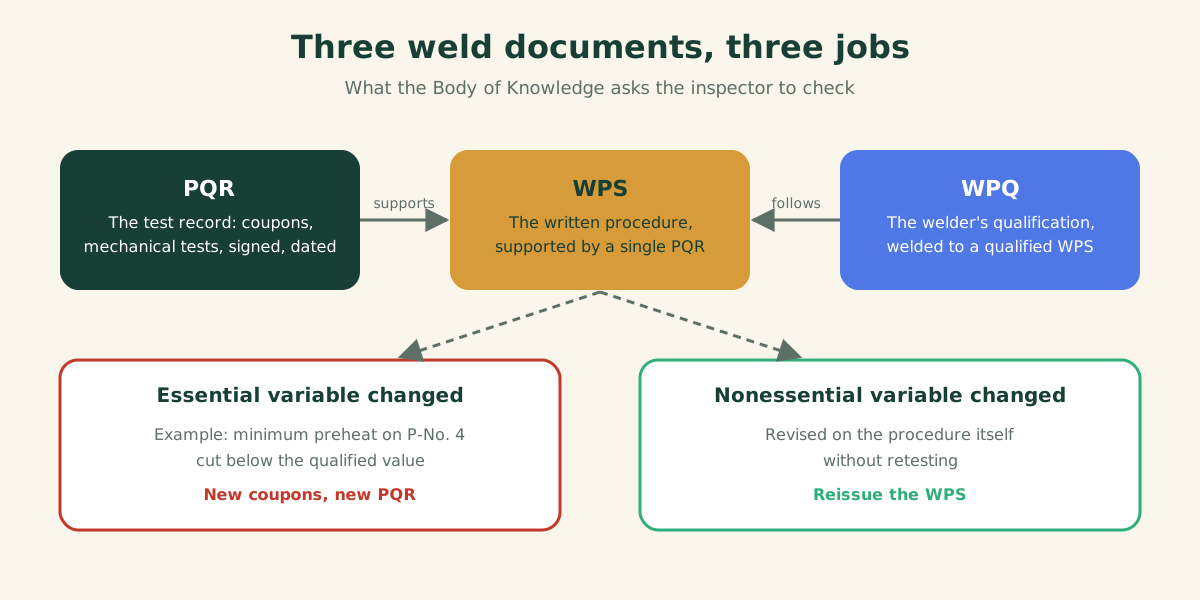
The PQR records the qualification test. The WPS is the written procedure supported by that test. The WPQ shows a welder is qualified to make a production weld according to the WPS. For the exam, the weld procedure review is limited on purpose: no more than one process on a single WPS, PQR or WPQ, a WPS supported by a single PQR, and base metals limited to P-No. 1, 3, 4, 5 and 8. Dissimilar metal joints and overlays are excluded.
One detail is worth memorizing because it is so easy to forget. The Body of Knowledge says the PQR and WPQ must be signed and dated. Editorial items such as the company name, WPS number and testing lab are not tested.
How do essential and nonessential variables change the answer?
The Body of Knowledge asks whether all required essential and non-essential variables have been properly addressed. The difference is what a change costs you.
A change in an essential variable means the procedure has to be requalified with new test coupons and a new PQR. A nonessential variable is revised on the WPS without retesting. A sample question has a contractor cutting the minimum preheat on P-No. 4 material because of schedule pressure. The inspector cannot accept that on a signature. The decrease is far beyond the margin Section IX allows, so it needs a new PQR.
The wrong options each borrow a real rule: a welding engineer’s signature (that handles nonessential changes), impact testing (tied to supplementary essential variables, which the exam leaves out of the WPS and PQR), or requalifying welders (which fixes nothing about the procedure).
What is the difference between a pneumatic and a hydrostatic leak test?
Both are leak tests in ASME B31.3, hydrostatic in 345.4 and pneumatic in 345.5, and the Body of Knowledge expects you to calculate the pressure for each.
The pneumatic multiplier is 110 percent of design pressure. The hydrostatic case uses a larger factor. A compressed gas stores far more energy than water, so a failure during a pneumatic test is far more dangerous, which is why the multiplier is lower and why the code wants the pneumatic route justified.
The sample case is a nitrogen header that must stay dry, so a hydrotest is out. The answer is 1.10 times the design pressure. One wrong option applies the hydrostatic factor to the wrong test, and another tests at design pressure, which proves nothing beyond normal operation.
In the field, the term pair changes who needs to be standing where. A pneumatic test needs a larger clear zone and a low-pressure preliminary check, a point the question explanation also makes.
Which quality factor goes with which product form?
This one is a quick win. The Body of Knowledge says the inspector should determine the casting quality factor, Ec, from ASME B31.3 302.3.3(b) and Table A-1A, and the weld joint quality factor, Ej, from 302.3.4 and Table A-1B. It adds that supplemental NDE can increase the joint factor, and that the joint factor sits inside the thickness and pressure formulas.
So a question that gives you a longitudinal weld wants Ej. A casting wants Ec. A candidate who reaches for the wrong table can do everything else right and still miss.
How do closed book, open book and the two Practical Knowledge sections differ?
The exam has two parts. The closed-book part tests working knowledge of API 570 and the reference documents. The open-book part uses more detailed information that you should be able to find but would not normally memorize. According to API’s published figures, the closed-book part is 110 questions in 2 hours 45 minutes, followed by 60 open-book questions in 3 hours 45 minutes.
Practical Knowledge General (section IV) is the list of nineteen topics. Practical Knowledge Specific (section V) says which parts of each reference may be tested. API 570, RP 574, RP 577 and RP 578 are subject to testing in their entirety. RP 571 and RP 576 are limited to named sections.
A last pair worth separating is the Body of Knowledge and the effectivity sheet. The first says what is covered, the second says which edition is effective for your window. Your plant may run an older edition, but the exam is written to the sheet.
How should you drill the term pairs?
Make a two-column card for each pair in the table, then write a one-line trigger for each: “alteration, test normally required”, “essential, new PQR”, “pneumatic, 1.10”. Say them aloud on the drive home.
Then check yourself against the free ten-question sample, where several of these pairs appear. Our General Practical Knowledge guide covers the thickness, life and interval chain, and the common mistakes post covers how candidates trip on editions and units.
What to do next
Open the Body of Knowledge from API’s API 570 page and underline every “and” and “or” in sections I and II. Each one hides a pair.
Then read the certification guide, browse the other API 570 posts and work through the practice tests.
Comments
Comments are read by a person before they appear. How we moderate.