Most people who fail API 570 did not fail on piping. They failed on preparation: the wrong edition, a formula they had to look up, a code section the exam never asks about.
Here are ten mistakes, each with what the plant does, what the exam does, and the fix. Exam-wide ones only. The domain-specific traps have their own posts.
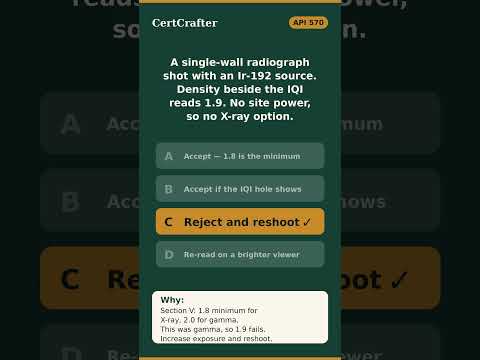 API 570 — Three of these four answers look right. Only one survives the code. Watch on YouTube · CertCrafter
If you want to see how the answer options are built, our short API 570 video shows a question where three of four answers look right and only one survives the code.
What are the 10 most common API 570 mistakes?
| # | Mistake | What the Body of Knowledge says |
|---|---|---|
| 1 | Studying the wrong edition | Questions come from the editions on the effectivity sheet |
| 2 | Looking formulas up | Corrosion rate, remaining life and intervals may be closed book |
| 3 | Using the wrong thickness | Life is measured against the minimum required thickness |
| 4 | One unit system only | US customary and SI formulas are both expected |
| 5 | Studying excluded sections | Thirty B31.3 items are excluded |
| 6 | Answering from plant habit | API 570 welding rules take precedence over B31.3 |
| 7 | Confusing repair and alteration | Pressure testing after repairs and alterations is listed |
| 8 | Guessing welding variables | You review a WPS, PQR and WPQ |
| 9 | Practicing on paper | Codes are on-screen PDFs |
| 10 | Treating the application as a formality | Experience is documented and verified |
Why does the wrong edition sink so many candidates?
Because it feels like a detail. It isn’t.
API’s effectivity sheet for the February 2027 and June 2027 windows lists API 570, 5th Edition, February 2024, then RP 571, 574, 576, 577 and 578 with their editions, plus ASME B31.3 (2024), B16.5, PCC-2 and Sections V and IX of the Boiler and Pressure Vessel Code (2023). The Body of Knowledge adds a warning that matters to anyone who works under a jurisdiction on an older edition: the exam is based on the sheet, not on your local rules.
On a plant you follow the edition your site or jurisdiction adopted. On the exam you follow the sheet. Both are correct in their own place.
The fix is a ten-minute job. Open the sheet for your window before you buy a single book. Our guide to the 2027 effectivity sheet walks through it.
Which formulas must you know without a book?
Three, and they are one chain: corrosion rate (API 570, 7.1.2), remaining life and inspection interval (6.3.3 and Table 1). The Body of Knowledge says plainly that these formulas and the rules for setting intervals may be closed book.
That matters because of how the day is split. The closed-book session has 110 questions in 2 hours 45 minutes. The open-book session has 60 in 3 hours 45 minutes. Nearly two thirds of the questions come before you can open anything.
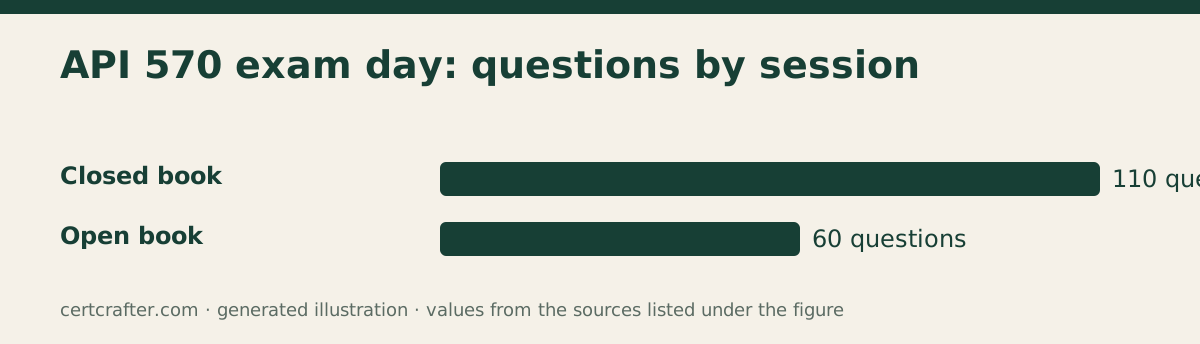
In the field nobody calculates a remaining life from memory. They open the spreadsheet. The exam takes the spreadsheet away, so practice with a blank page.
Which thickness goes into the calculation?
This is the mistake that costs marks even when the formula is perfect. Remaining life is the margin left divided by the corrosion rate, and the margin is the latest reading minus the minimum required thickness. Not the nominal wall. Not the thickness the pipe schedule suggests.
The rate has its own trap. It uses the time between the two readings, not the age of the line.
On a real job the trap gets worse. Readings come from many locations on a circuit, some noisy. Inspectors look at the trend, ask what the service is, and think about the damage mechanism before they trust a rate. An exam question hands you two clean numbers, so the only way to fail is to feed the wrong ones in.
Why do units catch people out?
Because most inspectors work in one system all year. The Body of Knowledge says candidates are expected to understand both US customary units (inches, feet, psi) and SI, and to use the formulas in both.
Run each practice calculation twice. Once in inches, once in millimeters. If the answers do not agree, you have a conversion habit to fix before exam day.
What is the point of reading the excluded sections list?
It saves weeks. The Body of Knowledge lists thirty ASME B31.3 requirements that are excluded from the exam, and the inspector is not expected to know them. Among them are most of the design criteria in paragraph 302 (all except the casting quality factor and weld joint quality factor), external pressure in 304.1.3, branch connections in 304.3, closures, reducers, flexibility analysis, and the nonmetallic and high pressure chapters.
RP 571 and RP 576 are partial too. Only fifteen entries of RP 571 are on the exam, including section 2 definitions, amine stress corrosion cracking, corrosion under insulation, chloride stress corrosion cracking, sulfidation and soil corrosion. For RP 576, only sections 5, 6.1 to 6.5 and 7.
API 570, RP 574, RP 577 and RP 578 are different. Those are subject to testing in their entirety.
Read the whole of B31.3 and you will have learned a lot of piping and lost a lot of time. Study the included parts hard.
Should you answer the way your plant does?
No, and this is the one experienced inspectors resist most.
A plant might hydrotest every repaired weld because that is the site rule. Another might inspect on a calendar that suits the shutdown plan. Neither is the exam answer. The exam answer is what API 570 says. Where API 570 has welding rules, the Body of Knowledge states they take precedence over the same areas in ASME B31.3.
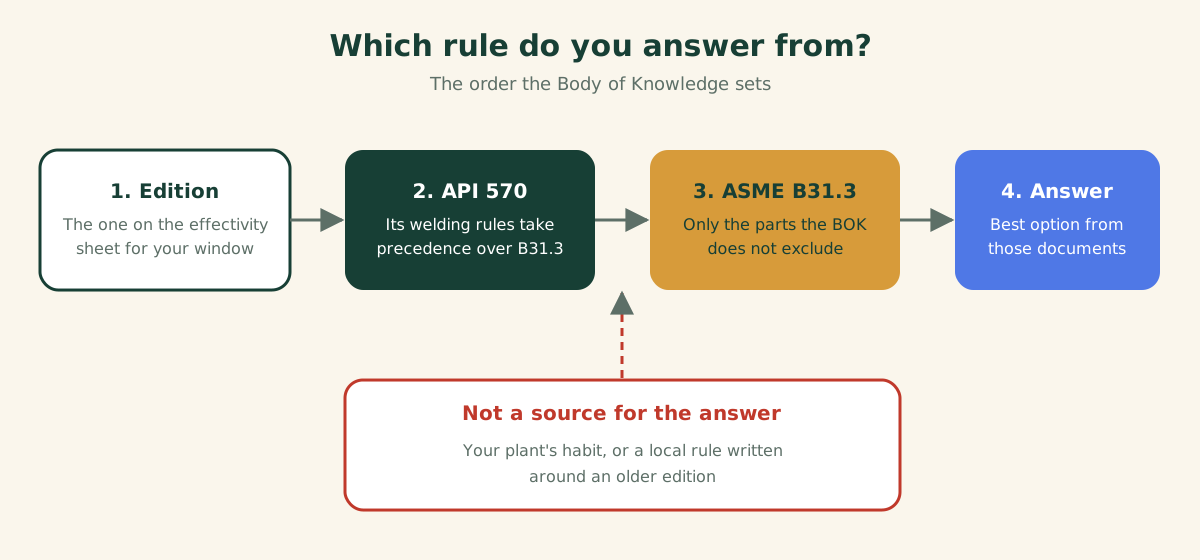
Ask one question of every item: which document answers this, and which edition? If you can’t name the paragraph, you are answering from habit.
What goes wrong with repairs, alterations and pressure tests?
Pressure testing after repairs, alterations or rerating is a listed topic, and candidates tend to flatten it into one rule. The usual flattening is “every weld on in-service piping gets a hydrotest.” That is too absolute.
One of our free sample questions covers a leaking weld that was excavated and rewelded during the run, with a superintendent who wants the line back without a hydrotest. The explanation separates the two cases. An alteration normally calls for a test. For a repair, suitable nondestructive examination can be accepted by the inspector where a test is not practical. Learn the split, then learn where in API 570 it sits, because the answer options will describe both halves.
How do candidates mishandle the welding questions?
By guessing. The Body of Knowledge expects you to review a welding procedure specification (WPS), the procedure qualification record (PQR) and the welder performance qualification (WPQ), decide whether essential and nonessential variables were addressed, check that the number and type of mechanical tests are right, and decide whether the welder is qualified for the production weld. It also states that the PQR and WPQ must be signed and dated.
The scope is narrower than people fear. One process per WPS, filler metals limited to one per process, base metals limited to P-No. 1, 3, 4, 5 and 8, dissimilar metal joints excluded, and brazing not covered.
Within that, the sorting question is always the same: does this change need new testing, or can it be revised on paper? Two free sample questions test exactly that, one on postweld heat treatment and one on a lowered preheat. Try them below before you read the explanations.
Why does practicing on paper hurt you?
Because the exam does not supply paper. Papers, notes and books are not allowed in the Prometric centers. During the open-book portion the pertinent codes are PDFs on your computer, in English, and only the sections listed on the effectivity sheet are available.
Habit matters here. An inspector who has tabbed and highlighted a paper B31.3 for ten years finds that searching a PDF is a different skill. Practice finding Table A-1B or a paragraph number on screen, against a clock, until it stops feeling slow.
Is the application really a formality?
It is the one mistake that has nothing to do with knowledge. API says the minimum experience must be documented on your application and will be verified after you submit it. The education and experience combinations run from one year for a candidate with an engineering degree to five or more years with no formal education, and the experience must have been acquired within the last ten years.
Dates matter too. The October 2026 window ends on October 30. The next one runs from January 29 to February 19, 2027, with an application deadline of November 26, 2026. Our post on exam format, scoring and dates lists the rest.
Passing is a scaled 400 on a 200 to 500 scale, and 30 of the 170 questions are unscored pretest items you cannot identify. Treat every question as if it counts.
What should you do next?
Print the ten mistakes, tick the ones you recognize in your own plan, and fix the first one today: open the effectivity sheet for your window.
Then try the free ten-question sample, read the certification guide, and browse the other API 570 posts. If you are still deciding between inspector paths, API 510 vs 570 vs 653 compares the three. The four practice tests follow the closed-book and open-book split.
Comments
Comments are read by a person before they appear. How we moderate.