Most API 570 candidates know what radiography and ultrasonic testing are. They lose marks because the exam asks what ASME Section V says about them, and the two are not the same thing.
What does the Nondestructive Examination section cover?
It is section III of API’s Body of Knowledge, and it names its sources exactly. The first is ASME Section V, Nondestructive Examination, where the exam covers only the main body of each referenced article. The second is the general NDE rules in ASME B31.3 and in API 570 itself.
The Section V articles in scope are few. Article 1 covers general requirements. Then come Article 2 on radiography, Article 6 on liquid penetrant, Article 7 on magnetic particle, Article 9 on visual examination, Article 10 on leak testing and Article 23 on ultrasonic thickness measurement.
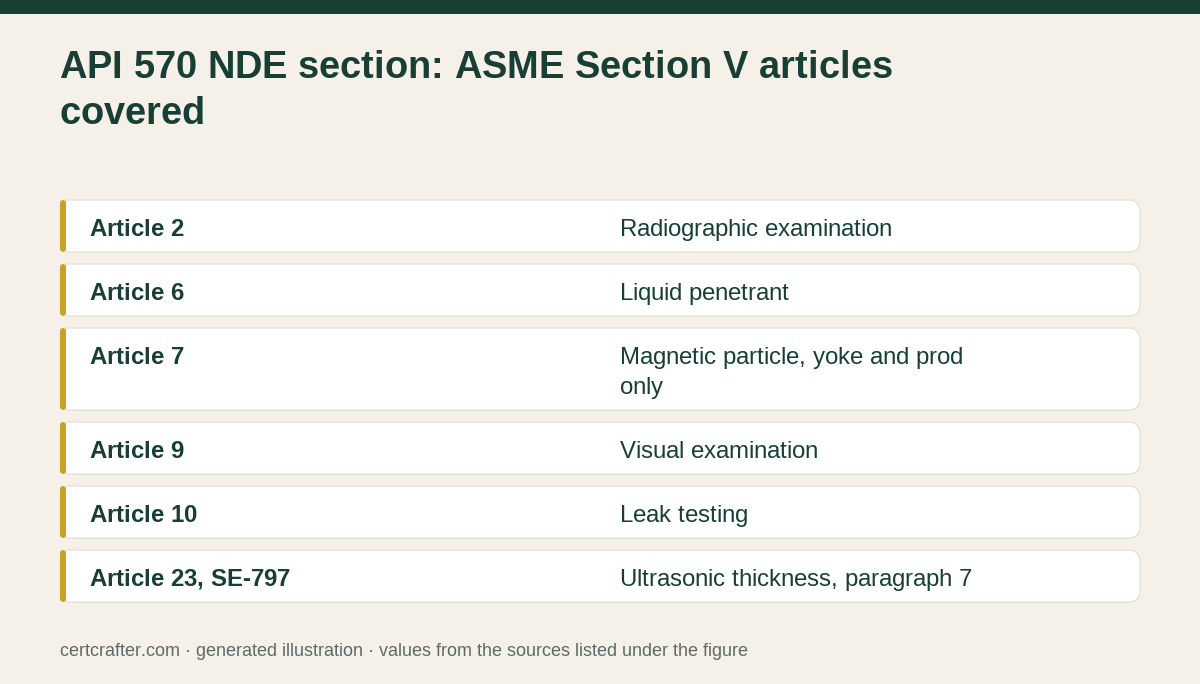
Two limits matter. Magnetic particle is yoke and prod techniques only. Ultrasonic is SE-797 only, the manual pulse-echo contact method for thickness, and the Body of Knowledge points to paragraph 7 for the procedure. Flaw detection by ultrasonic is not in this list.
How do inspectors use these methods on a plant?
A piping inspector rarely performs the examination. Specialists do, and the inspector decides what is needed, reviews the procedure and accepts or rejects the result. That is why the Body of Knowledge wording is “familiar with and understand”.
Take thickness. On a unit, readings are planned on the piping that thins first, such as the outlet side of a letdown valve. The gauge is calibrated on a block of the same material, the readings go into the record, and the corrosion rate comes from comparing them with earlier readings. Radiography on a butt weld brings the same discipline: the film is checked for marking, the image quality indicator and density before anyone looks for defects.
The common field mistake is accepting a record because the result looks fine. If the calibration, the procedure or the film quality was not right, the result is not a result.
How are NDE questions framed on the exam?
Almost every one gives a situation and a constraint, then asks what applies. A radiograph is taken with a gamma source and the site has no power for X-ray. A thickness gauge shows a reading that does not match the block. The constraint decides which rule to use.
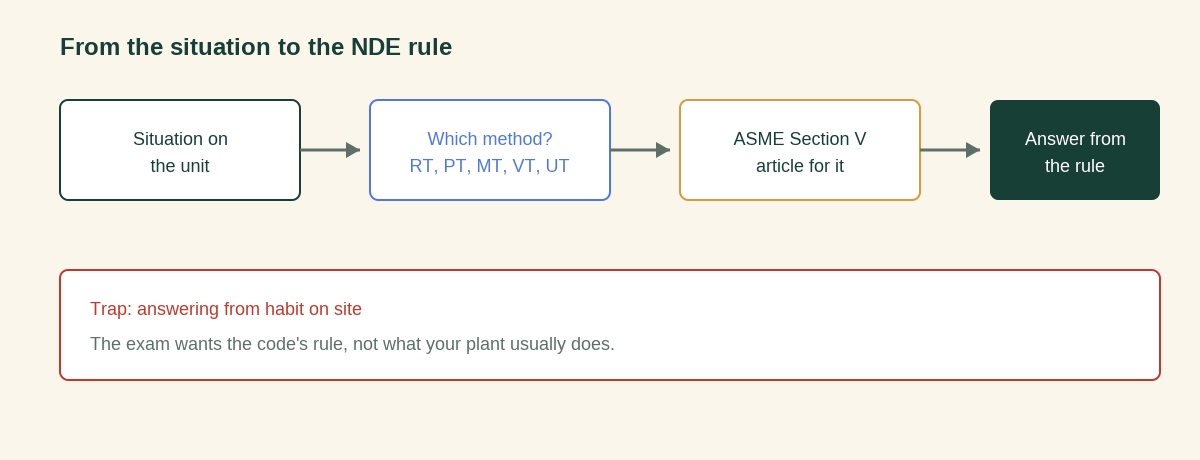
Worked example: from a plant situation to the right article
A repaired butt weld on a process line needs examining before the line returns to service, and the only source on site is a gamma source. Work it in four steps.
- Name the method the situation needs: radiography, so ASME Section V Article 2.
- Pick out the constraint: the source is gamma, not X-ray.
- Go to the Article 2 rules for the shot: marking, the image quality indicator, allowable density.
- Check each against the film, then the record. A film that fails on density is rejected even when the indicator shows.
Describe a second case, a surface crack check on a carbon steel elbow, and the path repeats with Article 6 or Article 7. The method of reasoning is the same every time, and it is the one thing worth drilling.
Here are two samples from the free tier of our API 570 bank, one open-book radiography question and one on ultrasonic thickness. Read the explanation after each, then say which article each one comes from.
The ultrasonic question rests on one idea: a pulse-echo gauge times a round trip, so thickness is half the transit time multiplied by the velocity of the material. The wrong options come from forgetting to halve and from using the wrong wave velocity. The radiography question turns on which source was used, because the source decides the minimum density that applies.
The API 570 Piping Inspector Complete Exam Kit works more of these under timed conditions, with every answer explained.
What do the rules look like side by side?
The articles share one pattern: scope, general requirements, technique, interpretation, records. The Body of Knowledge lists them in nearly the same order for each method.
| Article | Method | What the exam wants you to know |
|---|---|---|
| 2 | Radiographic | Marking, image quality indicators, density, backscatter control |
| 6 | Liquid penetrant | Procedures, contaminants, techniques, interpretation |
| 7 | Magnetic particle | Yoke and prod techniques, calibration |
| 9 | Visual | Procedures, physical requirements, evaluation |
| 10 | Leak testing | Bubble test, direct pressure technique, calibration |
| 23 | Ultrasonic thickness | SE-797, paragraph 7 procedure |
Use the table as a map, not a summary. The detail sits in the articles, and the exam draws from the detail.
Where do candidates lose marks in this section?
Three places, in my experience of what candidates report:
- They answer from site habit. The code rule and the plant’s usual practice can differ, and the exam wants the code.
- They treat the methods as one subject. Penetrant, magnetic particle and visual each have their own article with their own requirements.
- They skip records. Each article ends with documentation and record keeping, and questions on it are easy marks.
Candidates also open the wrong book. In the open-book part, the first job is to pick the article from the situation, then find the paragraph.
How should you study it?
Print the list of articles and write one line beside each: what the examiner would need to see to accept the result. Then practice going from a plant situation to the article in the on-screen format. Our guides on the 2027 effectivity sheet and the specific practical knowledge section cover the neighboring ground. Our channel also works many questions of this kind: API 570 Exam Prep, 23 Worked Questions, Fully Explained.
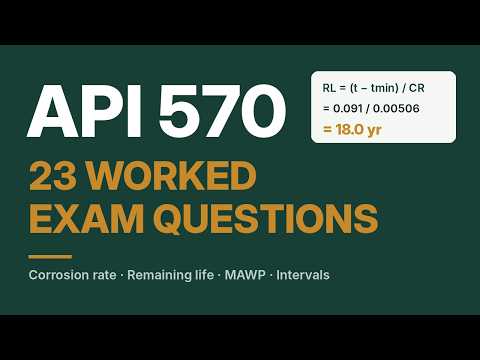 API 570 Exam Prep: 23 Worked Questions, Fully Explained Watch on YouTube · CertCrafter
What to do next
Open the Body of Knowledge from API’s API 570 page, go to section III, and tick the articles you have never read in full.
Then try the free ten-question sample, read the certification guide, and browse the other API 570 posts.
Comments
Comments are read by a person before they appear. How we moderate.