Most API 570 candidates start by reading codes front to back, and by the time the application deadline arrives they have covered a lot of pages the exam never asks about.
What order should an API 570 study plan follow?
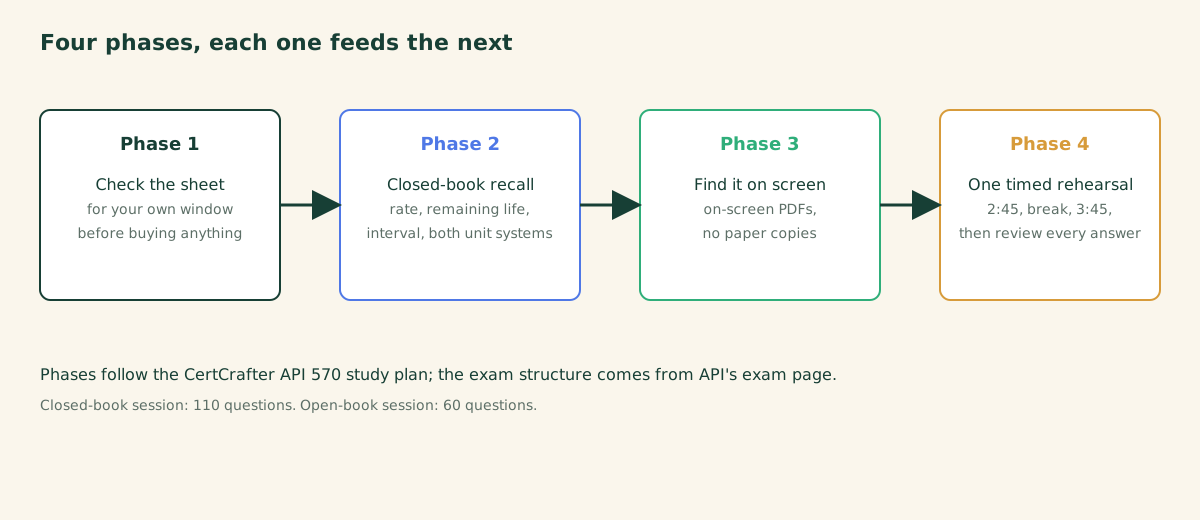
Four phases, in this order. The order matters more than the length of each one.
First, confirm which documents and editions apply to your exam window. Second, build recall of the calculations that API says may be closed book. Third, learn to find requirements quickly in the on-screen reference set. Fourth, sit one full rehearsal that copies the real structure and review every explanation.
 API 570 Exam Prep: 23 Worked Questions, Fully Explained Watch on YouTube · CertCrafter
The channel has a longer session on how the questions are framed: API 570 exam prep, 23 worked questions.
What does each phase actually involve?
| Phase | Job | Why it comes here |
|---|---|---|
| 1. Sheet | Match your documents to the effectivity sheet | Questions come from the editions on the sheet |
| 2. Closed book | Rate, remaining life, interval, in both unit systems | Scored without any reference on screen |
| 3. On screen | Find clauses in PDFs, not in tabbed paper | Papers, notes and books are not allowed |
| 4. Rehearsal | One full timed sit, then review every answer | Tests stamina and your finding speed together |
Phase 1 is short and cheap. Phase 2 is where most of your hours should go early. Phases 3 and 4 only work once phase 2 is solid, because slow arithmetic eats the minutes you need for navigation.
Why does the closed-book phase come before everything else?
API’s Body of Knowledge says the formulas for corrosion rate, remaining life and the inspection interval rules may be closed book during the exam. It also says candidates are expected to understand US customary and SI units and to use both systems of formulas.
That is a recall job, and recall needs repetition spread over days. Cramming it in the last week fails because the open-book half then feels easy and the closed-book half does not.
The same chain shows up on a real unit. You take thickness readings at a monitoring location, you work out how fast the wall is thinning, and you decide how long until it reaches the minimum. Then you set the next inspection date. The inspector who has done this by hand a few dozen times needs no book for it.
How do you plan backward from a real exam window?
Start at the window, not at today. API’s schedules page lists a 570 window from January 29 to February 19, 2027 with an application deadline of November 26, 2026, and another from June 4 to 25, 2027 with a deadline of April 1, 2027.

Worked example: a plan built from the June 2027 window
- Take the window start, June 4, 2027, and the application deadline, April 1, 2027. The deadline is the date by which your experience documentation and application must be done, so the plan has two clocks.
- Use the days before the deadline for phase 1, and for the first pass of phase 2. Application paperwork and the effectivity check sit together because both are administrative.
- Spend the weeks between the deadline and the window on the rest of phase 2, then phases 3 and 4. Place the rehearsal about a fortnight before the window so there is time to fix what it shows.
- Write the plan down as dates, not as hours per day. A date on a calendar survives a night shift. A promise to study every evening does not.
The shape is the point. Any long plan you read online that gives an exact number of weeks per phase is the writer’s estimate, not API’s, and API publishes no recommended study duration.
How do working inspectors fit study around a job?
Badly, at first. Plant work comes in surges: a turnaround, an outage, a corrosion under insulation walkdown that takes three weeks of evenings. A plan built on a fixed hour each night collapses the first time that happens.
What works is a plan that lets you miss a week without losing the sequence. Keep phase 2 to short daily recall sessions. Keep phase 3 for longer weekend blocks. Tell your supervisor the date of the rehearsal early, because it needs a long clear day.
Use your job as material. When you read a thickness report at work, work out the corrosion rate and the remaining life before you read the inspector’s number. Do it in both unit systems once.
Where do candidates go wrong with study plans?
The first mistake is studying documents you own instead of documents on the sheet. The Body of Knowledge says the exam is based on the editions in the effectivity sheet, even where your jurisdiction uses something else.
The second is reading the excluded sections list as optional. API lists whole parts of B31.3 as outside the exam, including flexibility analysis and Chapter IX on high pressure piping. Study time spent there is taken from corrosion and remaining life.
The third is practicing from paper. The exam shows PDFs of the codes on your computer during the open-book portion, and personal paper copies are not available. A candidate who tabbed a printed code for months has built habits that do not transfer.
The fourth is skipping the review. After a rehearsal, the questions you got right for the wrong reason are the ones that cost marks later.
How does the exam-day structure shape the plan?
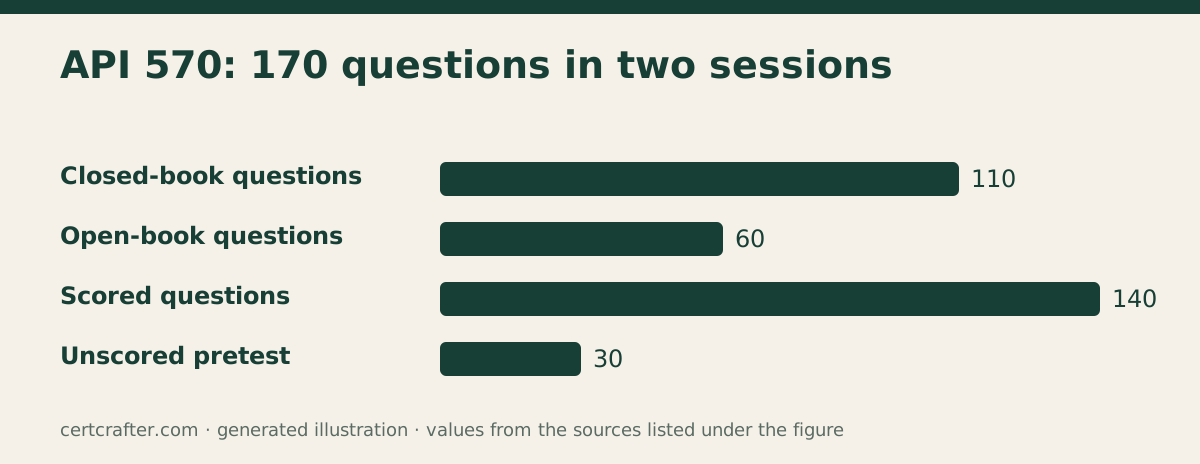
The exam day is 7.5 hours: a short tutorial, 2.75 hours closed book, a 45-minute break and 3.75 hours open book. There are 170 questions, 140 scored, and 110 are closed book with 60 open book. API publishes no raw percentage for passing, so do not plan around a number you read on a forum.
Because the 30 pretest questions are not marked, treat every question as scored. A plan should also include sitting the closed-book block without a break, once, before exam day.
The API 570 Complete Exam Kit works through the closed-book and open-book halves under timed conditions, with every answer explained.
What should you do next?
Open API’s API 570 page, pick your window, and write the application deadline and the rehearsal date on a calendar today.
Then read the effectivity sheet guide and how the exam is scored. The certification guide covers eligibility, the free sample shows how questions are framed, and the API 570 hub lists every topic post. The practice test bundle is the place to run the final rehearsal.
Comments
Comments are read by a person before they appear. How we moderate.