API 570 Practice Questions (Free, With Explanations)

By Sandeep Bandyopadhyay, Senior aerospace engineer · PMP, MBA, Six Sigma

TL;DR

Three free API 570 practice questions sit on this page, each with the full answer and explanation. They follow the exam's shape: 110 closed-book questions in 2 hours 45 minutes, then 60 open-book questions in 3 hours 45 minutes. That is 170 questions, 140 of them scored. Passing is a scaled 400 on a 200-500 scale. Windows from February 2027 use API 570 5th Edition and ASME B31.3 in its 2024 Edition.

Original questions, not exam dumps. Every CertCrafter question is written from the published body of knowledge and the referenced codes. None is copied from a live exam, and CertCrafter is independent: not affiliated with or endorsed by any awarding body.

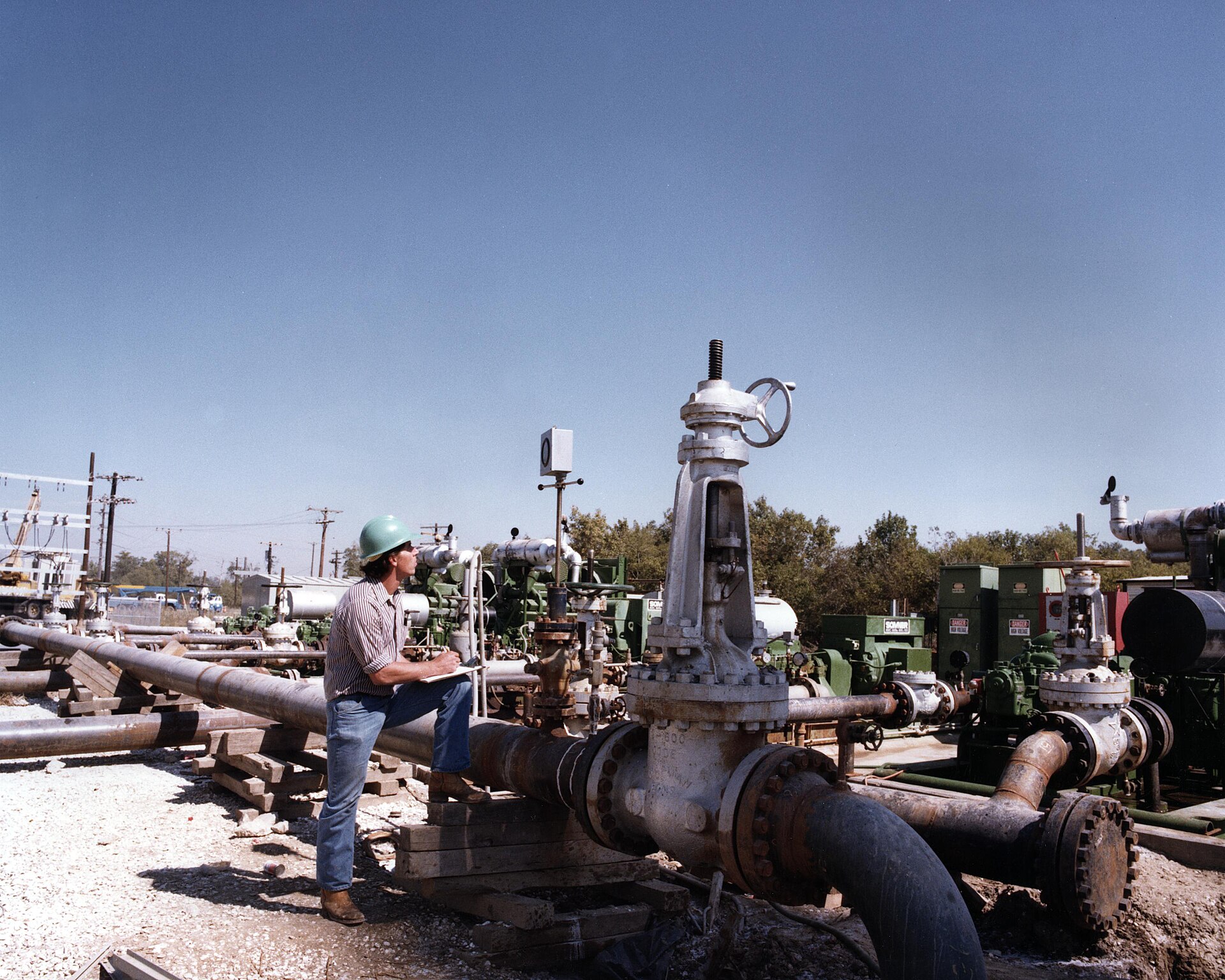
Large storage tanks and process piping at a strategic petroleum reserve site
Photo: United States Strategic Petroleum Reserve 029 by ENERGY.GOV (Wikimedia Commons), Public Domain, via Wikimedia Commons.

Many API 570 candidates know the rules and still miss the question, because the exam asks for a call on a piece of pipe, not a number recalled. The three free questions below are written that way, each with a full explanation you can open once you have committed to an answer.
Video: API 570 Exam Prep: 23 Worked Questions, Fully Explained API 570 Exam Prep: 23 Worked Questions, Fully Explained Watch on YouTube · CertCrafter
Image: video thumbnail, source: CertCrafter on YouTube (@certcrafters).

What do these free API 570 questions test?

Take them cold. The three questions touch three parts of an inspector’s job: where to look on piping that is losing metal, what to do with welding consumables that have been exposed, and how to judge a radiograph. They are labeled closed book or open book, as the exam labels them, and they come from the free sample behind the scored API 570 quiz.

The Body of Knowledge has five sections: practical knowledge general, calculations, practical knowledge specific, nondestructive examination, and welding procedure and qualification evaluation. API publishes no percentage weights for them. Each question puts you in front of a decision, with a constraint attached.

What does a thickness survey have to do with the exam?

Every reading predicts where the metal goes next. Erosion, flashing and turbulence thin pipe in places a uniform grid of readings will never find. Experienced inspectors read the process first and put the readings where the fluid changes velocity, phase or direction.

API RP 574 is the practices document that tells you where those places are. The first question sends you into exactly that thinking. A grid laid out evenly is easy to defend on paper and poor at finding the worst point.

Why do welding consumables show up in a piping exam?

Because an inspector signs off on repairs, and a repair is only as good as what went into it. A low hydrogen electrode that has picked up moisture puts hydrogen into the weld. On a joint with restraint and a hard heat affected zone, that is how delayed cracking starts, sometimes a day or more after the welder has gone home.

On site, the discipline is heated ovens, a logged exposure time, and a rule nobody argues with at six in the morning. API RP 577 is the reference. The second question puts that discipline under pressure from a schedule, and the exam wants you to hold the line.

How do you judge a radiograph without guessing?

Film quality has requirements of its own, apart from what the film shows. Density has limits, the image quality indicator has to be visible, and the minimum density depends on how the picture was made. The traps are usually two requirements that sound alike, and passing one does not excuse failing the other. ASME Section V is the reference. Read the stem for what was used to make the image, because the source decides which limit governs.
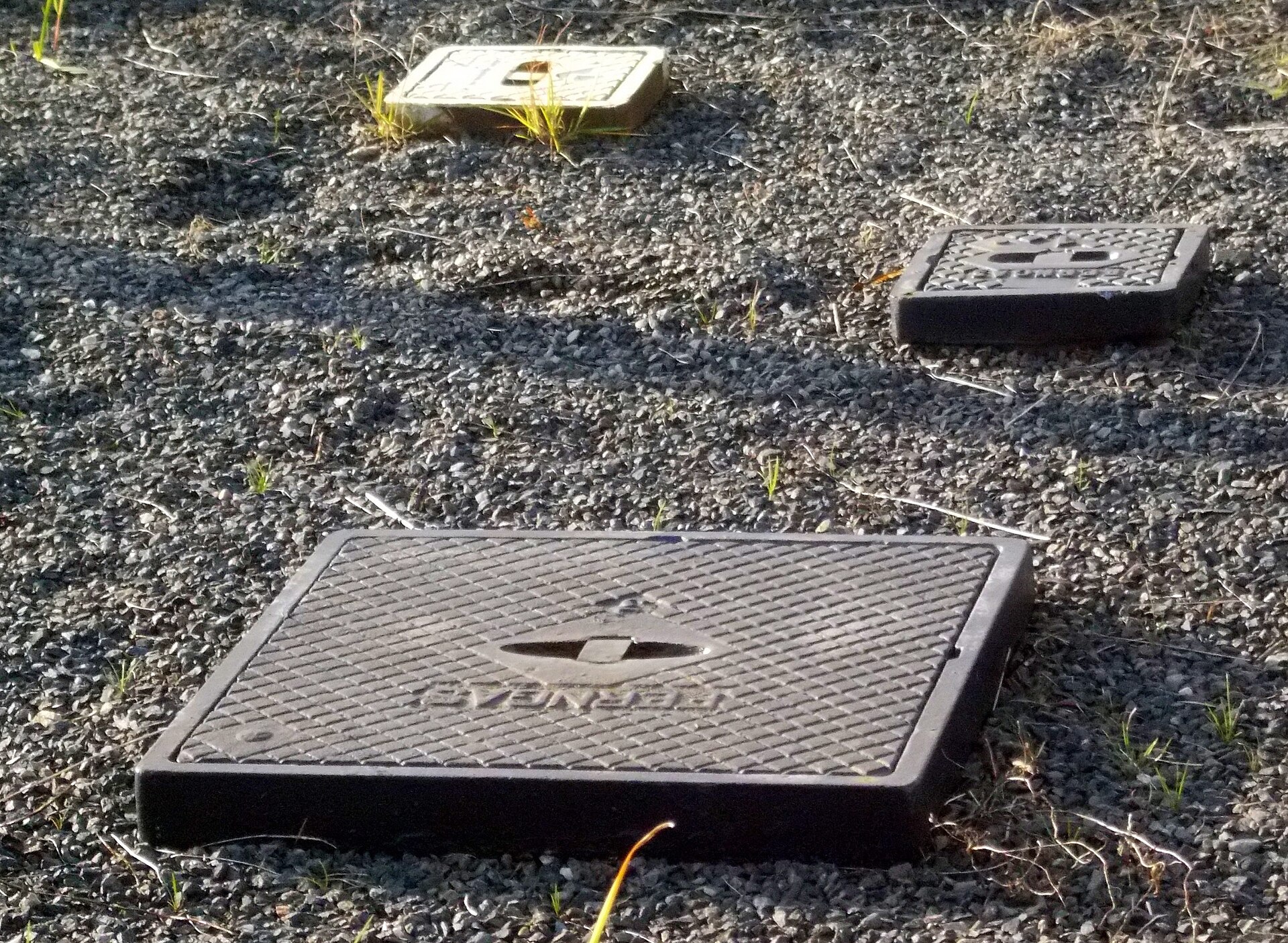
A manual valve on a gas pipeline, with flanged piping on both sides
Photo: CNG-Pipeline - Valve by Geri-oc (Wikimedia Commons), CC BY-SA 3.0 de, via Wikimedia Commons.

How is the API 570 exam structured?

The exam day is 7.5 hours at a Prometric test center: a short tutorial, 2 hours 45 minutes for the closed-book portion, a 45-minute lunch break and 3 hours 45 minutes for the open-book portion. There are 170 questions, of which 140 are scored. The split is 110 closed book and 60 open book.
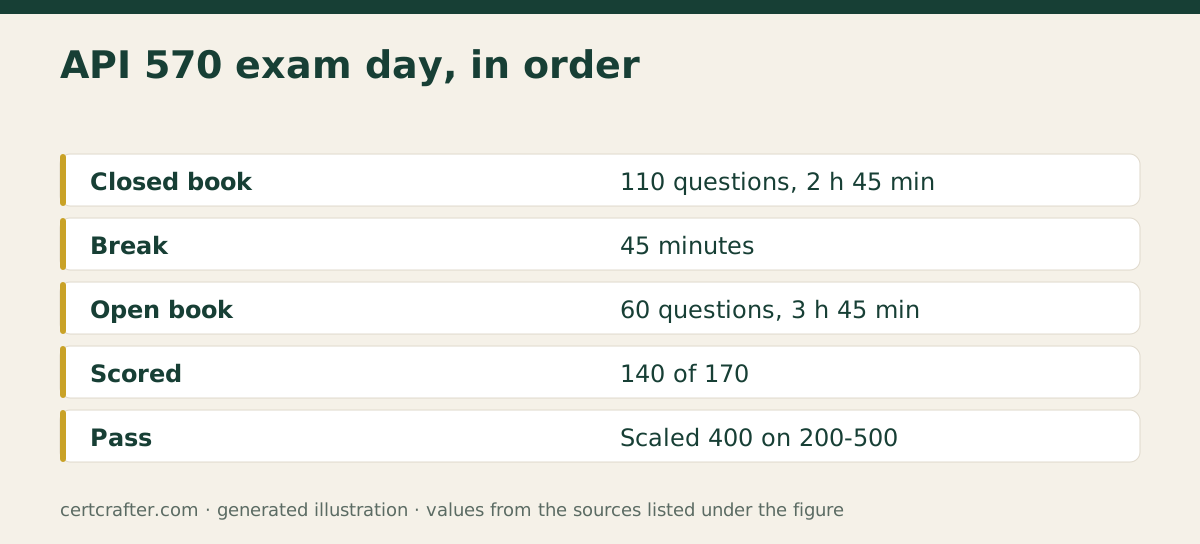
The API 570 exam day in order: 110 closed-book questions in 2 hours 45 minutes, a 45 minute break, 60 open-book questions in 3 hours 45 minutes, 140 of 170 scored, pass at a scaled 400 on a 200-500 scale
The exam day, in order. Illustration: CertCrafter, from API 570 Piping Inspector certification page.

Paper, notes and books stay out of the room. PDFs of the codes appear on your screen during the open-book portion only, limited to the sections on the effectivity sheet. If you have been studying from a tabbed paper copy of API 570, rehearse on screen.

What score do you need to pass API 570?

A scaled 400 on a 200-500 scale. API publishes no raw percentage, so treat any “you need 70 percent” advice as a guess.

Which formulas must you carry into the closed-book half?

The inspector must be able to calculate corrosion rates, remaining life and inspection intervals, and API says the formulas for these may be closed book. If they are not in your head, you cannot look them up until the second half. The Body of Knowledge also expects you to work in both US customary and SI units.
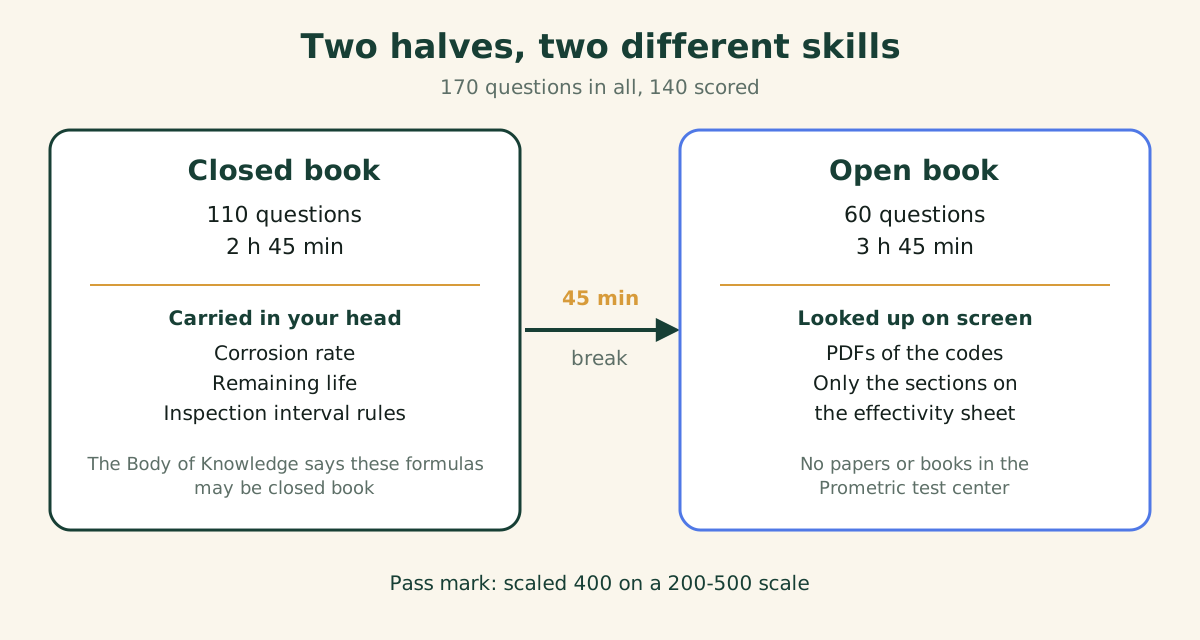
Two panels. Closed book: 110 questions in 2 hours 45 minutes, with corrosion rate, remaining life and inspection interval rules carried in your head. Open book: 60 questions in 3 hours 45 minutes, with PDFs of the codes on screen, limited to the sections on the effectivity sheet
Illustration: CertCrafter, from the API 570 Body of Knowledge. Illustration: CertCrafter, from API 570 Body of Knowledge, February and June 2027.

Which code editions apply from February 2027?

The sheet for February and June 2027 lists API 570 5th Edition (February 2024) and ASME B31.3 in its 2024 Edition, alongside the API recommended practices and ASME Sections V and IX. Material written to an older sheet can point at requirements that no longer apply.

When are the API 570 exam dates and fees?

API 570 runs in February, June and October:

Exam window Application deadline
January 29 - February 19, 2027 November 26, 2026
June 04 - 25, 2027 April 1, 2027
October 08 - 29, 2027 August 5, 2027

Initial certification for 2027 is $890 for API members and $1,140 for non-members. Full detail is on API’s certification page and schedules and fees page.

How should you use three free questions?

Not as a readiness test. They expose habits. Read every explanation, including on the ones you got right. When you miss one, log it by Body of Knowledge section and by the kind of mistake: the calculation, the code requirement, the field call, or a constraint you skimmed past.

The API 570 exam format, scoring and dates post covers the day in more detail, and API 570 formulas with worked examples shows one calculation step by step. The API 570 guide has the full fact sheet, and the hub of API 570 guides lists the rest. The channel has a video, API 570 Exam Prep: 23 Worked Questions, Fully Explained, and the API 570 practice test bundle gives you full-length practice on screen.

What these questions will not do

None is copied from a live exam. They are original, written from the published Body of Knowledge and the referenced codes, and no practice set replaces the codes themselves.

The API 570 Complete Exam Kit picks up where these three stop, with full exams timed like the real one. Next step: open the first question below and commit to an answer before you read the explanation.

Try these free questions

  1. [Open book] On the hydrocracker, a level control valve takes a large pressure drop and the liquid flashes as it passes the trim. The inspector is laying out a thickness survey of the valve and the piping around it. Following API RP 574, where should the readings be concentrated?

    1. On the inlet piping and the upstream flange, where the velocity of the fluid through the line reaches its highest value on the approach to the valve seat.
    2. On the bonnet and the packing area, on the reasoning that this is the thinnest part of a cast valve body in service.
    3. On the body wall directly under the seat ring, where the trim wears first and metal loss therefore starts earliest.
    4. On the outlet side of the valve body and the downstream piping including the first elbow, where the flashing two phase stream impinges.
    Show the answer and explanation

    Answer: D. Flashing across a control valve turns liquid into a high velocity two phase stream on the downstream side, and the resulting erosion and erosion-corrosion attacks the outlet half of the valve body and the piping just beyond it, concentrating wherever the stream changes direction. API RP 574 points the inspector at valve body thickness measurement in erosive service and at the piping downstream of pressure letdown, so the survey belongs on the outlet body wall, the downstream spool and the first elbow or tee. The upstream side sees liquid at a much lower velocity and rarely thins first. The bonnet and packing area is where leaks to atmosphere show up, but it is not where the flow does mechanical damage, and a cast bonnet is normally heavy. The seat ring is trim, and trim wear is a maintenance matter rather than a pressure boundary matter; a worn seat leaks through the valve while the body wall that actually contains pressure is untouched.

  2. [Open book] A repair crew leaves an opened can of E7018 electrodes on the scaffold through a wet night shift and wants to burn them in the morning. What does API RP 577 indicate about those electrodes?

    1. They may be used once the exposed rods have been wiped down and the coating on each one looks and feels completely dry to the welder who will burn them.
    2. They may be used for the fill and cap passes but should be kept out of the root, where restraint is highest.
    3. They must be reconditioned as the manufacturer directs or discarded, because moisture in a low hydrogen coating raises the risk of hydrogen cracking.
    4. They may be used if the preheat on the joint is raised, which drives the absorbed moisture off ahead of the arc.
    Show the answer and explanation

    Answer: C. The whole point of a low hydrogen electrode is the low moisture content of its coating, since moisture dissociates in the arc and puts diffusible hydrogen into the weld and the heat affected zone, where it combines with residual stress and a hard microstructure to produce delayed cracking. API RP 577 covers consumable control and describes storage in heated ovens with limits on atmospheric exposure, together with reconditioning by baking to the manufacturer's instruction or scrapping once those limits are passed. An overnight exposure in wet weather puts the can outside any reasonable exposure limit. A visual check is worthless here, because the moisture that matters is absorbed into the flux and cannot be seen or felt. Restricting the rods to fill and cap still puts hydrogen into the joint, and the cap is where transverse cracking is often found. Raised preheat does help hydrogen diffuse out, but it is a supplement to consumable control rather than a licence to weld with wet flux.

  3. [Open book] A single-wall radiograph of a butt weld in 6"-P-1204-A1A was made with an Ir-192 source, and the densitometer reads 1.9 through the body of the image beside the IQI. Site power is unavailable, so an X-ray source is not an option. What should the inspector do?

    1. Reject the film and reshoot with greater exposure, since a gamma radiograph must reach 2.0 minimum density
    2. Accept the film, because 1.9 meets the 1.8 minimum that the code sets for radiographs of this kind
    3. Accept the film if the required IQI hole is visible, since IQI sensitivity governs over film density
    4. Accept the film after re-reading it on a brighter viewer, since density limits apply only to composite viewing
    Show the answer and explanation

    Answer: A. ASME Section V sets the minimum transmitted film density through the body of the image at 1.8 for radiographs made with an X-ray source and 2.0 for those made with a gamma source, with a maximum of 4.0. This shot was made with Ir-192, so the 2.0 figure applies and 1.9 falls short. With no site power the X-ray option is closed, so the practical remedy is to increase exposure, by time or by geometry, and reshoot. Accepting 1.9 by quoting the 1.8 X-ray minimum is the trap the constraint is built around, since the source rather than the convenience of the number decides which minimum applies. IQI sensitivity and film density are separate acceptance requirements, and satisfying one does not excuse the other, so a visible hole does not rescue an underexposed film. Re-reading on a brighter viewer changes the viewing conditions rather than the density of the film.

Take the full free 10-question sample with scoring →

Frequently asked questions

How many free API 570 practice questions are on this page?

Three, each with its options and a full explanation. They come from the same free sample that backs the scored API 570 quiz. The paid bundle holds 1,020 questions across six complete tests.

Do three questions tell me whether I am ready for API 570?

No. They show whether a habit is sound, such as how you read a thickness survey or a consumable rule. Readiness shows up in full 170-question runs timed to 2 hours 45 minutes closed book and 3 hours 45 minutes open book.

What score do you need to pass the API 570 exam?

A scaled 400 on a 200-500 scale. API publishes no raw percentage, so a claim that you need 70 percent is not supported by API's own documents.

Official sources

  1. API 570 Piping Inspector certification page — accessed 23 October 2026
  2. API ICP Schedules & Fees — accessed 23 October 2026
  3. API 570 Publications Effectivity Sheet, February and June 2027 — accessed 23 October 2026
  4. API 570 Body of Knowledge, February and June 2027 — accessed 23 October 2026

Exam rules change. Check the awarding body's official page before you apply. CertCrafter is independent and is not affiliated with or endorsed by any awarding body.

Was this helpful?

Comments

    Comments are read by a person before they appear. How we moderate.