The formulas that decide most API 570 calculation questions fit on half a page. Corrosion rate, remaining life, and the rule that turns a life into an inspection interval. What takes practice is feeding them the right inputs.
This page works two examples through, then shows where candidates lose the marks.
Which API 570 formulas do you need to know?
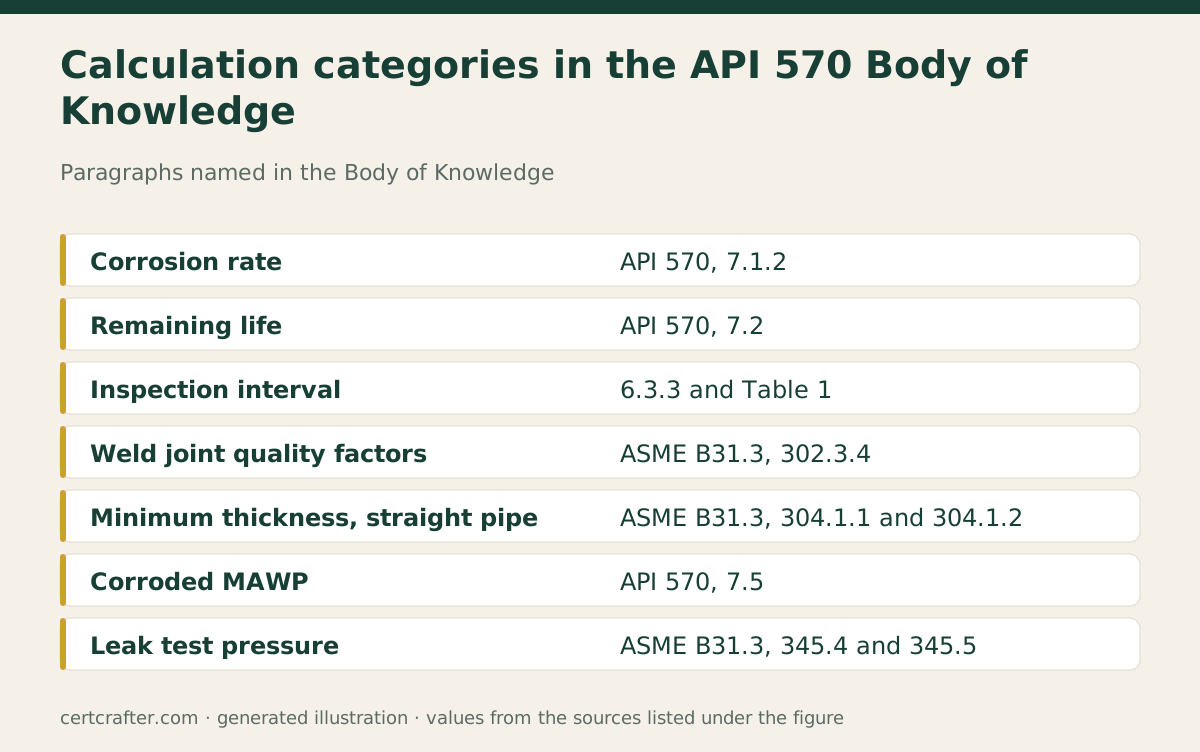
Start with what API says. Its Body of Knowledge describes calculation questions as oriented toward existing in-service piping, not new piping. They cover deterioration, repairs, rerates and alterations, and it groups them into eight categories.
The first category is the one you will use every working week: corrosion rates and inspection intervals. The inspector must be able to calculate a corrosion rate (API 570, 7.1.2), a remaining life (the paragraph right after it) and an inspection interval (6.3.3 and Table 1). The Body of Knowledge adds that these formulas, and the rules for setting intervals, may be closed book during the exam. The exam has 110 closed-book questions, so recall is not optional.
 API 570 Exam Prep: 23 Worked Questions, Fully Explained Watch on YouTube · CertCrafter
If you prefer to hear questions walked through, our channel has one: API 570 Exam Prep, 23 Worked Questions, Fully Explained.
The other categories are weld joint quality factors, internal pressure and minimum thickness, pressure testing, impact testing, preheat and heat treatment, thermal expansion, and flange thickness and working pressures. Those lean on ASME B31.3 and B16.5 tables, which you can open in the second half. The corrosion chain is the one you must carry in your head.
How do you calculate a corrosion rate and a remaining life?
Think of the pipe wall as a budget. The earlier reading is what you had. The latest reading is what is left. The minimum required thickness is the floor you may not go below. The margin between latest reading and floor is what you can still spend.
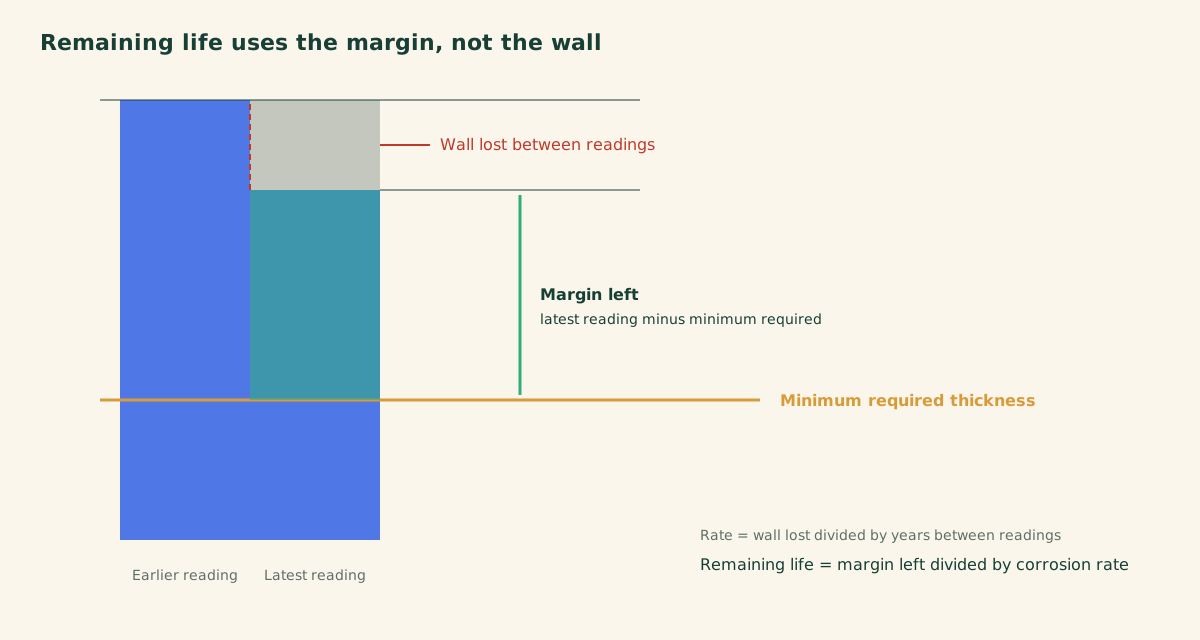
Two steps for the rate, two for the life.
- Wall lost: earlier reading minus latest reading.
- Corrosion rate: wall lost divided by the years between the two readings.
- Margin left: latest reading minus the minimum required thickness.
- Remaining life: margin left divided by the corrosion rate.
The interval is a separate step. Once you have the life, you set it against the rules in 6.3.3 and Table 1. Look those up in the book. Do not trust a number from a blog, this one included.
Worked example 1: one location, in millimeters
Invented readings for a carbon steel line, taken at the same spot. Earlier reading 10 mm. Latest reading 7 mm. Three years between them. The minimum required thickness for this line is 5 mm.
| Step | Working | Result |
|---|---|---|
| Wall lost | 10 minus 7 | 3 mm |
| Corrosion rate | 3 divided by 3 years | 1 mm per year |
| Margin left | 7 minus 5 | 2 mm |
| Remaining life | 2 divided by 1 | 2 years |
Two years. A life that short says the next inspection date matters more than the arithmetic did, and the interval rules in API 570 will not give you more time than the life allows.
What if a second location is already below the minimum?
Now the same line has a second reading point, an elbow downstream: 10 mm earlier, 4 mm now, three years apart, the same 5 mm minimum. It has lost 6 mm at 2 mm a year and already sits below the floor, so there is no margin to divide.
The second point is already under the floor. There is no life to calculate, because the margin is negative. The finding goes to the engineer for a fitness for service or repair decision, and the first location’s two years no longer matter. The worst location governs the circuit.
Repeat both in inches. The Body of Knowledge expects the formulas in US customary and SI, so the same example with inch readings is half the exam prep.
A third habit helps in both the exam and the field: write the units next to every number as you go. Millimeters, inches, years. The units cancel the way the arithmetic does, and a leftover unit shows you where a step went wrong before the answer does.
How do inspectors do this on a real plant?
Nobody works one pair of readings. A circuit has many thickness points, read at different dates by different people with different gauges. The calculation is the easy part. Judging the data comes first.
A reading that goes up between visits is a gauge or surface problem, not a pipe that healed. Inspectors check the scan position, the couplant and the instrument before they believe either number. They also ask what the line carries and which damage mechanism is likely, because a rate from a short run of readings can flatter or frighten.
Experienced inspectors also keep the picture of the whole circuit in mind. The rate at one point means little until you have set it beside its neighbors on the same line, the same service and the same material. A point that corrodes twice as fast as the points around it is a finding in its own right, and it is the sort of thing a spreadsheet will not tell you unless somebody asks.
Records matter just as much. A reading with no date, no location and no method cannot be used for a rate. Most disputed lives in the field turn out to be disputed records.
Where do candidates go wrong on these calculations?
The arithmetic seldom fails. The inputs do.
Using the nominal wall as the floor. The floor is the minimum required thickness for that line, not the thickness on the drawing.
Using the age of the line as the time. The time is between the two readings you are comparing.
Looking the formula up. The formulas may be closed book, and the first section runs 2 hours 45 minutes for 110 questions. Time spent hunting is time lost.
Forgetting the unit. A rate in millimeters per year divided into a margin in inches gives a confident wrong answer. Convert first, then divide.
Stopping at the life. A question that asks for the interval wants the next step, the rule from 6.3.3 and Table 1, applied to your life.
Questions in the open-book part work differently. They give you a pressure, a pipe size and an allowable stress and send you to ASME B31.3 for the formula. Our free sample set has two of those to try, embedded below. The first is a threaded connection thickness problem and the second a leak test pressure for a new header.
How should you rehearse these closed book?
Make a one-page card with the four steps and nothing else, then put it away. Write the steps from memory on a blank sheet, work one example in millimeters, then one in inches, and check against your card. Do that three times in a week and the sequence stays.
Add the trap questions after that. Give yourself a line with a floor that is not the nominal wall, a pair of readings with a gap that is not the age of the line, and a mixed set of units. Those three setups cover most of what a calculation question can throw at you in this chain.
What should you do next?
Take your own numbers from a line you know, or invent a set, and work both examples above in millimeters and then in inches, closed book, with a timer. Then try the embedded questions, and compare your working with the explanation.
For the wider picture, read API 570 common mistakes and API 570 General Practical Knowledge. The product page is at API 570 Piping Inspector, the practice tests at the API 570 bundle, the free sample at the quiz, and more guides in the API 570 hub.
Comments
Comments are read by a person before they appear. How we moderate.