Most API 570 candidates study the formulas and treat the reference documents as background. Section V of the Body of Knowledge says otherwise: it tells you exactly which documents, and which parts of them, the questions come from.
What is Practical Knowledge Specific?
It is the last section of API’s Body of Knowledge for the exam, and the shortest to read. Section IV lists the topics a piping inspector should know. Section V lists the documents where those topics are written down, and it states how much of each document is fair game.
The edition matters as much as the document. The Body of Knowledge says the exam is based on the editions in the effectivity sheet, even where a jurisdiction still works to something older. For the February and June 2027 windows the sheet names API 570 5th Edition (February 2024), RP 571 3rd Edition (March 2020), RP 574 5th Edition with Addendum 1, RP 576 5th Edition (September 2024), RP 577 3rd Edition (October 2020), RP 578 4th Edition (February 2023), ASME B16.5 (2020 Edition) and PCC-2 (2022). Check your own window before you open any book.
 API 570 Exam Prep: 23 Worked Questions, Fully Explained Watch on YouTube · CertCrafter
Our channel works many questions of this kind: API 570 Exam Prep, 23 Worked Questions, Fully Explained.
Which parts of each document can be examined?
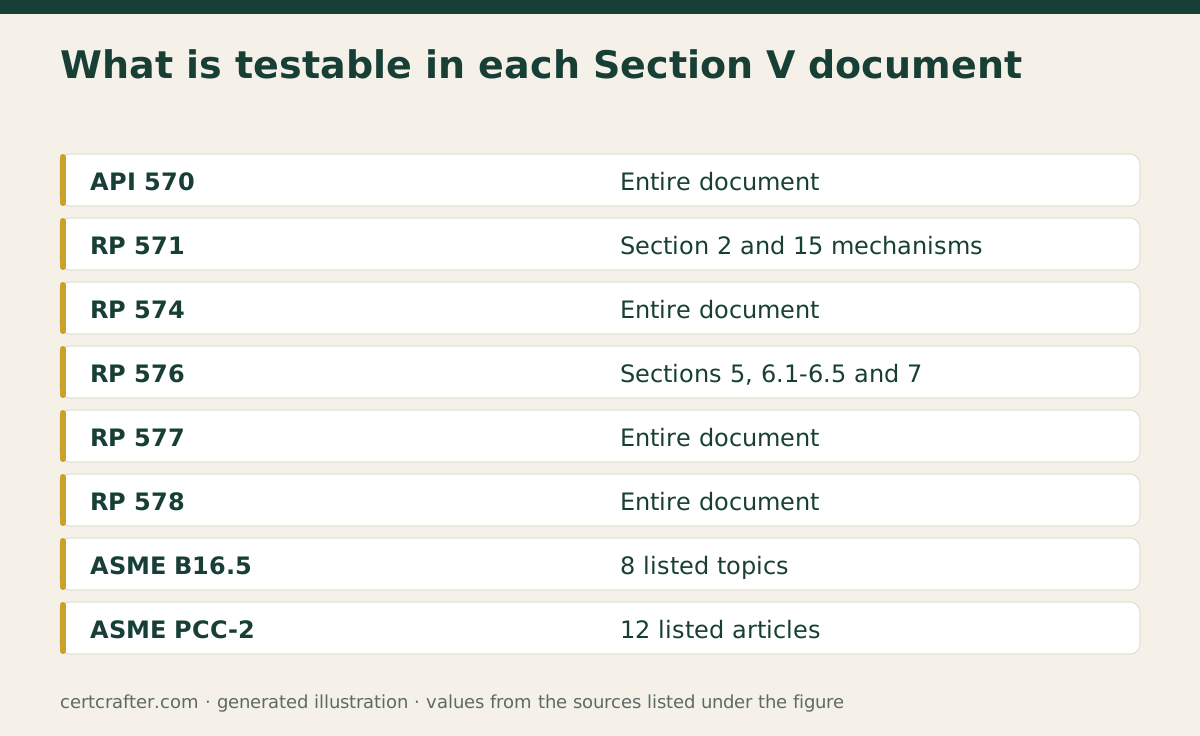
Four documents are entirely subject to testing: API 570 itself, RP 574, RP 577 and RP 578. A question can start on any page of them. The rest are cut down.
RP 571 is limited to Section 2, the definitions, and fifteen damage mechanisms. Among them are corrosion under insulation, chloride stress corrosion cracking, sulfidation, sour water corrosion, erosion and erosion corrosion, and microbiologically influenced corrosion. The mechanisms outside the list can sit on your shelf unread. RP 576 on pressure-relieving devices is limited to Section 5, Sections 6.1 to 6.5 and Section 7. ASME B16.5 is limited to eight topics, from scope and pressure-temperature ratings to markings, dimensions and limiting dimensions of gaskets. ASME PCC-2 is limited to twelve listed articles with their appendices, covering repair methods such as full encirclement sleeves, fillet welded patches, weld buildup and mechanical clamps.
How does an inspector use these documents on a plant?
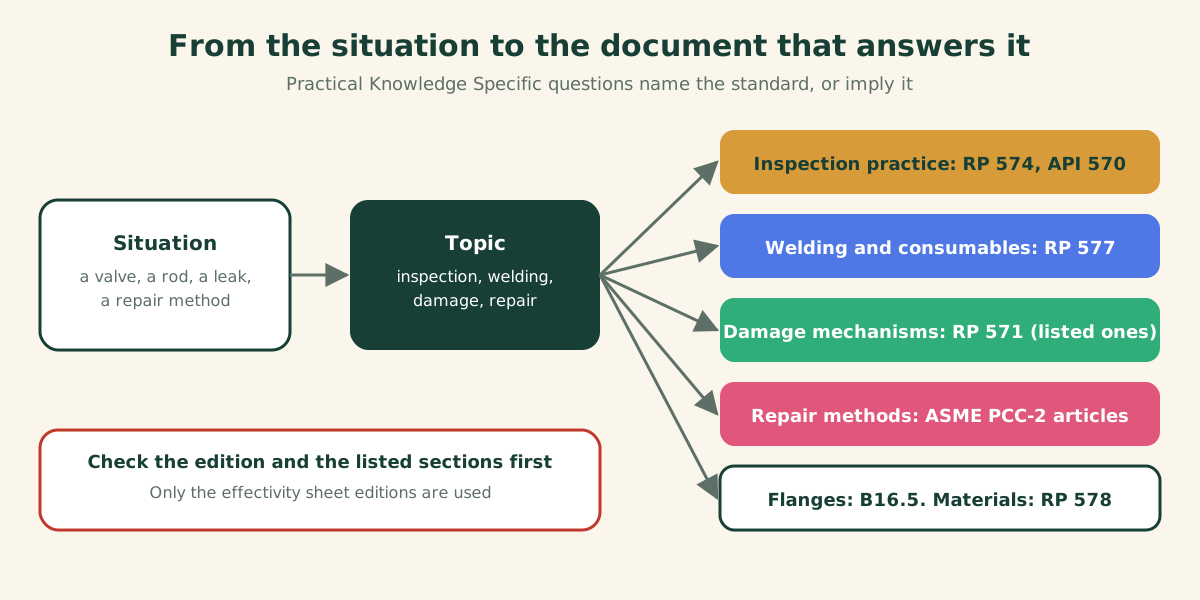
Nobody on a unit reads RP 574 cover to cover. You reach for it when a line is in erosive service and you need to decide where to put the thickness readings. You reach for RP 577 when a repair crew asks what to do about wet electrodes. You open RP 571 when a circuit starts leaking and you need to know which mechanism fits the service.
That is the pattern the exam copies. The documents are tools for a decision, and the question gives you the decision. Inspectors who know where each tool sits answer faster than those who know a little of everything.
Field practice also explains why RP 578 is wholly testable. Positive material identification and its record keeping are routine jobs on a unit, and the exam gives them the same weight as the rest.
Worked example: from a plant situation to the right document
One of our free sample questions describes a level control valve on a hydrocracker. A large pressure drop makes the liquid flash across the trim, and the inspector must lay out a thickness survey of the valve and the piping around it. Here is how to take it apart.
- The situation: pressure letdown with flashing, so a high velocity two phase stream.
- The document: the question says RP 574, inspection practices for piping components, which is testable in full.
- The mechanism: erosion and erosion corrosion, one of the fifteen RP 571 entries.
- Place the readings: on the downstream side, the outlet half of the valve body and the first elbow or tee, where the stream changes direction.
The distractors are the upstream flange, the bonnet and packing area, and the wall under the seat ring. Each is a place where something real happens on a valve, which is why they tempt. None is where flashing flow thins the pressure boundary. Pick the document first and the answer follows.
The API 570 Complete Exam Kit works this kind of situation under timed conditions, with every answer explained.
How do the questions get framed?
Most are open-book items that name a reference or imply one. A common shape is a short story from a unit, a constraint, and four answers that each sound like something a person has done on site.
The second sample question is a good case. A repair crew leaves opened E7018 electrodes on a scaffold through a wet night shift. The tempting answers say the rods are fine if they feel dry, or fine for the cap pass, or fine with more preheat. RP 577 points the other way: moisture in a low hydrogen coating raises the risk of hydrogen cracking, so the rods are reconditioned as the manufacturer directs or discarded. The right answer is a rule about consumable control, not a judgment about how the rod looks.
Notice the habit behind the wrong answers. Each one lets the person on the scaffold decide. The exam wants what the document says.
Where do candidates lose marks in this section?
They study RP 571 as a whole book. Only fifteen mechanisms and the definitions are listed, so the hours spent on the rest are hours not spent on RP 574 or RP 578.
They underrate the documents that are entirely testable. API 570 itself is subject to testing in its entirety, and so are RP 574, RP 577 and RP 578. A skim is not enough.
They study from an older edition because a colleague has a paper copy. The exam supplies on-screen PDFs of the effective editions, and personal paper copies are not allowed in the testing center.
And they forget the clock. The exam has 170 questions, of which 110 are closed book and 60 are open book. Open-book time is for finding the clause, so you need to know which document to open before you start looking.
How should you study it?
Print the section V list and write beside each document what you could do with it on a unit. For RP 571, tick the fifteen mechanisms and ignore the rest. Then practice opening the right document from a situation alone, in the on-screen format. Our guides on the 2027 effectivity sheet, the general practical knowledge section and the common mistakes cover the neighboring ground.
What to do next
Open the Body of Knowledge from API’s API 570 page, go to section V, and list the documents you have not yet opened in the on-screen format.
Then try the free ten-question sample, read the certification guide, and browse the other API 570 posts. The practice tests follow the closed-book and open-book split.
Comments
Comments are read by a person before they appear. How we moderate.