My 4 engineering books go FREE on Kindle Fri 6 – Tue 10 Nov (PT). See the books → FREE on Kindle now: all 4 engineering books, until Tue 10 Nov 11:59 pm PT. Ends in . Grab yours → My 4 books: FREE on Kindle Fri 6 – Tue 10 Nov (PT). See → FREE on Kindle now: 4 books, left Grab yours →

API 570 Practice Questions, Set 2 (Free)

By Sandeep Bandyopadhyay, Senior aerospace engineer · PMP, MBA, Six Sigma

TL;DR

This second set of free API 570 practice questions covers three calls an inspector makes on live piping: how to judge a locally thinned patch, whether a repair needs a pressure test, and what a lower preheat does to a welding procedure. Each has a full explanation. The exam is 170 questions, 140 scored, passing is a scaled 400 on a 200-500 scale, and the 2027 windows use API 570 5th Edition.

Original questions, not exam dumps. Every CertCrafter question is written from the published body of knowledge and the referenced codes. None is copied from a live exam, and CertCrafter is independent: not affiliated with or endorsed by any awarding body.

A cast iron standpipe with a domed cap leaning beside a country road, part of a buried pipeline
Photo: Elkesley to Lincoln water pipeline air valve by Bob1960evens (Wikimedia Commons), CC BY-SA 4.0, via Wikimedia Commons.

Most API 570 candidates can recite a rule and still lose the question, because the stem hides which rule applies. These three questions are about that moment: a patch of thin wall, a weld repair, a procedure change.
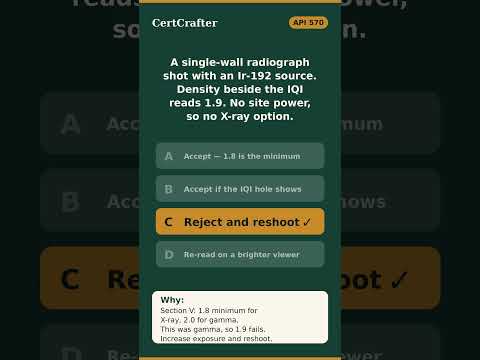
Video: API 570 — Three of these four answers look right. Only one survives the code. API 570 — Three of these four answers look right. Only one survives the code. Watch on YouTube · CertCrafter
Image: video thumbnail, source: CertCrafter on YouTube (@certcrafters).

What do these three free questions test?

Each one drops you into a plant situation with a constraint attached. A line has a thinned patch among scattered pitting. A leaking weld was cut out and redone during the run, and the unit wants the line back. A contractor wants to cut preheat on low alloy pipe because the schedule is tight.

None asks you to recite a number. They come from the free sample behind the scored API 570 quiz, and the first set is on the earlier API 570 questions page. Commit to an answer, then open the explanation.

How does an inspector judge a locally thinned patch?

The wall does two jobs, and the code checks them separately. It holds pressure, and it holds the pipe up and together against weight, span and longitudinal loads.

For pressure, hoop stress is carried over a length of wall, so the code lets you average thickness readings across a length through the thin area. That length is tied to the pipe diameter. You do not pick it. For the structural job there is no averaging: the lowest single reading has to be enough on its own.

On a plant walk this is the argument that follows every survey. Someone wants to retire a line on its single lowest point. Someone else wants to average the whole circuit and call it fine. Both are wrong, in opposite directions. The first retires serviceable pipe. The second spreads a local defect into readings taken metres away and can hide a path through the wall.
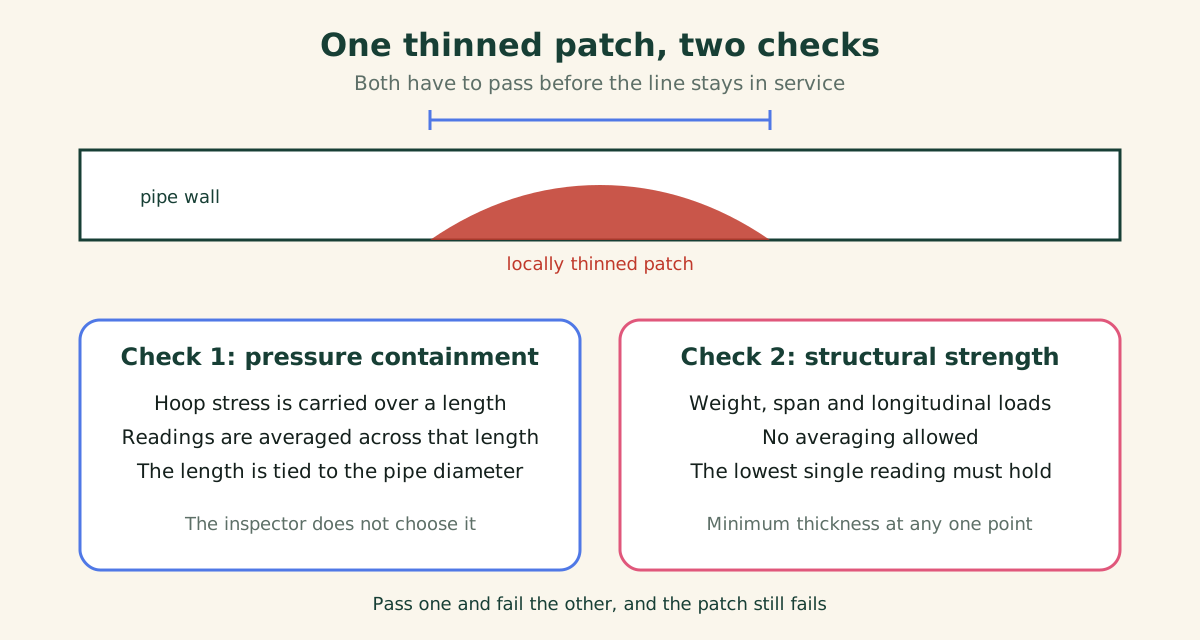
A pipe wall with one thinned patch and two boxes: the pressure check averages readings over a length tied to the pipe diameter, the structural check uses the lowest single reading, and both must pass
Illustration: CertCrafter, from the API 570 Body of Knowledge. Illustration: CertCrafter, from API 570 Body of Knowledge, February and June 2027.

The exam trap is the option that sounds careful. “Treat the lowest reading as the whole circuit” feels safe, and it is the answer people choose when two checks are asked for. Look for the option that names both.

Does every weld on in-service piping need a hydrotest?

No, and the code draws the line between a repair and an alteration. An alteration normally calls for a pressure test. For a repair, the code allows suitable nondestructive examination where a test is not practical, accepted by the inspector. The effectivity sheet lists PCC-2 Article 502 on nondestructive examination in lieu of pressure testing, so this is on the exam’s reading list.

Cutting out a leaking weld and rewelding it is a repair. That opens a route past the hydrotest, but the route runs through the examination being done and documented, not through the unit superintendent’s startup date. On site, the argument is rarely about whether a test is allowed. It is about who signs that the substitute was enough.

A brick valve house standing alone in a ploughed field, with a village in the distance
Photo: Elan Valley Pipeline Valve House, Cleobury Mortimer - geograph.org.uk - 2416644 by Peter Evans (Wikimedia Commons), CC BY-SA 2.0, via Wikimedia Commons.

Candidates miss this one by swinging to an extreme. “Every weld needs a hydrotest” would make most on-stream repair work impossible. “A previous test covers it” ignores that the old test says nothing about metal deposited afterwards.

Why can’t a contractor lower the preheat to save time?

Because preheat controls how fast the weld cools, and on P-No. 4 low alloy material that decides whether hydrogen cracking shows up. Under ASME Section IX, a decrease in minimum preheat beyond a set margin is an essential variable for the common arc processes. An essential variable change means new test coupons and a new procedure qualification record.

The inspector cannot accept the revision on a signature. A welding engineer’s sign-off handles nonessential variables only. Requalifying the welders does nothing for the procedure, and adding impact tests answers a different question. The Body of Knowledge lists Section IX under welding procedure and qualification evaluation, and you can read more on the habit in API 570: The Most Common Mistakes.

How long does API 570 certification last?

Longer than one exam, and it asks for work. API’s certification page sets out a three-year cycle: at least 20 percent of your time spent on in-service piping inspection, and 24 hours of continuing professional development. Every six years there is an open-book web quiz of 25 questions, four hours allowed.
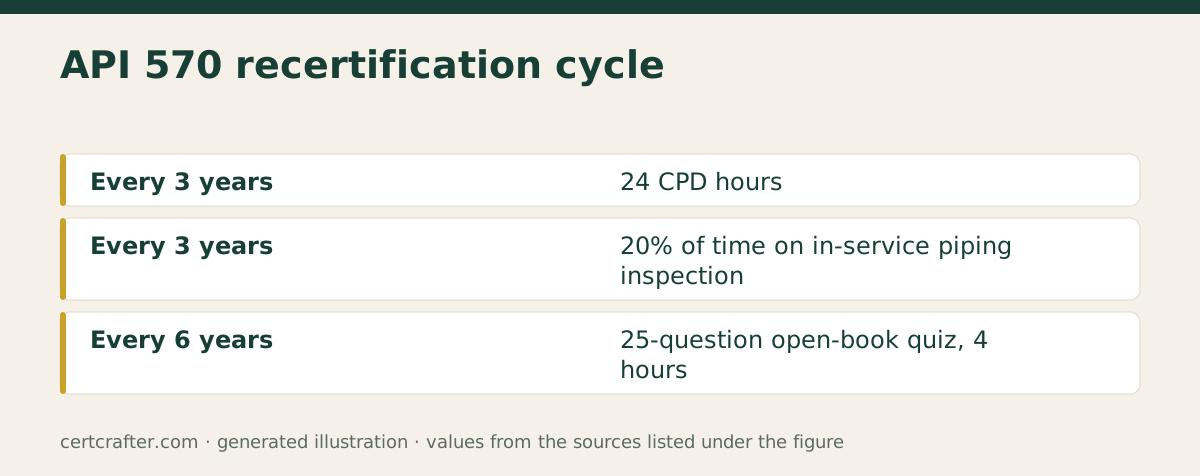
API 570 recertification: every 3 years 24 CPD hours and 20 percent of time on in-service piping inspection, every 6 years a 25-question open-book quiz in 4 hours
Illustration: CertCrafter, from the API 570 certification page. Illustration: CertCrafter, from API 570 Piping Inspector certification page.

The API 570 Complete Exam Kit picks up the exam half of that, with full exams timed like the real one and every answer explained.

How is the API 570 exam structured?

The exam is 170 questions, 140 of them scored, in two sessions: 110 closed book in 2 hours 45 minutes, a 45-minute break, then 60 open book in 3 hours 45 minutes. Passing is a scaled 400 on a 200-500 scale, and API publishes no raw percentage. It is given in person at Prometric with the references on screen, so rehearse on screen. The corrosion rate, remaining life and inspection interval formulas can land in the closed-book half.

Which code editions and exam dates apply?

The sheet for February and June 2027 lists API 570 5th Edition (February 2024), ASME B31.3 in its 2024 Edition and the 2023 ASME code for Sections V and IX. Material written to an older sheet can send you to requirements that no longer apply.

Exam window Application deadline
January 29 - February 19, 2027 November 26, 2026
June 04 - 25, 2027 April 1, 2027
October 08 - 29, 2027 August 5, 2027

Initial certification on API’s 2027 schedule is $890 for members and $1,140 for non-members, and a late application adds $200. The certification page and the schedules and fees page carry the detail. Our exam format, scoring and dates post lays out the day.

How should you use this set?

Log each miss by Body of Knowledge section and by the kind of error: calculation, code requirement, field call, or a constraint you skimmed past. Then read the API 570 study plan and the API 570 guide, and browse the hub of API 570 guides. The API 570 practice test bundle runs the full rhythm.

None of these questions is copied from a live exam. They are original, written from the published Body of Knowledge and the referenced codes.

Next step: open the first question and answer it before you read why.

Try these free questions

  1. Scattered pitting and one locally thinned patch roughly 3 in. long are found on a 10 in. line. How does API 570 have the inspector evaluate that thinned patch when judging the line for continued service?

    1. Treat the single lowest reading as the thickness of the whole circuit, since that point will fail first under pressure.
    2. Average readings across the length the code allows for the pressure check, while the lowest point still meets the minimum needed for structural strength and longitudinal loads.
    3. Average every reading taken anywhere on the circuit, on the basis that the pitting is scattered and none of it is deep.
    4. Set the pitting aside and trend only the general wall loss across the circuit, because scattered pits of that kind do not carry hoop stress the way the surrounding sound wall does.
    Show the answer and explanation

    Answer: B. API 570 separates two duties the wall performs. Hoop stress from internal pressure is carried by the wall over a length, so the code lets thickness readings be averaged across a defined length through a locally thinned area when checking pressure containment, and that averaging length is tied to the pipe diameter rather than chosen by the inspector. The second duty is structural, covering weight, span and longitudinal loading, and for that the minimum measured thickness at any single point has to stand on its own without averaging. Both checks have to pass. Using the lowest reading alone for everything is conservative to the point of retiring serviceable pipe, which is why the averaging rule exists. Averaging over the whole circuit spreads a local defect into readings taken metres away and can hide a through wall path entirely. Ignoring pitting is wrong on the facts, since a deep pit is a local thin spot and, in sour or wet service, a crack initiation site as well.

  2. A leaking weld on 4"-P-2208-C2 was excavated and rewelded during the run, and the unit superintendent wants the line back in service without a hydrotest. What governs whether the pressure test can be omitted?

    1. Any weld made on in-service piping requires a hydrostatic test before the line is returned to service
    2. An alteration normally requires a test, while for a repair the inspector may accept suitable NDE instead
    3. A pressure test is required only where the repair involves a full encirclement welded sleeve over the defect
    4. No pressure test is needed after any repair or alteration provided the line passed its most recent scheduled test
    Show the answer and explanation

    Answer: B. API 570 separates repairs from alterations when it comes to pressure testing. An alteration normally calls for a pressure test, while for a repair the code allows appropriate nondestructive examination to be substituted where a test is not practical, with that substitution accepted by the inspector and, in the alteration case, by the piping engineer. Cutting out and rewelding a leaking weld is a repair, so a route to omitting the hydrotest exists, and it turns on suitable NDE being performed and documented rather than on the superintendent's schedule. The claim that every weld on in-service piping demands a hydrostatic test before restart would make most on-stream repair work impossible and is not what the code says. Tying the requirement to full encirclement sleeves picks one repair method arbitrarily. Relying on a previous successful test ignores that the earlier test says nothing about the weld deposited afterwards.

  3. [Open book] A contractor submits a WPS revision dropping the minimum preheat on P-No. 4 material from 300 degrees F (149 degrees C) to 150 degrees F (66 degrees C), citing schedule pressure. Under ASME Section IX, what should the inspector require?

    1. Acceptance once the contractor's welding engineer signs the revision, since minimum preheat is a nonessential variable on this procedure
    2. Rejection until a new procedure qualification record supports the lower preheat, since that decrease is an essential variable
    3. Acceptance provided impact testing is added to the qualification, since preheat is a supplementary essential variable only
    4. Acceptance once each welder assigned to the job requalifies at the reduced preheat temperature
    Show the answer and explanation

    Answer: B. ASME Section IX treats a decrease in preheat temperature of more than a set margin below the qualified value as an essential variable for the common arc processes, and an essential variable change means the procedure has to be requalified with new test coupons and a new procedure qualification record. Dropping the minimum from 300 degrees F to 150 degrees F on P-No. 4 low alloy material is a decrease far beyond that margin, and P-No. 4 is exactly the material group where preheat controls the cooling rate and the risk of hydrogen assisted cracking. The inspector therefore cannot accept the revision on paper. A welding engineer's signature handles nonessential variables, which are revised on the procedure without retesting, and preheat in this direction is not one of them. Maximum interpass temperature is the variable tied to supplementary essential status and impact testing. Requalifying welders does nothing about the procedure.

Take the full free 10-question sample with scoring →

Frequently asked questions

How is this set different from the first free API 570 set?

It uses three different free-sample questions, on thinned pipe, repair versus alteration and welding procedure changes. The first set covered a valve survey, electrodes and radiographs. Together they show six of the free-sample questions.

Do I need to memorize the thickness formulas for API 570?

Yes, for corrosion rate, remaining life and inspection interval. API's Body of Knowledge says the formulas and the interval rules may be closed book, so you cannot count on looking them up in the open-book half.

How long does an API 570 certification last?

The certification runs on a three-year cycle. API's certification page asks for 24 CPD hours in each cycle, plus an open-book recertification quiz every six years.

Official sources

  1. API 570 Piping Inspector certification page — accessed 4 November 2026
  2. API ICP Schedules & Fees — accessed 4 November 2026
  3. API 570 Publications Effectivity Sheet, February and June 2027 — accessed 4 November 2026
  4. API 570 Body of Knowledge, February and June 2027 — accessed 4 November 2026

Exam rules change. Check the awarding body's official page before you apply. CertCrafter is independent and is not affiliated with or endorsed by any awarding body.

Was this helpful?

Comments

    Comments are read by a person before they appear. How we moderate.