
My 4 engineering books go FREE on Kindle Fri 6 – Tue 10 Nov (PT). See the books → FREE on Kindle now: all 4 engineering books, until Tue 10 Nov 11:59 pm PT. Ends in . Grab yours → My 4 books: FREE on Kindle Fri 6 – Tue 10 Nov (PT). See → FREE on Kindle now: 4 books, left Grab yours →

API 570 Piping Calculations: What the Exam Tests

By Sandeep Bandyopadhyay, Senior aerospace engineer · PMP, MBA, Six Sigma

TL;DR

API's Body of Knowledge lists eight calculation topics for API 570, all aimed at piping already in service: corrosion rate and interval, joint quality factors, required thickness, pressure testing, impact testing, preheat, thermal expansion and flanges. Only the first group is flagged as possibly closed book, in both US customary and SI units. The rest are code lookups, so the skill is finding the right clause and reading it correctly.

Original questions, not exam dumps. Every CertCrafter question is written from the published body of knowledge and the referenced codes. None is copied from a live exam, and CertCrafter is independent: not affiliated with or endorsed by any awarding body.

The valve house of a long-distance water pipeline in the English countryside
Photo: Elan Valley Pipeline Valve House, Cleobury Mortimer - geograph.org.uk - 4026225 by Peter Evans (Wikimedia Commons), CC BY-SA 2.0, via Wikimedia Commons.

Most API 570 candidates treat the calculations section as one big formula sheet. API’s list is shorter and odder than that: a few formulas to hold in your head, and a larger group of lookups where the marks go to whoever finds the right clause first.

What calculations does API actually list for API 570?

The calculations section opens with a scope statement. Code calculation questions are oriented toward existing in-service piping, not new piping. You are not designing a line. You are checking one that has been running, and asking what corrosion, a repair, a rerate or an alteration has done to it.

Then comes a list of eight categories. Here they are with the clause API names for each.

Topic What the inspector works out Where API points
Corrosion rates and intervals Rate, remaining life, next interval API 570, 7.1.2, 6.3.3 and Table 1, plus the remaining life paragraph
Quality factors Casting factor and weld joint factor ASME B31.3, 302.3.3(b) and 302.3.4
Internal pressure Required thickness, blank thickness, corroded MAWP B31.3, 304.1.1, 304.1.2, 304.5.3; API 570, 7.5
Pressure testing Hydrostatic or pneumatic test pressure B31.3, 345.4 and 345.5
Impact testing Exempt temperature, required Charpy values B31.3, 323.2.2 and 323.3
Preheat and heat treatment Which welds need it, what temperature B31.3, 330 and Table 330.1.1
Thermal expansion Total expansion between two temperatures B31.3, Appendix C, Table C-1
Flanges Working pressure, minimum dimensions ASME B16.5, Section 2 and the dimension tables

Eight rows, and only the first holds formulas you build from memory. The others are tables and short equations sitting in a code book.
Video: API 570 Exam Prep: 23 Worked Questions, Fully Explained API 570 Exam Prep: 23 Worked Questions, Fully Explained Watch on YouTube · CertCrafter
Image: video thumbnail, source: CertCrafter on YouTube (@certcrafters).

If you want to watch someone work through questions like these, our channel has API 570 Exam Prep: 23 Worked Questions, Fully Explained.

Which calculations may be closed book?

Category one. The Body of Knowledge says the formulas for corrosion rate, remaining life and the rules for setting inspection intervals may be closed book during the exam. The exam has 110 closed-book questions followed by 60 open-book ones, so the first part is where a shaky formula costs you with no book to catch you.

It also says candidates must understand US customary units (inches, feet, psi) and the SI system, and use both sets of formulas. That sounds like a small detail until a question hands you millimeters and kilopascals on a day you only practiced inches.
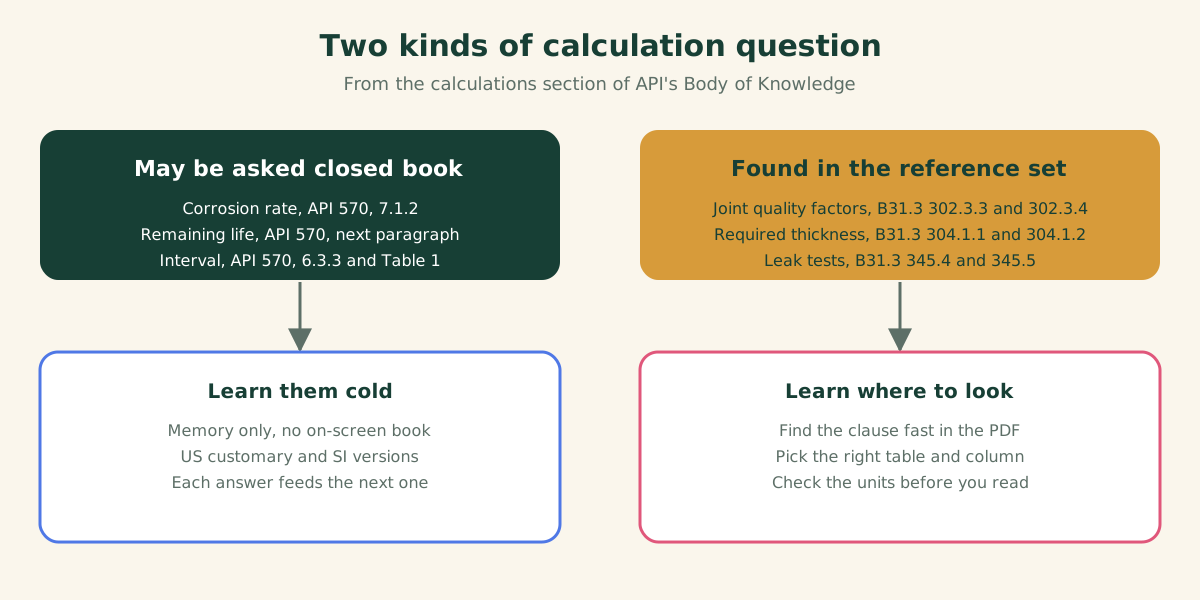
Two columns: corrosion rate, remaining life and interval may be closed book and must be memorized; joint quality factors, required thickness and leak tests are found in the reference set
Which calculations to memorize and which to look up. Illustration: CertCrafter, from API 570 Body of Knowledge, February 2027 and June 2027.

How do the lookup calculations work?

They are chains. Take required thickness. The Body of Knowledge says the weld joint quality factor may be part of an internal pressure problem, because that factor sits inside the formulas for required thickness or design pressure. So one question can ask you to find a joint factor in a B31.3 table, carry it into a thickness formula, and then add or subtract the corrosion allowance, depending on what the problem says.

Each step is easy alone. The marks go to the candidate who keeps the chain straight under a clock.

Two habits help. Write the clause number next to every number you pull from a table, so you can retrace a step in ten seconds. And do the units check before the arithmetic, not after.

The API 570 Complete Exam Kit works these chains under timed conditions in both unit systems, with every answer explained.
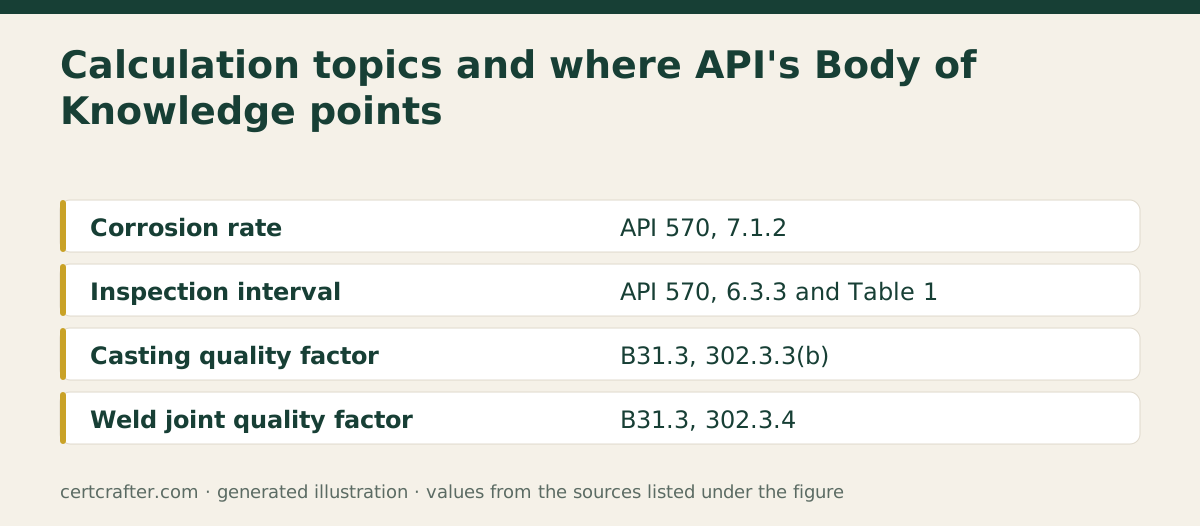
Table of four calculation topics and the API 570 or ASME B31.3 paragraph for each: corrosion rate 7.1.2, interval 6.3.3 and Table 1, casting factor 302.3.3(b), weld joint factor 302.3.4
Where the Body of Knowledge sends you. Illustration: CertCrafter, from API 570 Body of Knowledge, February 2027 and June 2027.

How do inspectors use these calculations on a plant?

Nobody on a plant computes a corrosion rate for fun. The number decides whether a line stays in service, gets a shorter interval, or goes on a repair list. A required thickness tells you how much of the wall is spoken for before corrosion is counted at all.

Reratings and repairs work the same way. If the service conditions change, the pressure the line can carry changes with them, and the check goes back to the same B31.3 clauses the exam points at. A pressure test after a repair or alteration is a calculation too: someone has to work out the test pressure, then confirm the line can take it.

There is one trap that site work and the exam share. Many plants and jurisdictions run on other editions than the exam does. API’s own note says some organizations use documents or editions other than those on the effectivity sheet, and that the exam is based on the sheet. Answer from the sheet, not from what your site binder says.
A water pipeline valve with its pipework and handwheel above ground
Photo: Water Pipeline Valve - geograph.org.uk - 6175946 by Graeme Yuill (Wikimedia Commons), CC BY-SA 2.0, via Wikimedia Commons.

Where do candidates lose marks on the calculations?

The first place is the closed-book formulas. Candidates who rely on a book they cannot open in that part of the exam find out the hard way.

The second is wrong editions. The effectivity sheet for the February and June 2027 windows lists ASME B31.3 in the 2024 Edition, B16.5 in the 2020 Edition, and ASME Section V and IX in the 2023 Edition. A table from an older B31.3 can give a different answer from the one the exam wants.

The third is chasing excluded material. The Body of Knowledge lists B31.3 requirements the inspector will not be expected to know: most of clause 302 except the two quality factors, curved and mitered pipe, branch connections, closures, reducers, flexibility analysis and more. Time spent on those is time not spent on the eight topics above.

The fourth is the pairing of inputs. A joint factor read from the wrong row, a corrosion allowance added when the problem said to subtract it, or a temperature in the wrong scale all give a clean, wrong answer that sits right among the options.

How should you practice these calculations?

Split your sessions the way the exam splits its content. Spend one block on the three closed-book calculations until you can write them out in both unit systems without a source. Spend another on the lookups, using the on-screen PDFs rather than paper, because paper is not allowed in the test center.

Then mix them. A real question rarely announces which kind it is. The two sample questions below are free, and both are calculation questions framed the way the exam frames them.

Check your own window too. The next API 570 window on the schedule is January 29 to February 19, 2027, with an application deadline of November 26, 2026, and it falls under the February 2027 and June 2027 Body of Knowledge.

What should you do next?

Open API’s Body of Knowledge from the API 570 exam page, go to the calculations section, and mark each of the eight topics as memorize or look up. Then read how worked formulas and the general practical knowledge section connect to them.

Try the free sample quiz, read the certification guide, see the other API 570 posts, and look at the practice tests when you want timed drilling.

Try these free questions

  1. [Open book] A threaded NPS 2 connection, outside diameter 2.375 in., runs at 1,000 psig. The allowable stress is 20,000 psi, E and W are 1.0, Y is 0.4, the corrosion allowance is 0.050 in. and the thread depth to be included as a mechanical allowance is 0.07 in. Using ASME B31.3, what minimum required thickness must the pipe provide before mill tolerance is considered?

    1. About 0.128 in., the pressure design thickness plus the thread depth only.
    2. About 0.108 in., the pressure design thickness plus the corrosion allowance only.
    3. About 0.178 in., the pressure design thickness plus the thread depth and corrosion allowance.
    4. About 0.204 in., the required thickness divided by 0.875 for the mill tolerance.
    Show the answer and explanation

    Answer: C. ASME B31.3 builds the minimum required thickness as the pressure design thickness plus the sum of the mechanical, corrosion and erosion allowances, and thread depth is a mechanical allowance because threading removes metal from the wall. The pressure design thickness is P D divided by twice the quantity S E W plus P Y: 1,000 times 2.375 is 2,375, and twice 20,400 is 40,800, giving 0.058 in. Adding the 0.07 in. thread depth and the 0.050 in. corrosion allowance gives 0.178 in. Option one forgets the corrosion allowance and option two forgets the thread depth, the commonest slip on threaded pipe. Option four divides by 0.875, which is the step used afterwards to select a nominal wall to order, and the question asked for the requirement before mill tolerance. Schedule 80 at 0.218 in. nominal gives 0.191 in. after under-tolerance, which would satisfy the requirement.

  2. [Open book] A new nitrogen header on the hydrotreater has a design pressure of 285 psig (1965 kPa) and cannot be hydrotested because the system must stay dry for service. The owner elects a pneumatic leak test under ASME B31.3. What test pressure applies?

    1. 314 psig
    2. 428 psig
    3. 285 psig
    4. 570 psig
    Show the answer and explanation

    Answer: A. ASME B31.3 sets the pneumatic leak test pressure at 110 percent of the design pressure, a lower multiplier than the hydrostatic case because the stored energy in a compressed gas makes the consequence of a failure during the test far more severe. The code also calls for a preliminary check at low pressure before the full test pressure is approached, and for the pneumatic route to be justified because a hydrostatic test is impractical, which the dry service requirement supplies here. The arithmetic is 1.10 times 285, which is 313.5 psig, reported as 314 psig. The 428 psig option applies the 1.5 factor belonging to hydrostatic testing and would put an unacceptable amount of energy into the header. Testing at 285 psig simply holds the line at design pressure, which proves nothing beyond normal operation. Doubling the design pressure to 570 psig comes from an old shop rule and has no standing in the code.

Take the full free 10-question sample with scoring →

Frequently asked questions

What calculations are on the API 570 exam?

API's Body of Knowledge lists eight categories: corrosion rates and inspection intervals, weld joint and casting quality factors, internal pressure and minimum thickness, pressure testing, impact testing, preheating and heat treatment, thermal expansion, and flange thickness and working pressure. A separate line covers the minimum thickness of a permanent blank.

Are the API 570 calculations closed book?

Some may be. The Body of Knowledge says the formulas for corrosion rate, remaining life and the rules for setting inspection intervals may be closed book. The other topics point to tables and clauses you can look up in the on-screen reference set during the open-book part.

Do I need both US customary and SI units for API 570?

Yes. The Body of Knowledge says candidates are expected to understand both systems and to use the formulas in both. Practice each calculation twice, once per system, so a metric question does not slow you down.

Official sources

  1. API 570 Piping Inspector, exam information — accessed 9 November 2026
  2. API ICP Schedules and Fees — accessed 9 November 2026
  3. API 570 Publications Effectivity Sheet, February 2027 and June 2027 — accessed 9 November 2026
  4. API 570 Body of Knowledge, February 2027 and June 2027 — accessed 9 November 2026

Exam rules change. Check the awarding body's official page before you apply. CertCrafter is independent and is not affiliated with or endorsed by any awarding body.

Was this helpful?

Comments

    Comments are read by a person before they appear. How we moderate.