Most API 570 candidates read the Body of Knowledge once, as a syllabus. It works better as a map, because it tells you which document each question comes from and which half of the exam it can land in.
What is the API 570 Body of Knowledge, and why read it first?
It is a ten-page document from API listing every topic the exam can draw on. The rule at the top is short: only information in the references it names, at the editions on the effectivity sheet, is used for questions.
The Body of Knowledge also settles a question people argue about. Examples inside it, such as the pointer to API 570 paragraph 7.1.2 for corrosion rate, are an aid. They do not exclude the rest of that section. And if a document lists excluded sections, everything else in it is fair game.
The 2027 edition covers the February and June 2027 windows and says it replaces 2026. If you studied from last year’s notes, check the sheet before anything else. The 2027 effectivity sheet post lists the editions.
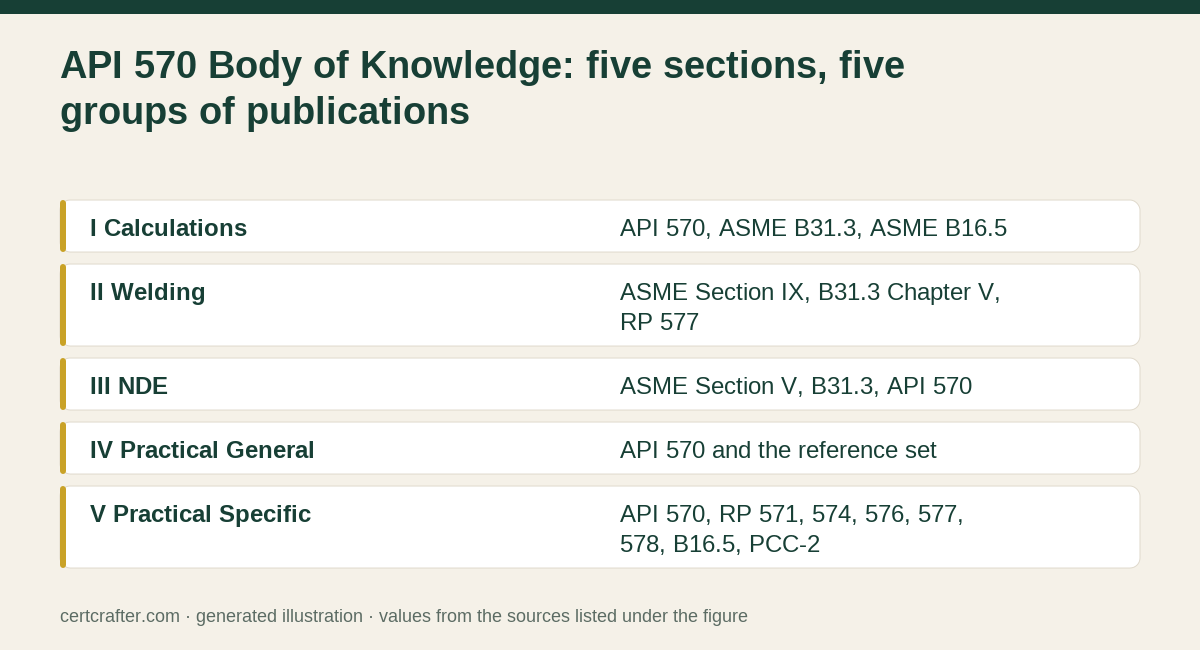
What are the five sections, and what does each point to?
Section I is calculations for in-service piping: corrosion rates, remaining life and inspection intervals, weld joint and casting quality factors, internal pressure and minimum thickness, pressure testing, impact testing, preheat and heat treatment, thermal expansion, flange wall thickness and working pressure, and the minimum thickness of a permanent blank. Both US customary and SI units are expected. The sources are API 570, ASME B31.3 and ASME B16.5.
Section II is welding procedure and qualification review under ASME Section IX, plus the general welding rules of B31.3 Chapter V and any welding rules in API 570, which take precedence. RP 577 is in full. Brazing is not covered.
Section III is nondestructive examination: Section V Articles 1, 2, 6, 7, 9, 10 and the SE-797 part of Article 23, plus the general NDE rules in B31.3 and API 570.
Section IV, Practical Knowledge General, is a list of nineteen topics. They run from certification requirements and types of inspection to records, repairs, alterations, rerating, pressure testing after repairs, flange markings and positive material identification.
Section V, Practical Knowledge Specific, names the publications themselves: API 570 and RP 574, 577 and 578 in full, RP 571 and RP 576 in part, B16.5 and PCC-2 article by article.
Which parts of the map are tested in full, and which in part?
This is where the map pays for itself. The Body of Knowledge says API 570, RP 574, RP 577 and RP 578 are subject to testing in their entirety. RP 571 is Section 2 and fifteen named mechanisms. RP 576 is Section 5, 6.1 to 6.5 and Section 7. PCC-2 is twelve articles with their appendices. B31.3 has thirty groups of requirements excluded, among them branch connections, flexibility analysis and high pressure piping, but not the quality factors in 302.3.3 and 302.3.4.
None of the API documents is short, so you will not read it all well. Spend the hours on the whole documents, and spend only a pass on the partial ones.
How do closed book and open book change the way you read it?
The Body of Knowledge says the closed-book portion tests working knowledge, and the open-book portion tests detail you would be expected to find but not memorize. For Section I it adds one explicit warning: the formulas for corrosion rate, remaining life and inspection interval, and the rules for setting intervals, may be closed book.
So the same section needs two kinds of study. Learn the chain from thickness readings to interval by heart. Learn where the B31.3 tables and B16.5 flange ratings sit so you can find them on screen. The API 570 piping calculations post takes the calculation side further.
How do inspectors use the map on a real plant?
On a unit you never meet these as five sections. A single job touches several. A corroded elbow found on a routine round starts as practical knowledge (what is the damage mechanism and how fast is it moving), turns into a calculation (what is left and when is the next look), and may end as a repair that needs a qualified procedure and the right NDE afterward.
That is how the exam treats it too. A question rarely announces its section. The skill is recognizing which publication holds the answer, and that is what a map trains.
The field mistake is answering from site practice. Plants set their own rules, sometimes stricter, sometimes from an older edition. The Body of Knowledge says plainly that the exam is based on the effectivity sheet, not on local practice or jurisdiction.
Worked example: tracing one topic through the map
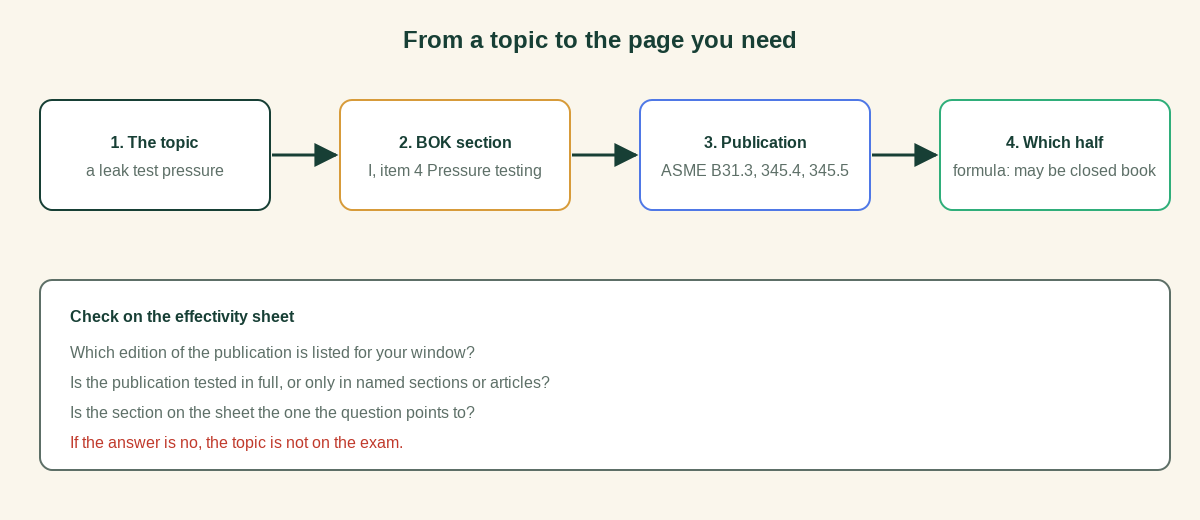
Take a topic a candidate might meet: the pressure used to leak test a repaired line. Here is how to place it.
- Name the topic in the Body of Knowledge’s own words. Pressure testing appears in Section I, item 4, and again in Section IV as pressure testing after repairs, alterations or rerating.
- Find the publication. Section I points to ASME B31.3, 345.4 for hydrostatic and 345.5 for pneumatic leak testing. Section IV points you back to API 570.
- Check the sheet. B31.3 is the 2024 Edition, issued December 2024. PCC-2 Article 501 on pressure and tightness is listed too.
- Decide the half. Working out a test pressure is a calculation you may need closed book. Knowing which test the code allows in a given case is detail you can look up.
Four steps, and you know which three documents to open and what to practice. Do this once for each section and your reading list writes itself.
Where do candidates go wrong with the Body of Knowledge?
Three mistakes show up again and again.
The first is treating a pointer as a limit. The paragraph numbers in the document are examples. They are not the edges of the topic.
The second is studying the excluded material because it is interesting. Branch reinforcement and flexibility analysis matter on a real job, and neither is tested.
The third is ignoring Section IV because it is a plain list. It covers nineteen topics, and most of them are answered from API 570 itself, which is tested in its entirety.
When should you start, and what about the window?
API’s schedule lists the January 29 to February 19, 2027 window for API 570 with an application deadline of November 26, 2026, which is today. If that has passed by the time you read this, the next window is June 4 to 25, 2027, with a deadline of April 1, 2027. Both use this same Body of Knowledge.
Before you plan the weeks, find out where you stand. The free API 570 sample questions show you which of the five sections to open first. The API 570 Complete Exam Kit then adds six practice tests with 1,020 questions, each explained.
 API 570 Exam Prep: 23 Worked Questions, Fully Explained Watch on YouTube · CertCrafter
Our channel has a longer session on this: API 570 Exam Prep: 23 Worked Questions, Fully Explained.
What should you do next?
Print the five section headings. Under each, write the publications from the effectivity sheet and mark which are tested in full. Then take the free sample and put a tick beside the section where you lost the most marks. Start there, and read the post on that section: piping NDE, welding qualification or specific practical knowledge.
Comments
Comments are read by a person before they appear. How we moderate.