Most PMP candidates study Process as a list of ten tasks and then meet a stem that blends three of them. The marks go to whoever finds the verb that decides it.
What does the Process domain cover in the 2026 PMP exam?
Process carries 41% of the exam, the largest share of the three domains. PMI’s July 2026 outline lists 10 tasks under it, and says every exam form addresses all of them.
Each task has enablers. PMI calls them illustrative examples of the work, not an exhaustive list. Read them as the verbs you may meet in a stem: assess, recommend, baseline, verify, validate.
 PMP Risk Management Explained: Register, Responses, Reserves and Risk vs Issue (2026 Exam) Watch on YouTube · CertCrafter
The channel’s video on risk registers, reserves and risk versus issue covers the contingency thinking that sits behind the planning and finance tasks.
Which Process tasks does this page cover?
Three of the ten tasks, finance, schedule and status, already have their own page: finance, schedule and status tasks. This one covers the other seven and shows how the whole domain fits together.
| Task | What PMI asks for |
|---|---|
| 1, plan | Assess the project, recommend an approach, build and maintain the integrated plan |
| 2, scope | Define scope, get stakeholder agreement, break it down |
| 3, value | Identify value, prioritize by value and feedback, verify benefits can be measured |
| 4, resources | Define and plan resources, then manage and optimize availability |
| 5, procurement | Plan, select contract types, negotiate, manage suppliers, verify the agreement is met |
| 7, quality | Gather quality requirements, plan processes, run reviews, manage cost of quality |
| 10, closure | Get approval of completion, set closure criteria, validate readiness for transition |
Notice how uneven they are. Procurement lists 10 pieces of work and resources lists 2. That doesn’t mean resources matters less on a project, only that PMI gave it fewer examples.
How big is each task in the outline?
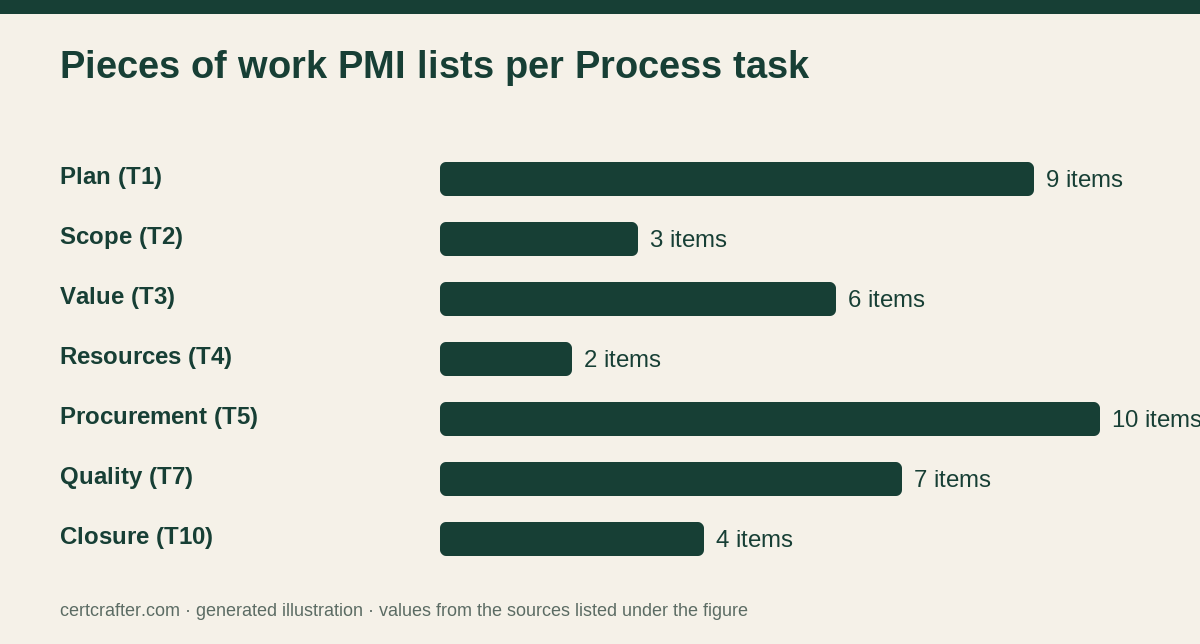
The count tells you where PMI gave the most examples, which is where a stem has the most to draw on. It is not a weighting. PMI states weights only at the domain level.
How do the Process tasks work on a real project?
On a real project they are one chain. You assess the job, pick an approach, plan, scope, resource, buy, and then keep checking that value is still being delivered.
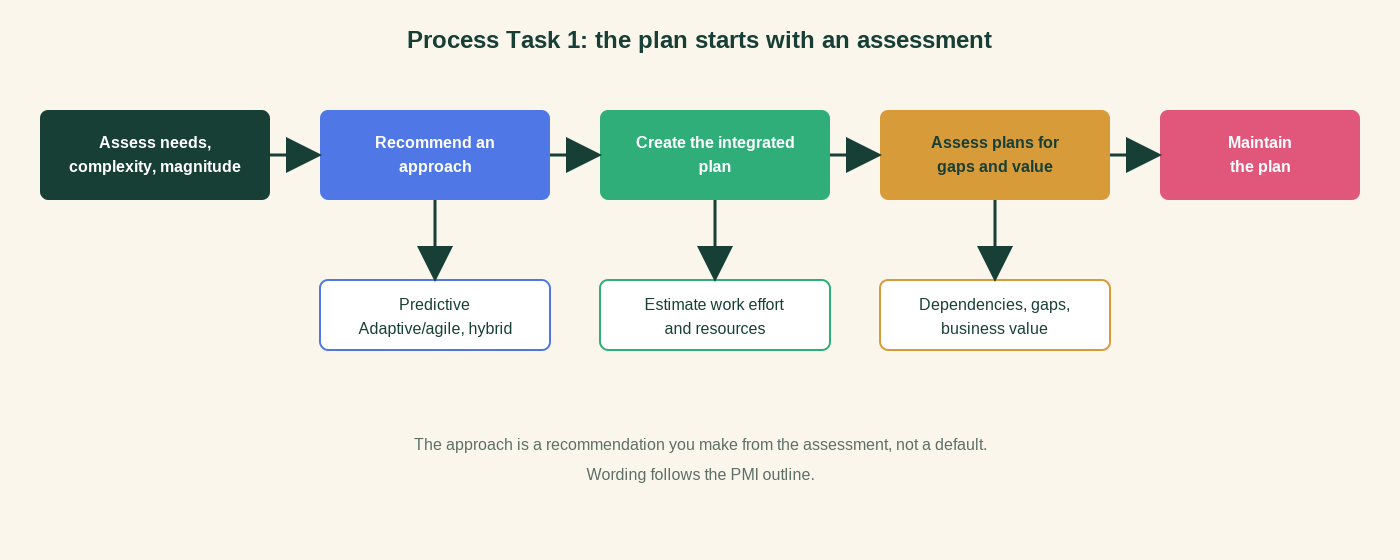
Task 1 is where the chain starts, and it starts with an assessment, not a template. The outline asks you to assess needs, complexity and magnitude, then recommend an approach: predictive, adaptive or hybrid. A team that picks the approach first and fits the project to it has the order backwards.
Value is the task people underrate. The outline asks you to verify that a measurement system is in place to track benefits. On site that means someone owns the number that says the project paid off, and it isn’t only the delivery team. A project can hit its dates and still fail that test.
Procurement is where scope meets money. Selecting a contract type, negotiating and managing the supplier are all listed, and so is verifying that the agreement’s objectives were met. Closing a contract on delivery alone, without that check, is a common field error.
Quality is the task that gets cut first when dates tighten. The outline lists gathering quality requirements, running ongoing reviews and managing the cost of quality, so a review dropped to save a week is a planning failure you can name, not bad luck.
Resources sit between the plan and the schedule. Defining what the work needs is one act, and optimizing availability while the project runs is another. People get double-booked across projects, and the plan has to say who gives way.
Closure gets squeezed when the budget runs out. PMI lists validating readiness for transition, for example to an operations team, and concluding the final lessons learned. A handover with no named receiver is not a closed project.
Worked example: which task owns the problem?
Say a stem tells you a vendor delivered everything in the contract, the sponsor is unhappy because nobody can show the benefit the project promised, and the operations team has not accepted the handover.
- Split the symptoms. Delivery against the contract is procurement, Task 5. The missing benefit is value, Task 3. The handover is closure, Task 10.
- Ask what is still open. The contract is met, so procurement is quiet. The benefit has no measure, so Task 3 comes first.
- Rule out the option that closes the project. Closure needs stakeholder approval and a ready receiver.
- Pick the option that sets up the benefit measurement with the sponsor, then moves to transition.
The PMP Complete Exam Kit works more of these under timed conditions, with every answer explained.
Where do candidates lose marks on Process questions?
They treat the approach as fixed. PMI says predictive, adaptive/agile and hybrid items run through all three domains, about 40% predictive and 60% agile or hybrid. So a Process question may use backlog and iteration language, and the task logic still holds.
They answer the nearest task, not the right one. A stem about a late supplier invites a procurement answer when the real gap is in the plan’s dependencies.
And they skip the verb. “Assess”, “recommend” and “verify” are different acts. An answer that implements when the stem asks you to assess first is usually wrong.
Which Process questions can you try for free?
The free sample includes Process scenarios. Two are embedded below: one on a responsibility matrix and one on a team that has worked in two-week iterations for years. Name the task before you read the options.
What should you do next?
Take the free sample quiz and write the task number next to each Process miss. Then read what changed in the 2026 outline for the weights, and the PMP 2026 certification page, the practice test bundle and the PMP guides hub for the rest.
Comments
Comments are read by a person before they appear. How we moderate.