Most PMP candidates met this domain as a footnote, because it was 8% of the old exam. It is now 26%, and the marks go to whoever knows who owns a problem.
What does the Business Environment domain cover in the 2026 PMP exam?
It carries 26% of the exam, the smallest of the three domains but more than a quarter of the paper. PMI’s July 2026 outline lists 8 tasks under it. The domain is about the world around the project: the rules it must follow, the organization it sits in, and the outside changes that land on it.
Each task has enablers, short lines of work. PMI gives them as examples, so read them as the verbs a stem may use: define, confirm, execute, evaluate, recognize, survey.
 PMP Risk Management Explained: Register, Responses, Reserves and Risk vs Issue (2026 Exam) Watch on YouTube · CertCrafter
The channel’s video on risk registers, responses, reserves and risk versus issue covers the line between a risk and an issue, which Task 4 tests directly.
Which tasks sit in the Business Environment domain?
| Task | What PMI asks for |
|---|---|
| 1, governance | Establish structure, rules and reporting, define success metrics, outline escalation paths and thresholds |
| 2, compliance | Confirm requirements, classify them, find threats, measure how far the project complies |
| 3, change | Run change control, communicate status, implement agreed changes, update documents |
| 4, impediments | Evaluate impact, prioritize, intervene, recognize when a risk becomes an issue |
| 5, risk | Identify, analyze, monitor, plan, keep the register, communicate impact |
| 6, improvement | Use lessons learned, update organizational process assets |
| 7, organizational change | Assess culture, evaluate the impact of change on the project |
| 8, external environment | Survey regulation, technology, geopolitical and market shifts, assess impact on scope or backlog |
Notice that risk appears here, not under Process. Candidates who file it under planning misread where the exam puts it.
How big is each task in the outline?
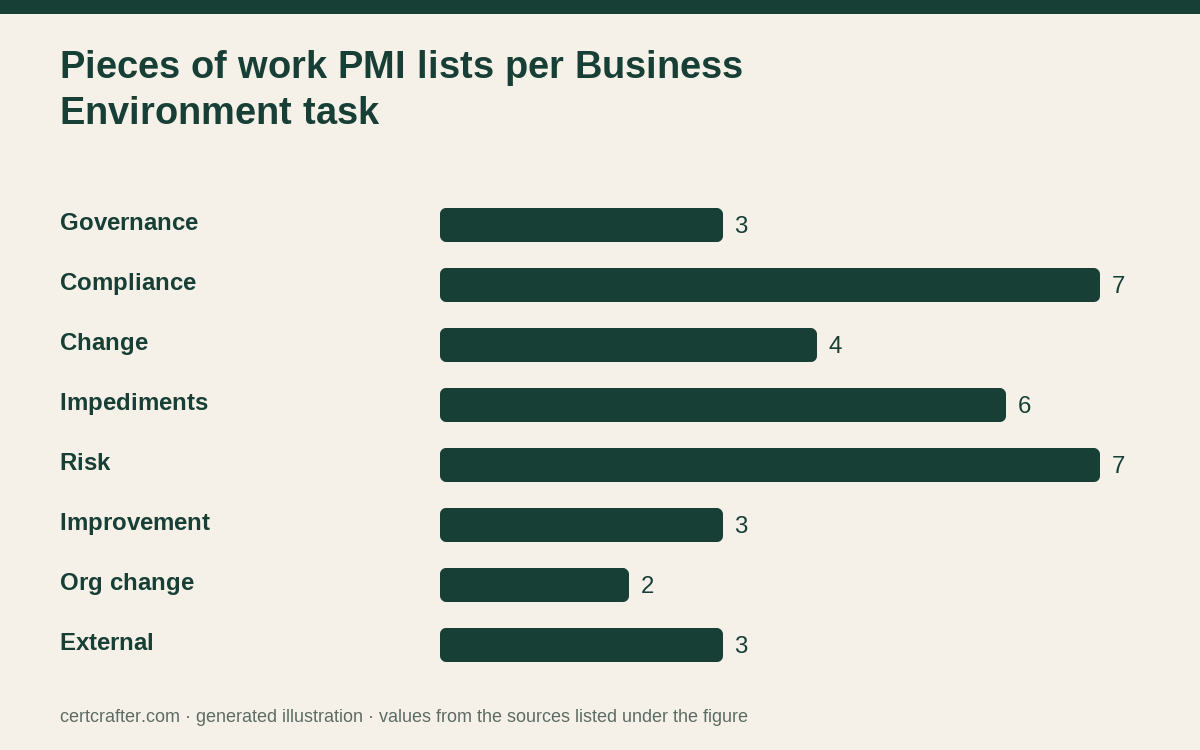
The count shows where PMI gave the most examples, which is where a stem has the most to draw on. It is not a weighting. PMI states weights only at the domain level.
How do these tasks work on a real project?
On a site or a program office they are one set of guardrails. Governance says who decides, compliance says what you may not do, and change control says how the plan moves.
Governance comes first, and it is more specific than a charter. The outline asks for escalation paths and thresholds, so a team should know the cost or delay at which a problem leaves the project manager’s hands and goes to the sponsor. Projects without a threshold escalate late or all the time.
Compliance is a list of categories, not one thing. PMI names security, health and safety, sustainability and regulatory compliance, then asks you to determine threats and measure the extent of compliance. A project that has a plan but no measure cannot say whether it is compliant.
Change control is dull and decisive. Execute the process, communicate the status of proposed changes, implement what was agreed and update the documents. The usual field failure is the last step: the change is built, the baseline stays old, and the next report compares the wrong numbers.
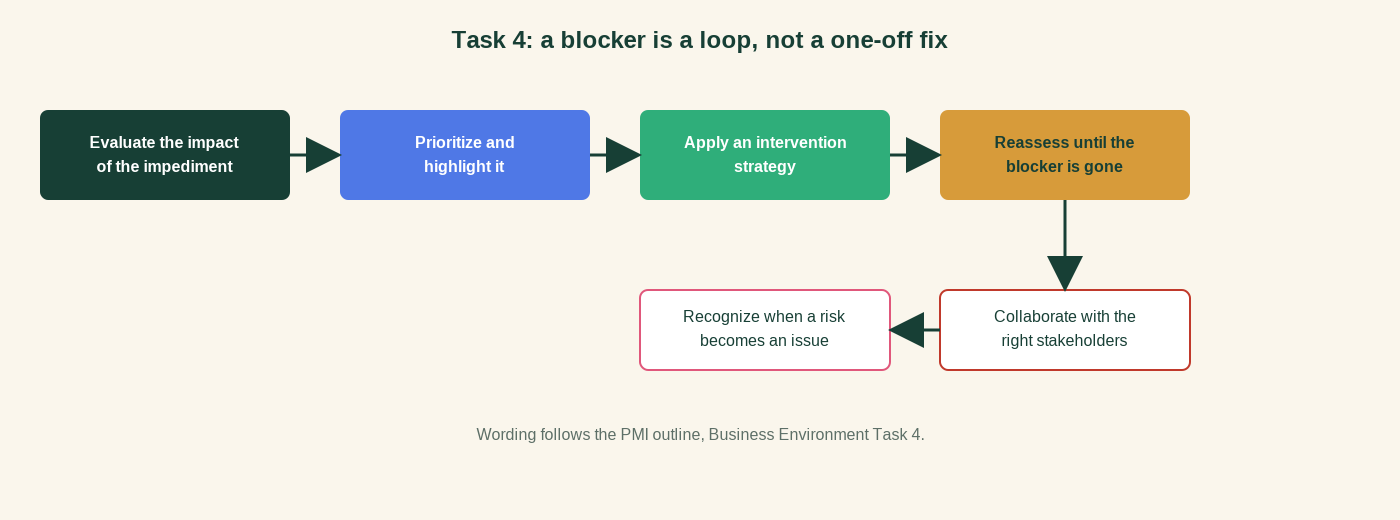
Impediments are where agile and predictive projects meet. The loop is the same: evaluate, prioritize, intervene, reassess. The step candidates skip is recognizing when a risk has become an issue. Once the event has happened, it no longer belongs in the risk response column.
The external environment task is the newest weight. PMI asks you to survey regulations, technology, geopolitical and market changes, then assess the impact on scope or backlog and keep reviewing. A scan done once at planning and never repeated is the common gap.
Worked example: risk, issue or external change?
Say a stem tells you a regulator has published a new reporting rule that takes effect in nine months, your rollout goes live in seven, and the product as designed does not meet the rule.
- Name what happened. A published rule with a start date is a fact, not an uncertainty. It is not a risk.
- Pick the task. Surveying the external environment and assessing its impact on scope is Task 8. Compliance, Task 2, follows.
- Compare the dates. The rule applies after go-live, so the first release can ship but the scope has to change.
- Choose the answer that assesses the impact on scope or backlog and routes the change through change control, not the one that adds a line to the risk register.
The PMP Complete Exam Kit works more of these under timed conditions, with every answer explained.
Where do candidates lose marks on Business Environment questions?
They file a fact as a risk. A dated rule, a signed decision or an event that has already happened is an issue or a change, and the options that log it as a risk are built to tempt you.
They fix what they do not own. If the blocked item belongs to a function outside the project, clearing it is not a team task. The task asks you to collaborate with the right stakeholders, and escalation by the agreed path is often the answer.
And they ignore the approach. PMI says about 40% of items are predictive and 60% agile or hybrid. A governance or change question may use backlog and iteration language, and the task logic still holds.
Which Business Environment questions can you try for free?
The free sample includes three Domain III scenarios. Two are embedded below: one on a regulatory change in a multi-country rollout, and one on an impediment the team could not clear. Name the task before you read the options.
What should you do next?
Take the free sample quiz and write the task number next to each Domain III miss. Then read what changed in the 2026 outline and the Process domain page for the biggest domain. The PMP 2026 certification page, the practice test bundle and the PMP guides hub have the rest.
Comments
Comments are read by a person before they appear. How we moderate.