Most project managers can run a status meeting. Fewer can say which of three Process tasks a scenario is testing when the money, the dates and the report all go wrong in the same paragraph.
What do the finance, schedule and status tasks cover?
The Process domain holds 10 tasks and carries 41% of the 2026 PMP exam. Three of them are about tracking the work: Task 6, plan and manage finance, Task 8, plan and manage schedule, and Task 9, evaluate project status.
They sound alike, and on a real project one person does all three in the same week. The outline keeps them apart anyway. Each lists its own work, and a question is written to sit under one of them.
 PMP Risk Management Explained: Register, Responses, Reserves and Risk vs Issue (2026 Exam) Watch on YouTube · CertCrafter
The channel’s video on risk registers, reserves and risk versus issue covers the contingency side of the finance task.
How does PMI word each task?
Here is the work PMI lists, trimmed to the pieces that separate the three.
| Task | Pieces of work that set it apart |
|---|---|
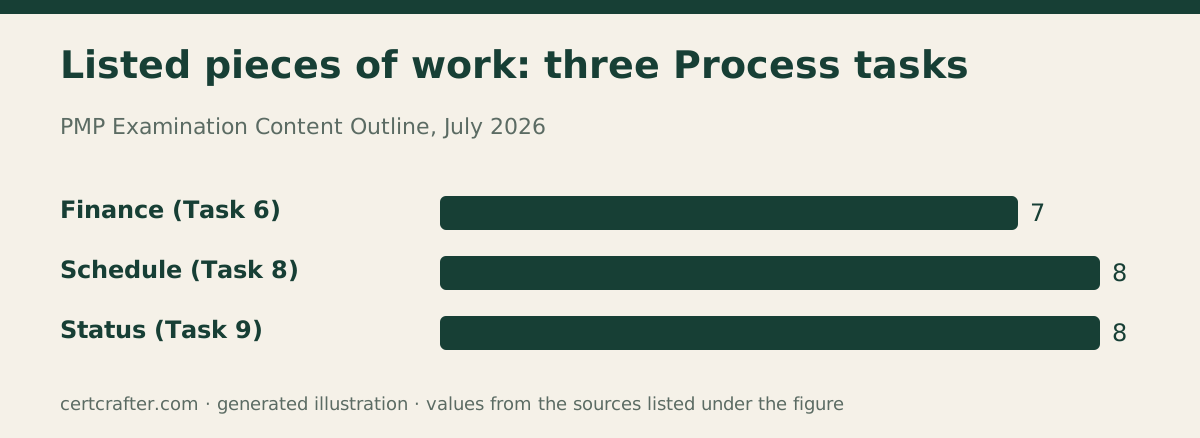
| 6, finance | Plan spend tracking, plan financial reporting, quantify contingency allocations, monitor financial variations and work with governance, manage financial reserves |
| 8, schedule | Prepare a schedule for the chosen approach, estimate, baseline the schedule, execute the schedule management plan, analyze schedule variation |
| 9, status | Develop metrics, tailor and maintain artifacts, assess current progress, measure and update metrics, communicate status |
Read the verbs down the right-hand column. Finance is about allocations, reserves and variations. Schedule is about the baseline and what moves against it. Status is about metrics, artifacts and telling people.
How does this work on a real project?
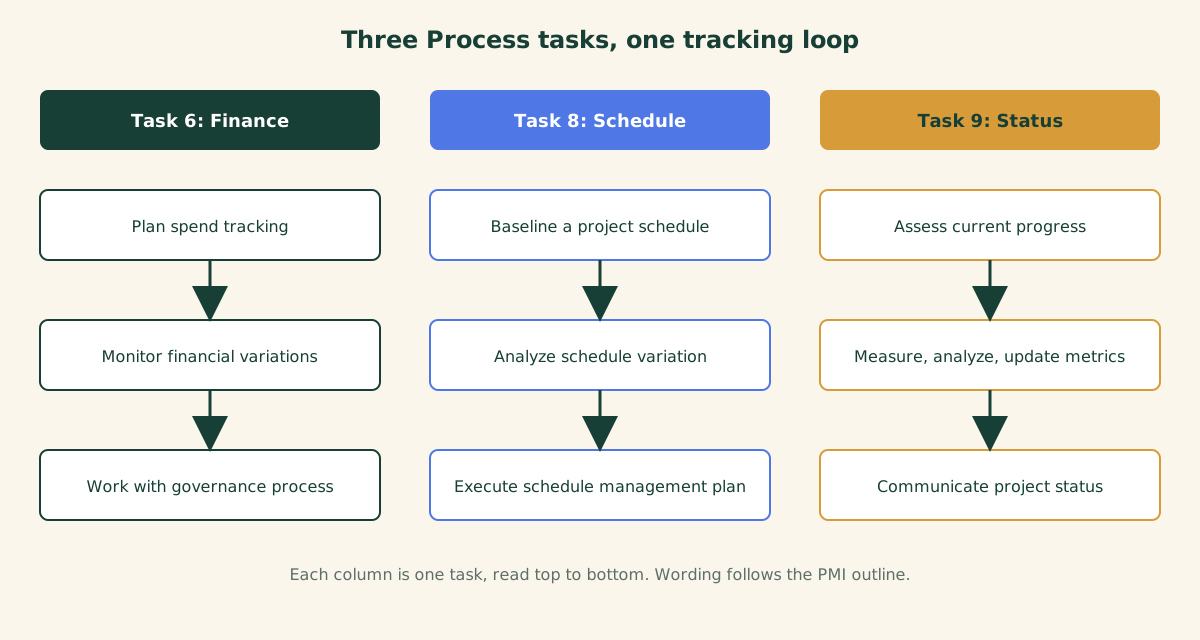
On site, the three tasks form one loop. You plan how spend will be tracked, you baseline the schedule, and you decide which metrics will tell you whether either is slipping. Then you watch, and when something moves you tell the right people.
Take the finance task. Monitoring financial variations comes with a second half: working with the governance process. A variance on a ledger is information. A variance above the threshold your governance sets is a decision that belongs to someone else. Project managers who quietly absorb overruns from the reserve, without going to the body that owns it, are the ones whose projects end in an audit.
Schedule has the same pattern. Baselining is a deliberate act. Once the baseline exists, analyzing schedule variation means comparing against it, not against last week’s guess. A schedule that gets rewritten every Friday has no baseline, so it has no variation to analyze.
Reserves deserve their own note. The outline lists quantifying risk and contingency allocations and managing financial reserves as separate pieces of work. One sets the amount aside, the other decides when it may be spent. A reserve nobody governs is just a hidden budget line.
Status closes the loop. The outline asks you to tailor the artifacts to what each audience needs and to keep them reachable. A sponsor, a vendor and a site supervisor do not want the same page. The sponsor wants the decision that is coming. The supervisor wants this week’s constraints. The vendor wants to know what changed in the dates it was given. One set of metrics can feed all three, as long as someone chose what each reader sees.
Worked example: which task is the question really about?
Say a stem tells you a rollout is two weeks behind its baseline, spend is on plan, and the sponsor says she cannot tell from the weekly email whether to worry. The project manager’s first instinct is to redesign the report.
- Separate the three symptoms. Two weeks behind baseline is a schedule matter. Spend on plan means finance is quiet. The sponsor’s confusion is a status matter.
- Ask what has not happened yet. Nobody has analyzed the schedule variation, so the cause and its effect on the end date are unknown.
- Rule out the option that jumps to communication first. A better report of an unexplained delay is still an unexplained delay.
- Pick the option that analyzes the variation, then tailors what goes to the sponsor.
The order is the skill. Analysis sits in Task 8 and the message sits in Task 9, and the first one feeds the second.
The PMP Complete Exam Kit works more of these under timed conditions, with every answer explained.
Where do candidates slip on these tasks in the exam?
They reach for a number. Because finance and schedule feel quantitative, candidates look for a calculation, and the stem has none. The 2026 outline lists these as management work, and the questions are framed around what you do next, not around arithmetic.
They also skip governance. When the stem mentions a variance and a threshold, the answer often involves the governance process rather than a private fix.
And they confuse the status artifact with the status work. Producing a report is one piece of Task 9. Assessing progress and updating the metrics come before it. Ask yourself whether the facts are known yet. If not, you are not at the reporting step.
What should you do next?
Take the free sample quiz and tag each Process miss with the task number you thought it was and the one it was. Then read what changed in the 2026 outline and the field errors in PMP common mistakes. The PMP 2026 certification page, the practice test bundle and the PMP guides hub hold the rest.
Comments
Comments are read by a person before they appear. How we moderate.