Pick PMP if you have already led projects for long enough that PMI will count it. Pick CAPM if you have not. That is the whole decision for most people, and the rest of this page is about checking it against PMI’s own documents.
Both outlines are PMI’s. The PMP one is the July 2026 edition. The CAPM one on PMI’s site carries a 2023 copyright, so treat its numbers as that edition’s.
What is the difference between PMP and CAPM?
The two credentials sit at different points in a career. PMI’s PMP outline says candidates must show experience leading and directing projects. Its CAPM outline describes the skills that entry and associate level people need to understand project management fundamentals.
The PMP outline even sends people who fall short of its requirements toward CAPM. It says individuals who do not meet the eligibility requirements should consider other certifications such as the CAPM.
| PMP | CAPM | |
|---|---|---|
| Education | Secondary diploma or higher | Secondary diploma, GED or equivalent |
| Experience | 24 to 60 months leading projects, by education level | None stated in the outline |
| Training or education | 35 hours aligned to the outline | 23 hours of project management education |
| Domains | People 33%, Process 41%, Business Environment 26% | Four domains, from 17% to 36% |
| Format stated | 180 questions, 170 scored, 240 minutes | Not stated in the outline we saved |
I left the CAPM format blank on purpose. The outline PDF in our saved sources does not give a question count or a time limit, and a number from memory is how comparison pages go wrong. Check PMI’s CAPM handbook page before you book.
Which one am I eligible for?
This is where the decision gets made. PMP eligibility has two parts, and you need both.
The first part is experience. PMI sets four tiers. A secondary diploma needs 60 months of non-overlapping experience leading projects. A post-secondary program brings it to 48 months, a bachelor’s-level degree to 36, and a bachelor’s from a program accredited by PMI’s Global Accreditation Center to 24. All of it must fall in the last 10 years.
The second part is 35 hours of project management training aligned to the PMP outline. Books and practice exams alone do not count. Employer-sponsored courses, training companies and self-paced courses with an end-of-course assessment do.
CAPM asks for a secondary diploma and 23 hours of project management education. It records those hours whatever date you took them, and registrations are processed in 24 hours or less unless you are selected for audit.
 PMP 2026 — PMP or CAPM first? Watch on YouTube · CertCrafter
If you want the short version on video, the channel has PMP 2026: PMP or CAPM first?.
Worked example: counting your months for PMP
Experience is counted in months, not in projects, and overlapping time is counted once. Say you hold a bachelor’s degree, so the tier is 36 months. Here is how a candidate would work out where they stand.
- List each project you led with its start and end month.
- Draw them on one timeline. Project A ran 1 January to 31 March. Project B ran 1 February to 31 May.
- Count the covered months once. The two together cover 1 January to 31 May, which is 5 months, not 3 plus 4.
- Add every other project the same way, keeping only work in the last 10 years.
- Compare the total with your tier. At 5 months you are far short of 36.
PMI is explicit that this matches how the application is assessed: you cannot count the time leading two projects twice. Routine operations, administrative tasks, school projects and personal events do not qualify.
A candidate in that position has an honest answer. CAPM is available now. PMP waits until the months add up.
Does CAPM count toward PMP?
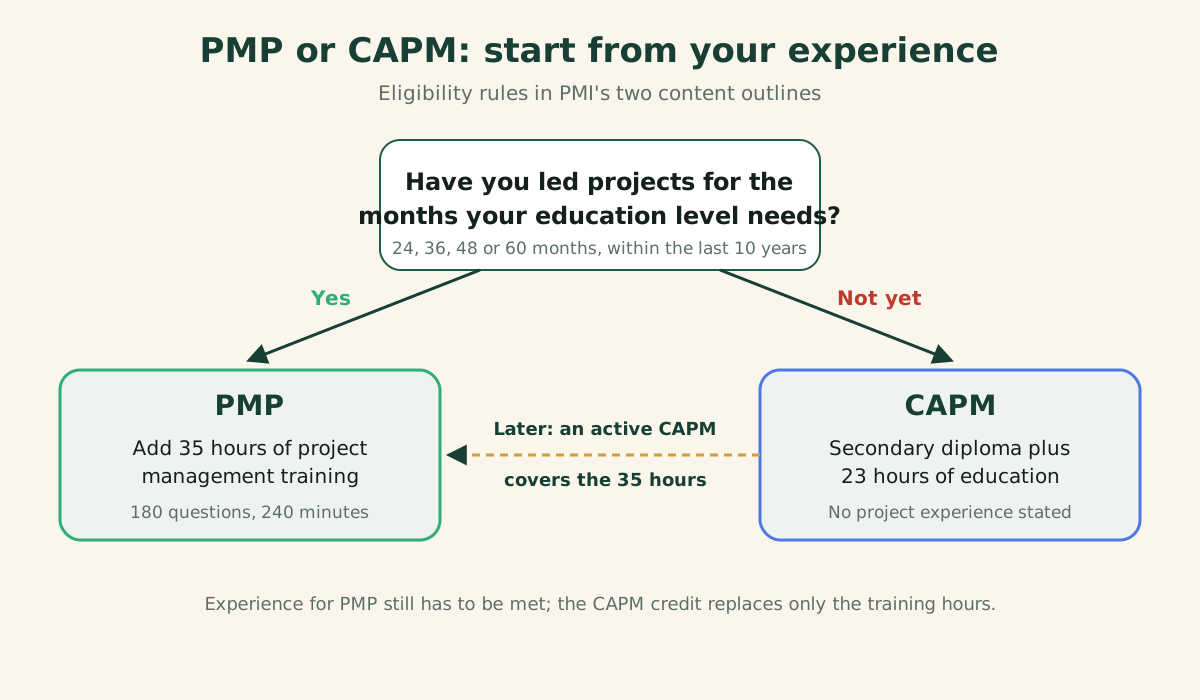
Partly. PMI says an active CAPM holder who has met the education and experience requirements does not need to document the 35 training hours, because holding it earns a 35-hour credit. The word that matters is “and has met the experience”. CAPM does not shorten the months of leading projects. It removes the paperwork for the course.
So CAPM first makes sense when you are two or three years from the experience you need and want a credential, a structured syllabus and a training record in the meantime. It makes less sense if you already have the months, because you would sit one exam to avoid documenting a course you can take once.
What does each exam test?
Look at the blueprints side by side and the difference is in the verbs. CAPM tasks ask you to distinguish, explain, calculate and use. You distinguish a project from operations, issues from risks, assumptions from constraints. You apply critical path methods and calculate schedule and cost variances. You use a risk register and a stakeholder register in a given situation.
PMP tasks ask you to decide and lead. Develop a common vision. Manage conflicts. Recommend a development approach, predictive, agile or hybrid. Define governance escalation paths and thresholds. Run the change control process. Recognize when a risk has become an issue. PMI says each candidate has to apply project management concepts and their own experience to on-the-job situations through scenario-based questions.
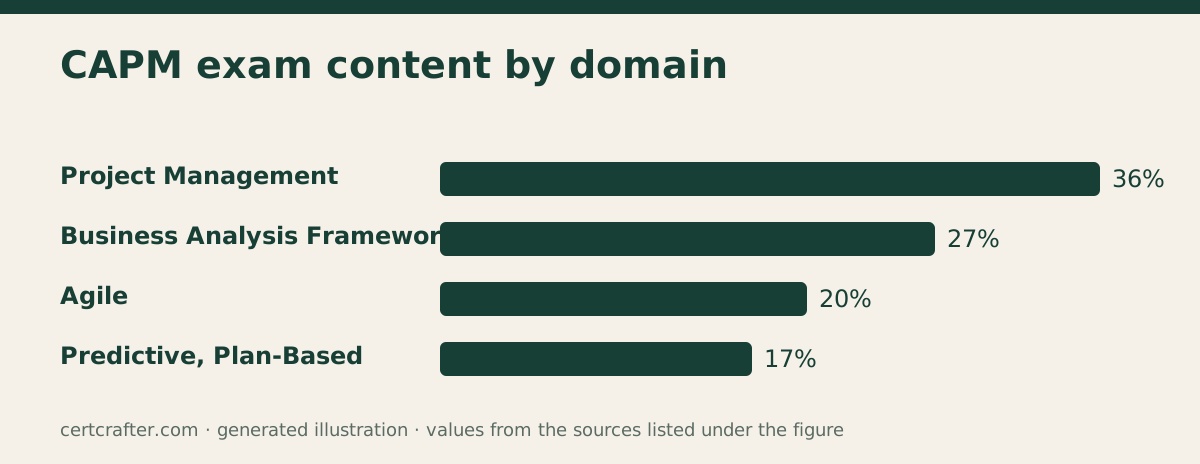
One content difference trips people up. CAPM has a whole domain on business analysis frameworks, 27% of items, covering requirements gathering, traceability, product roadmaps and acceptance criteria. PMP has no business analysis domain. Its Business Environment domain, 26%, is about governance, compliance, change, risk and the external environment instead.
How do the roles look on a real project?
Think of a plant shutdown or a software rollout. The person keeping the risk register up to date, tracking schedule variance against the baseline and recording who the stakeholders are is doing work the CAPM outline names. That is a team member or coordinator role, and it is a perfectly good place to start.
The person deciding that the rollout will run in iterations for one workstream and a fixed plan for another, agreeing with the sponsor when an issue escalates, and answering for compliance is working at the PMP level. The mistake I see in the field is a coordinator who has run the schedule for three years and assumes that means they have led the project. PMI counts leading and directing the project, not supporting it. If your sponsor, not you, made the decisions, check your wording before you apply.
The reverse mistake also happens. A senior project manager who has never written a work breakdown structure down in the form the syllabus uses sometimes dismisses CAPM-style questions as beneath them. The vocabulary is exact, and a lazy definition costs the mark.
Where do candidates go wrong on each exam?
On CAPM, the traps are definitional. Issues versus risks, a milestone versus a task duration, the project management plan versus the product management plan. Read the verb in the question and answer exactly that. Learn what each register is for and what goes in it.
On PMP, the trap is answering from the textbook instead of from the scenario. PMI says the exam is not written according to any single text. About 40% of items represent predictive approaches and the other 60% are split between agile and hybrid, and these appear in all three domains. So a question about procurement may sit inside an iteration-based team, and a question about people may sit inside a fixed-scope construction job. Decide which way of working the team is using first, then choose the response that fits it.
Also expect new formats. The 2026 PMP outline lists Case or Scenario and Graphic-Based questions as new, alongside multiple choice, multiple response, matching and point and click, some of them only available at a test center.
What should you do next?
If you meet a PMP tier and have the 35 hours, go for PMP and spend your time on the three weighted domains. Read the PMP 2026 certification page to see how the practice tests map to them, then try the free sample quiz and note which domain you miss most. Our write-up of the 2026 outline changes shows why Business Environment now deserves a quarter of your study time. The PMP guides hub lists the rest as they publish.
If you are short on months, count them properly using the example above, and plan CAPM with its 23 hours now. We do not sell a CAPM practice set, so the PMP practice test bundle is for when you are ready for the next step.
Comments
Comments are read by a person before they appear. How we moderate.