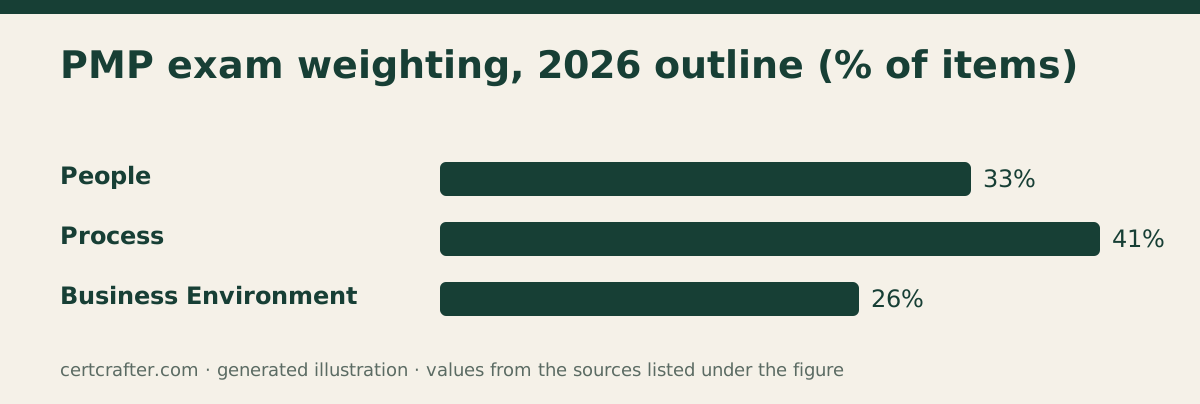
The July 2026 PMP outline did not add a domain or drop one. It moved the weight, and it moved a lot of it. Business Environment, the domain that covers governance, compliance, change control and the world outside the project, now carries 26% of the items. It used to carry 8%.
If your study notes were built on the old split, a quarter of the exam is thinly covered. That is the main thing to fix.
How did the domain weights change?
PMI publishes the new split in the outline: People 33%, Process 41%, Business Environment 26%. The earlier split, as recorded in CertCrafter’s own notes on the previous outline, was People 42%, Process 50% and Business Environment 8%. Treat that earlier split as our record, not as a quote from the July document, which only shows the new numbers.
Process is still the largest domain. But the gap between the three is now narrow enough that you cannot skip one and hope the other two carry you. A candidate who is strong on schedules and cost and weak on compliance would have lost little before. Now that same person gives away most of a quarter of the paper.
What is in each domain now?
The outline lists 26 tasks: 8 under People, 10 under Process and 8 under Business Environment. PMI says every exam addresses all tasks for a domain.
| Domain | Weight | Tasks | Examples from the outline |
|---|---|---|---|
| People | 33% | 8 | Develop a common vision, manage conflicts, lead the team, engage stakeholders, plan communication |
| Process | 41% | 10 | Integrated plan, scope, value-based delivery, resources, procurement, finance, quality, schedule, status, closure |
| Business Environment | 26% | 8 | Governance, compliance, change control, impediments and issues, risk, continuous improvement, organizational change, external environment |
Notice where the new weight went. Governance, compliance and the external environment are not about running a schedule. They are about the conditions the project lives in. A sponsor changes. A regulation lands mid-project. A supplier’s country changes its rules. Those are the situations Business Environment tasks describe.
How do the new topics show up on a real project?
Take compliance, which the outline now lists with security, health and safety, sustainability and regulatory examples. On a plant upgrade, the compliance task is the permit that has to be in place before a crew can start, and the person who finds out in week six that it was never filed. The outline asks you to classify compliance categories, spot the threats, measure how far the project meets them and weigh the cost of getting it wrong.
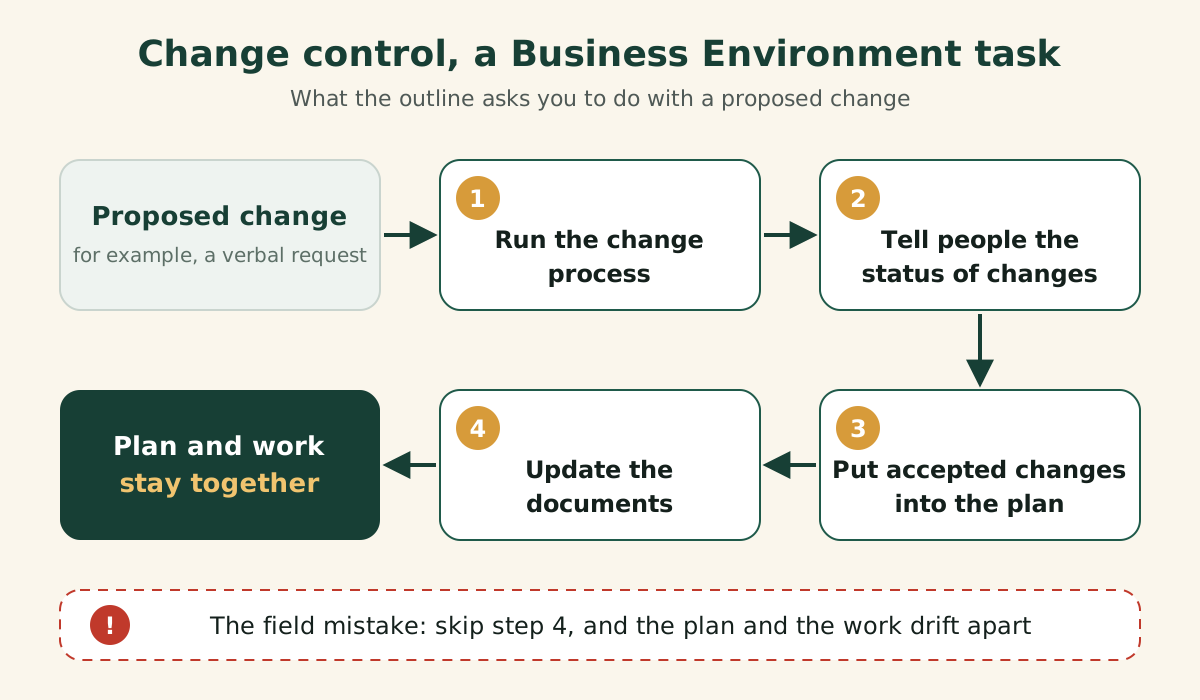
Change control is the same story. Every project manager has watched a small verbal request grow into a rework bill. The task is plain: run the change process, tell people the status of proposed changes, put the accepted ones into the plan and update the documents. The mistake in the field is skipping the last step, so the plan and the work drift apart.
Then risk. The outline says to recognize when a risk becomes an issue, and it names risk registers and responses, including for security and sustainability. If you want a walk through that topic on video, the channel has PMP Risk Management Explained: Register, Responses, Reserves and Risk vs Issue.
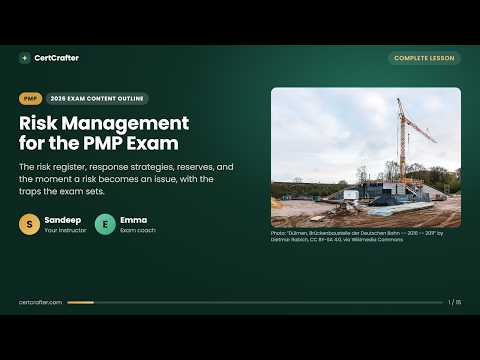 PMP Risk Management Explained: Register, Responses, Reserves and Risk vs Issue (2026 Exam) Watch on YouTube · CertCrafter
What does PMI add about AI and sustainability?
Both appear because PMI’s job task analysis found them relevant to practice. The outline does not give them a domain of their own. They show up inside tasks.
Sustainability sits in the integrated plan task as an example of critical information requirements, in the quality task as part of the cost of quality, and in the compliance list. AI is named in the introduction as a trend PMI evaluated. In practice, expect scenarios where a team is building or using an AI tool and the question is about the project’s response: who owns the decision, what gets documented, which stakeholders need to hear about it.
Our free sample set has two scenarios of this kind. One has a bank building an AI assistant that suggests next actions to branch staff. The other has an iteration-based team hit mid-iteration by a statutory reporting change. Both are about judgment, not definitions.
How is the exam delivered and scored?
The PMI document gives the format plainly. 180 questions, of which 10 are pretest and do not affect your score. 240 minutes. Two 10-minute breaks: the first after the case-study section, the second about halfway through the independent questions. Once you review your answers and start a break, you cannot go back to the earlier section.
New question types matter here. The outline marks Case or Scenario and Graphic-Based questions as new. A case gives you a detailed situation, sometimes with charts, and then asks several questions about it. Graphic-based items make you read a chart or diagram first. The other types are multiple-choice single response, multiple response, enhanced matching, point and click, matching and pull-down list, and some of those are available only at a test center.
The practice sets here use four-option single-answer items, so use them for the concepts and use PMI’s own outline for the formats.
How many questions use agile, predictive or hybrid approaches?
About 40% of items represent predictive approaches. The remaining 60% are split between adaptive or agile and hybrid approaches, and the exact numbers vary by form. PMI also says these approaches appear in all three domains and are not tied to any one task.
That changes how you read a scenario. Do not assume a waterfall answer because the question is about a contract, or an agile answer because it is about people. Read the situation first and decide which approach the team is working in. Then pick the response that fits.
Worked example: re-weighting your study time
Say you have 60 hours left and your old plan gave Business Environment almost nothing.
- Split the hours by the new weights: 33% People is about 20 hours, 41% Process is about 25 hours, 26% Business Environment is about 16 hours.
- Mark which of the 8 Business Environment tasks you could explain to a colleague without notes. Be honest.
- Put the extra hours into the unmarked ones first, usually compliance, governance escalation thresholds and external change.
- Do a mixed set of scenario questions and tag each miss by domain.
- Move hours toward the domain with the most misses.
The split is arithmetic on PMI’s weights, not a prediction of any single exam.
What should you check before you book?
The outline also restates eligibility: 35 hours of project management training aligned to the outline, plus a stated amount of experience leading projects that depends on your education level. A currently active CAPM certification waives the training requirement. Books and practice exams alone do not count as the 35 hours.
On retakes, PMI allows up to three attempts within a one-year eligibility period. After that you wait a year. Read the PMI Certification Handbook for the current rules before you pay, because those rules are PMI’s to change.
What to do next
Start with the PMP 2026 certification page to see how the practice tests map to the three domains. Try the free sample quiz and note which domain you miss most. When you want the full set, the practice test bundle covers all of them, and the PMP guides hub lists the other posts as they publish.
Comments
Comments are read by a person before they appear. How we moderate.