PMP 2026: The 10 Most Common Mistakes

By Sandeep Bandyopadhyay, Senior aerospace engineer · PMP, MBA, Six Sigma

TL;DR

The most common PMP 2026 mistakes come from treating the exam as a PMBOK Guide test, studying one approach only, skipping the Business Environment domain, and acting before analyzing. PMI's July 2026 outline says the exam is scenario based, spans predictive, agile and hybrid work, and weights People 33%, Process 41% and Business Environment 26%. Fix the habits, not just the facts.

Original questions, not exam dumps. Every CertCrafter question is written from the published body of knowledge and the referenced codes. None is copied from a live exam, and CertCrafter is independent: not affiliated with or endorsed by any awarding body.

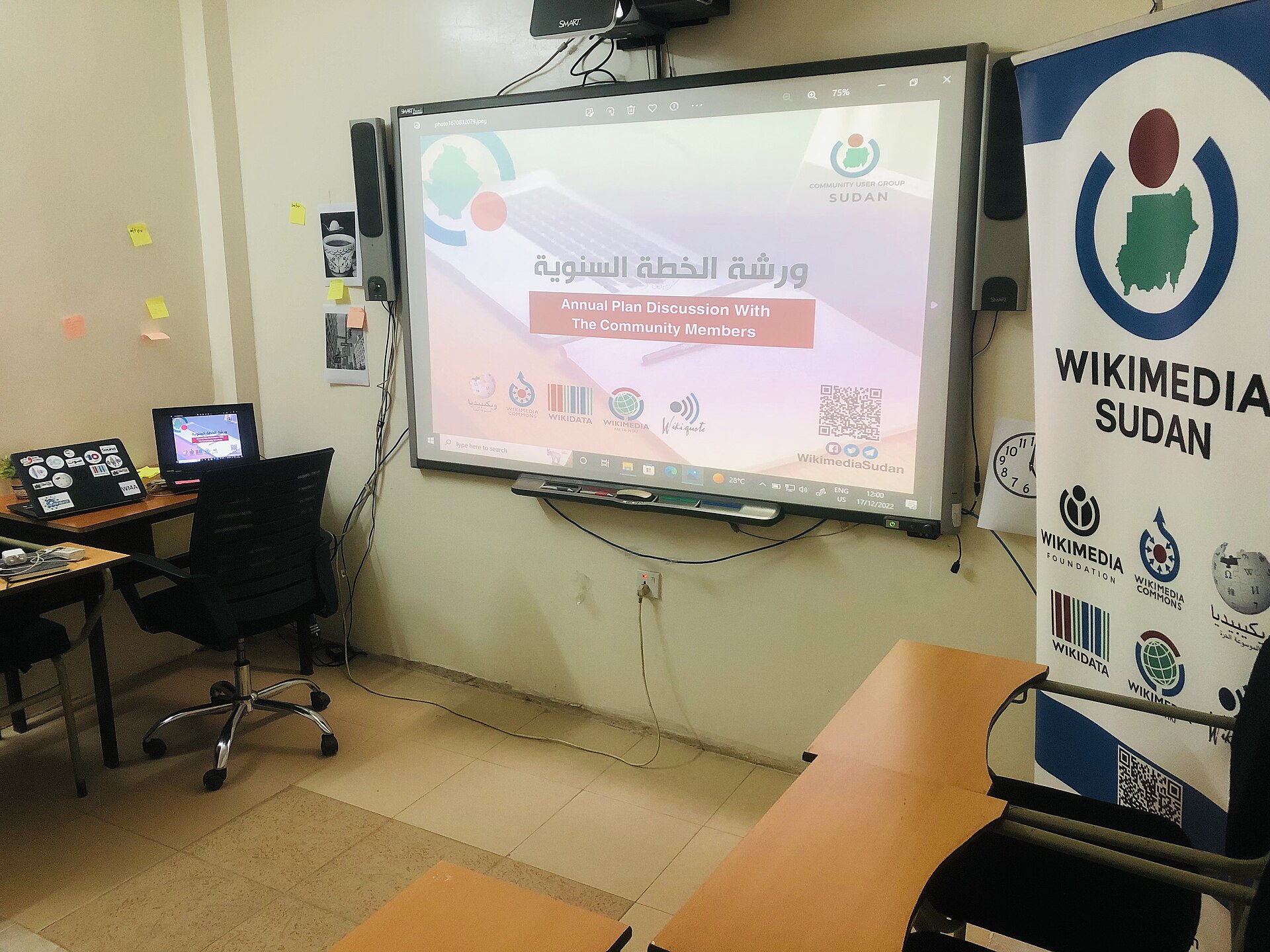
Colleagues gathered around a table at an annual planning meeting
Photo: Annual plan meeting Wikimedia Sudan 04 by Hassan Hassoon (Wikimedia Commons), CC BY-SA 4.0, via Wikimedia Commons.

Most PMP candidates who miss the mark knew the material. They lost marks choosing a sensible second step when the question asked for the first.

Why do capable project managers still fail PMP questions?

Because the exam does not test what you know. PMI’s July 2026 outline says each candidate must apply project management concepts and their own experience to on-the-job situations through scenario-based questions. The PMBOK Guide, in PMI’s own words, is a source of core knowledge. The exam assesses whether you can think critically and apply it.

That changes how you should read the ten mistakes below. Some are about knowledge, some about how projects really run, and some about how the exam frames a question. They overlap on purpose, because real mistakes do.
Video: PMP Risk Management Explained: Register, Responses, Reserves and Risk vs Issue (2026 Exam) PMP Risk Management Explained: Register, Responses, Reserves and Risk vs Issue (2026 Exam) Watch on YouTube · CertCrafter
Image: video thumbnail, source: CertCrafter on YouTube (@certcrafters).

The channel’s video on risk management, register and reserves covers one of the areas where these mistakes cluster.

Which mistakes come from the knowledge itself?

Studying the PMBOK Guide as if it were the syllabus. PMI says the outline and the Guide differ noticeably, and its own FAQ-style note says the exam is not written from any single text. The syllabus is the outline: three domains, 26 tasks.

Skipping Business Environment. It carries 26% of the items. It holds governance, compliance, change control, issues, risk, continuous improvement, organizational change and external business changes. Candidates who come from delivery roles often treat it as someone else’s job. It is not.

Learning one approach. About 40% of items represent predictive approaches and the remaining 60% are divided between adaptive/agile and hybrid, and these appear in every domain. A candidate who only knows waterfall, or only knows sprints, is exposed on most of the paper.

Ignoring what is new. The 2026 outline adds artificial intelligence and sustainability. Sustainability turns up inside tasks you already know, such as critical information requirements, compliance and cost of quality. It is not a separate chapter, so you will not find it by looking for one.
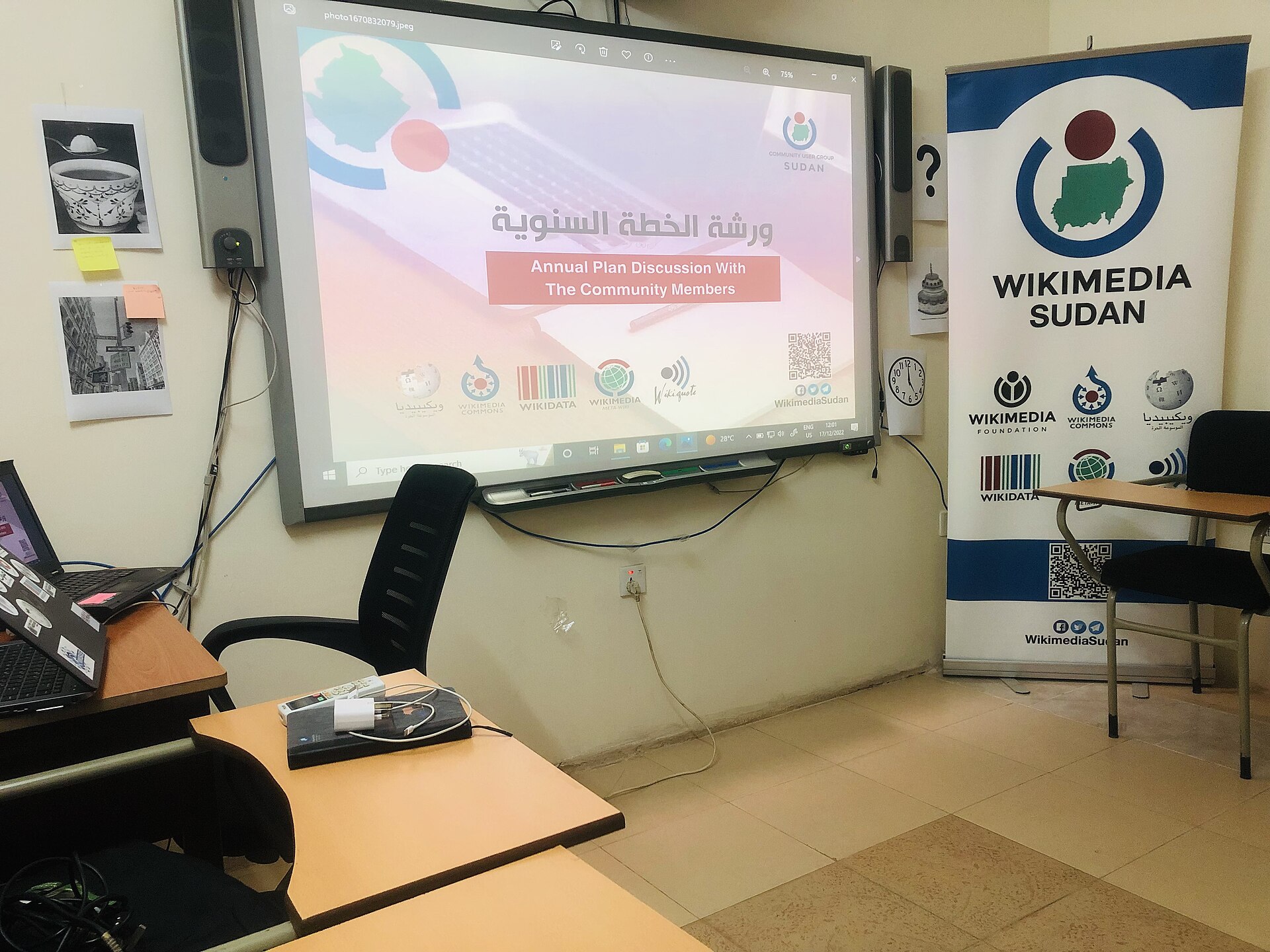
A second view of the planning meeting, with attendees reviewing the agenda
Photo: Annual plan meeting Wikimedia Sudan 05 by Hassan Hassoon (Wikimedia Commons), CC BY-SA 4.0, via Wikimedia Commons.

Which mistakes happen on real projects, and show up in the exam?

Letting a risk sit when it has become an issue. The outline lists “recognize when a risk becomes an issue” as its own piece of work. On a site, this is the risk that had a probability last month and a date today. The register still lists it under “monitor”. Move it, and change who owns the response.

Building before the change has cleared control. A sponsor mentions a tweak in a corridor, the team starts, and the paperwork follows three weeks later. The outline’s order is the reverse: run the change control process, communicate the status of the proposed change, implement the changes that clear it, then update the project documentation so the baseline matches what was built.
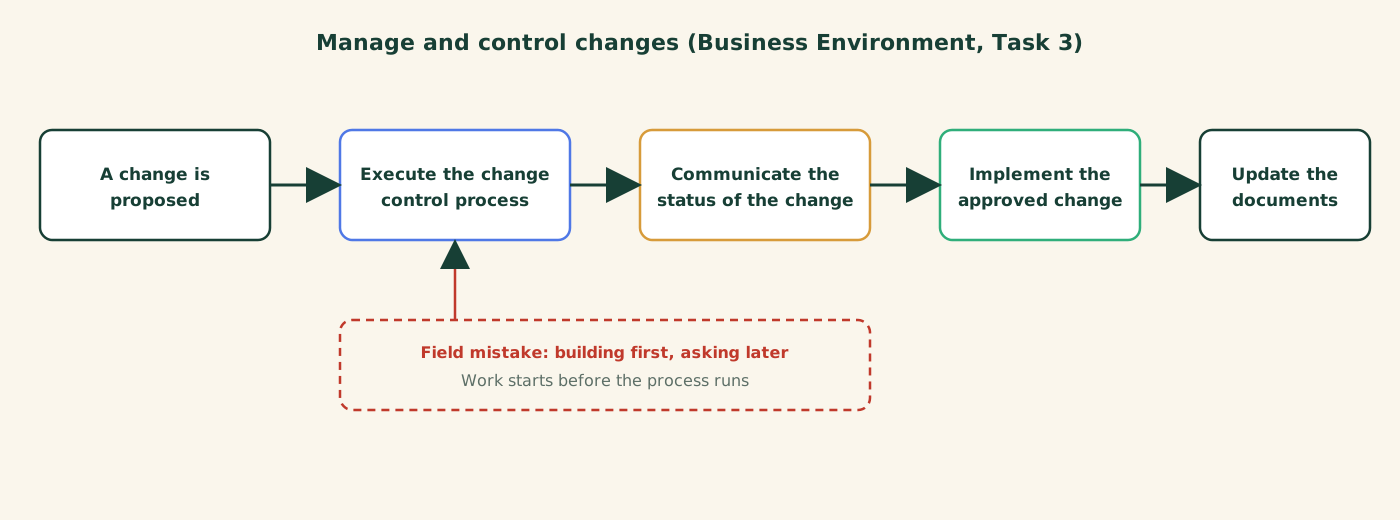
Five steps of change control in the PMP outline: change proposed, execute the change control process, communicate status, implement the approved change, update documents; a field mistake of starting work before the process runs
Change control as the outline lists it. Illustration: CertCrafter, from PMP Examination Content Outline, July 2026 (PMI).

Judging success on schedule and budget alone. PMI’s outline reframes success around stakeholder value and desired outcomes, and describes success as the project being perceived to have delivered value worth the effort and expense. A project on time and on budget that nobody uses is not a success under that definition.

Acting before analyzing. Two of the stakeholder tasks list analysis ahead of action: identify, analyze, then tailor communication. In the field it looks like a polished status briefing sent to a sponsor you never sounded out.

Which mistakes belong to the exam itself?

Answering the second-best option. Several choices in a PMP scenario are reasonable. The stem plants one fact that nobody has acted on yet, and the best first move deals with that fact. Read for it before you read the options.

Missing a quality gap that was planned and never measured. Here is a trap pattern in the sample set. A regulator rejects batch records because a quality metric was listed in the plan, but no measurement method or acceptance threshold was written down. The mistake is not the audit. It is that the metric was never made measurable. Try it yourself below.

Misjudging the clock. The exam has 180 questions, including 10 unscored pretest items, in 240 minutes, with two 10-minute breaks. The pretest questions are placed at random, so you cannot spot and skip them.

Worked example: pacing the paper

  1. Take the stated allowance: 240 minutes for 180 questions.
  2. Divide 240 by 180 on paper before exam day. That average is your pace per question, and you should know it without a calculator.
  3. Treat it as an average, not a limit. Graphic, matching and case-study items will take longer, so bank time on the short ones.
  4. Check your progress at the first break rather than at the end.

The point is not the figure. It is deciding the pace before the exam, so a long scenario does not make the decision for you. The tutorial and the survey sit outside the 240 minutes, so neither costs you time.

The PMP Complete Exam Kit works more of these under timed conditions, with every answer explained.

Which of these can you try for free?

Two scenarios from the free sample set are embedded in this post. One concerns subtitle files rejected for timing drift. The other is the blister-packaging line that failed inspection. Cover the options, find the one fact in each stem that no one has acted on, then choose.

What should you do next?

Take the free sample quiz, and tag each wrong answer with one of the ten mistakes above. Then read what moved in the 2026 outline and how the People domain is tested. The PMP 2026 certification page, the practice test bundle and the PMP guides hub have the rest.

Try these free questions

  1. Loomstream runs a subscription video service and is localising its back catalogue into nine languages. Subtitle files are produced by three vendors, in Buenos Aires, Cairo and Ho Chi Minh City, and are checked by a single quality team in Dublin. Over the last quarter about eighteen percent of delivered files were rejected for timing drift, where subtitle cues fall progressively out of step with the audio. Each rejection triggers a rework cycle, and because the working days barely overlap a rejected file usually comes back two days later. The project manager has already added two reviewers in Dublin and the rejection rate has not shifted. All three vendors use their own subtitling tools and none of them checks timing before delivery. What should the project manager do next?

    1. Add a third reviewer in Dublin and raise the inspection from a sample of each delivery to every file, so that no drifting subtitle file can reach the platform unchecked.
    2. Introduce a rejection charge into the three vendor contracts at the next renewal so that the cost of the defects sits with the parties that are creating them.
    3. Shift the Dublin team's working hours to overlap the vendors so that a rejected file can be corrected and returned inside a single working day instead of two.
    4. Work with the three vendors to add an automated timing check inside their own tooling before delivery.
    Show the answer and explanation

    Answer: D. Adding reviewers has already been tried and the rejection rate has not moved, which is the clue that the problem is not detection. Defects are being created upstream, at three vendors none of whom check timing, and inspection at the far end of a two-day round trip can only ever find them again. Option 4 moves the check to the point of creation, which is the cheapest place to catch anything, and it removes the time zone penalty entirely because the vendor fixes drift before the file ever leaves. Option 1 is the instinct the project manager has already acted on once. Full inspection would raise detection to near certainty and it is not absurd, but it doubles cost, adds queueing delay, and leaves the eighteen percent creation rate exactly where it was. Option 2 is a legitimate commercial lever and it does align incentives, so it may be worth doing at renewal, but it is slow, it does not tell a vendor how to stop producing drift, and punitive terms with a supplier who lacks the tooling tend to produce disputes rather than quality. Option 3 is a genuine improvement to cycle time and would help the schedule; it just accepts the defect rate as a fixed feature of the process instead of attacking it. Prevention beats inspection here because the cause is known, local and fixable. ECO Domain II, Process, task 'Plan and optimize quality of products and deliverables'; PMBOK Guide Eighth Edition, the Embed Quality Into Processes and Deliverables principle.

  2. Pelham Pharma has validated a new blister-packaging line. At the final qualification review the regulator's inspector rejected the batch records. The tamper-seal check appeared in every record as a pass or fail entered by the line operator, with no stated measurement method and no acceptance threshold, and two operators asked how they judged a pass gave different answers. Everything else passed: the equipment qualification, the cleaning validation, the operator training records and the deviation log. Rework and requalification will take five weeks, and the launch market has a competitor entering in three months. The quality management plan listed tamper-seal integrity among its quality metrics, and the project ran two quality audits during the build phase. What did the project manager fail to do earlier?

    1. Schedule quality audits often enough during the build for the gap to surface before qualification.
    2. Define, for each named quality metric, how it would be measured and what result counts as acceptable.
    3. Identify the regulator's inspector in the stakeholder register and engage him on acceptance expectations.
    4. Use control charts on the trial runs so there was data showing the sealing process was stable.
    Show the answer and explanation

    Answer: B. A metric that cannot be measured the same way twice is not a metric. The quality management plan named tamper-seal integrity, which is why the check appears in every batch record, but naming a metric is only half the work: the plan has to state the measurement method and the acceptance threshold, or what gets recorded is an opinion. Two operators giving different accounts of what a pass means is the direct evidence of that omission, and it is what the inspector rejected. More frequent quality audits is tempting because audits are the process-improvement mechanism, but the stem says two audits ran during the build. An audit checks whether the process is being followed, and when the process itself says the operator judges the seal, a compliant audit finds nothing wrong. More of the same control would not have caught it. Missing the inspector from the stakeholder register is a plausible-sounding root cause and is not the cause here: the acceptance requirement is not one inspector's preference, it is what any regulator would expect of a validated line, and it belonged in the plan whoever inspected. Control charts on trial runs would have shown variation in a measured value, which is useful, but there was no measured value to chart, and the absence of a defined measurement sits upstream of the absence of data. ECO Domain II, Process, task 'Plan and optimize quality of products and deliverables'; PMBOK Guide Eighth Edition, Scope Performance Domain and the Embed Quality Into Processes and Deliverables principle.

Take the full free 10-question sample with scoring →

Frequently asked questions

What is the biggest mistake on the PMP exam?

Studying only the content and not the judgment. PMI's outline says candidates must apply concepts and their own experience to scenario-based questions, so knowing a definition is not enough if you pick the wrong first action.

Do I need to study agile for the 2026 PMP exam?

Yes. PMI says about 40% of items represent predictive approaches and the remaining 60% are divided between adaptive/agile and hybrid approaches, and that these appear across all three domains.

Is the PMP exam based on the PMBOK Guide?

Not directly. PMI's outline says there are noticeable differences between the outline and the PMBOK Guide, and that the exam assesses your ability to think critically and apply practices based on experience.

Official sources

  1. PMP Examination Content Outline, July 2026 (PMI) — accessed 27 October 2026

Exam rules change. Check the awarding body's official page before you apply. CertCrafter is independent and is not affiliated with or endorsed by any awarding body.

Was this helpful?

Comments

    Comments are read by a person before they appear. How we moderate.