Candidates who treat People as the easy domain tend to lose marks there. The questions read like common sense, and the wrong options are all things a reasonable manager might do.
What does the People domain cover in the 2026 PMP exam?
People is Domain I of the July 2026 outline, and it carries 33% of the items. PMI lists 8 tasks under it. In order, they are:
- Develop a common vision.
- Manage conflicts.
- Lead the project team.
- Engage stakeholders.
- Align stakeholder expectations.
- Manage stakeholder expectations.
- Help ensure knowledge transfer.
- Plan and manage communication.
Each task comes with a short list of examples of the work involved. PMI calls them enablers and says they are illustrations, not an exhaustive list. For conflict, the examples include identifying the source, analyzing the context, applying an agreed resolution strategy and setting ground rules. That tells you what a good answer looks like: a named step, not a feeling.
One more point from the outline matters here. Predictive, agile and hybrid approaches appear in every domain, about 40% of items predictive and the rest split between agile and hybrid. A People question about a sprint team and one about a construction crew test the same task.
 PMP 2026 — PMP or CAPM first? Watch on YouTube · CertCrafter
If you are still deciding where to start, the channel has a short video, PMP or CAPM first?, and the post on PMP versus CAPM covers eligibility.
How do the 8 tasks work on a real project?
Take the tasks in pairs, because that is how they arrive on site.
Vision and leadership come first. On a systems migration, the project manager who has not got sponsor, operations and vendor to say the same sentence about what “done” means will spend month four arguing about scope that was never really agreed. The outline’s wording is to help ensure a shared vision, promote it and keep it current. The last part is the one people forget.
Conflict and team come next. Experienced managers rarely settle a dispute in the meeting where it explodes. They find out what the dispute is really about, agree the ground rules, and deal with a broken rule when it happens rather than at the end of the month. The outline lists establishing ground rules and managing violations as separate pieces of work for that reason.
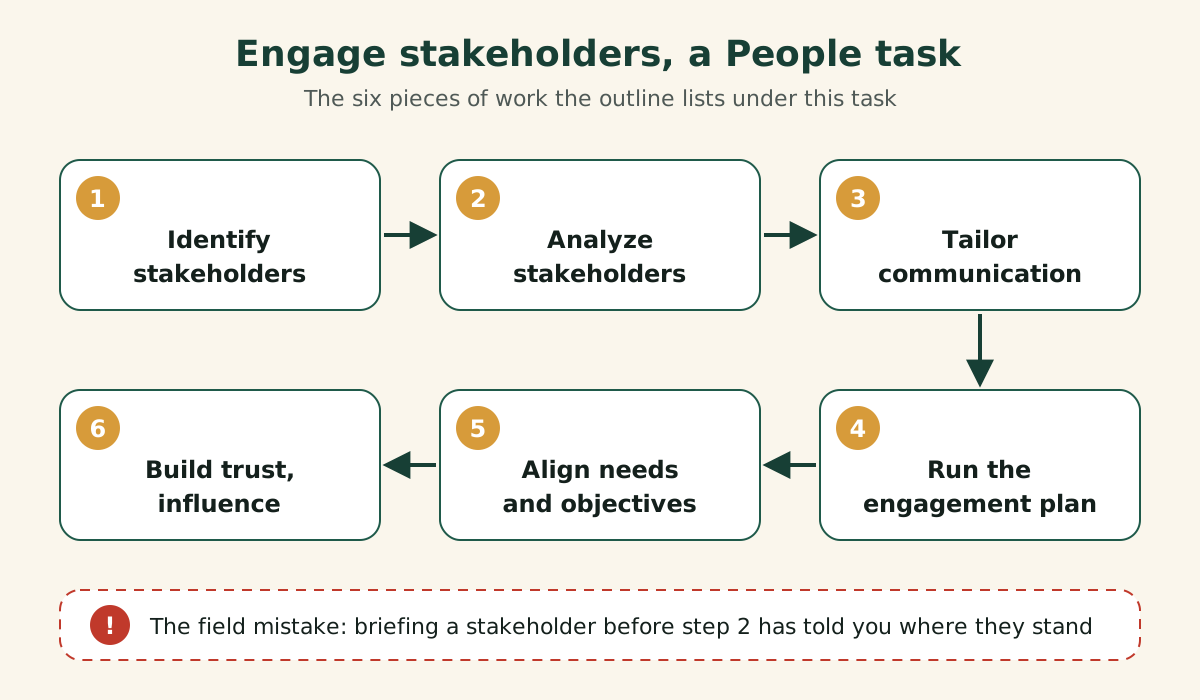
Stakeholders take up four of the eight tasks: engage, align, manage expectations, and communicate. That is the clue to how much the exam cares. In the field it shows as the stakeholder register that was last touched when the project was signed off, and the status report that goes to everyone in the same format.
Worked example: a new sponsor arrives mid-project
Say your sponsor retires in month seven of twenty and a senior director takes over. The register still names the old sponsor as champion. You have one meeting booked.
- Treat the register as out of date for this one person. Do not refresh all of it first.
- Find out where the new sponsor stands: supporter, sceptic or undecided. Ask a peer, read what they said at the last steering meeting, or ask them directly.
- Decide where she needs to stand for the project to succeed, and what the gap is.
- Only then shape the meeting, tailoring what you say to the gap, which is the outline’s “analyze and tailor communication to stakeholder needs.”
Step 2 comes before the status briefing. That order is the whole example.
What do candidates get wrong on People questions?
Three patterns show up again and again.
The first is reaching for a document before a person. Sending the report, updating the plan or asking for a mandate feels productive. The outline’s wording keeps pointing the other way: identify, analyze, facilitate, build trust. A conversation usually comes before an artifact.
The second is solving the wrong layer. Duplicated accountability on a responsibility matrix is a roles problem, and a team member’s silence in design sessions is an engagement problem. The scenario names the symptom, and the correct option fixes the cause.
The third is confusing a good option with the best first one. Several answers in a People question are sensible. The question asks which one comes first, and the stem usually plants a fact that decides it: a stakeholder nobody has met alone, a register that predates the sponsor, a matrix nobody has read.
The habit that fixes all three is simple. Read the stem for the one fact nobody has acted on yet, and start there.
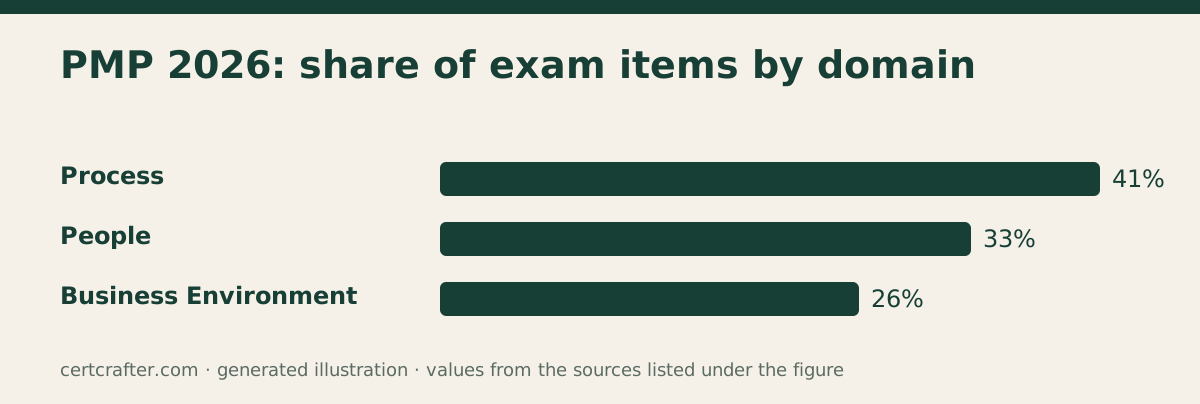
A third of the paper is large enough that a weak People score cannot be covered by strong scheduling. Process is bigger at 41%, but the gap is eight points, and both domains reward the same habit of reading the scenario closely before choosing.
Which People questions can you try for free?
The free sample quiz includes scenarios of this kind. Three are embedded below this section. One checks accountability on a responsibility matrix, one involves a resistant head of operations, and one a new sponsor with a history. Read each stem twice before you look at the options, and name the fact that decides it.
The PMP Complete Exam Kit works more People scenarios under timed conditions, with every answer explained.
What should you do next?
Take the free sample quiz and note which of the 8 tasks your wrong answers fall under. Then read how the weights moved in what changed in the 2026 outline. The PMP 2026 certification page shows how the practice tests map to the three domains, the practice test bundle covers all of them, and the PMP guides hub lists the other posts as they publish.
Comments
Comments are read by a person before they appear. How we moderate.