Many PMP candidates know what to do about a blocker and still lose the point. The stem asked who should deal with it, and they answered as if it were their own.
Why do so many PMP questions turn on who decides?
Because the outline tests it by name. In the Business Environment domain, which PMI’s July 2026 outline weights at 26%, the first task is to define and establish project governance, and one enabler is to outline governance escalation paths and thresholds. Another task is to remove impediments and manage issues.
Read those two together and you have the shape of a whole family of questions. A blocker appears. The stem tells you, in one detail, who owns it. Your job is to notice that detail before you choose.
 PMP Risk Management Explained: Register, Responses, Reserves and Risk vs Issue (2026 Exam) Watch on YouTube · CertCrafter
The channel’s video on risk management, register and reserves covers the neighboring skill, spotting the moment a risk becomes an issue, which the same task lists as an enabler.
What does the outline say about blockers?
The task is called Remove impediments and manage issues, and its enablers read like a short procedure. Evaluate the impact. Prioritize and highlight. Determine and apply an intervention strategy. Reassess continually. The last two enablers add recognizing when a risk becomes an issue, and collaborating with relevant stakeholders on an approach to resolve it.
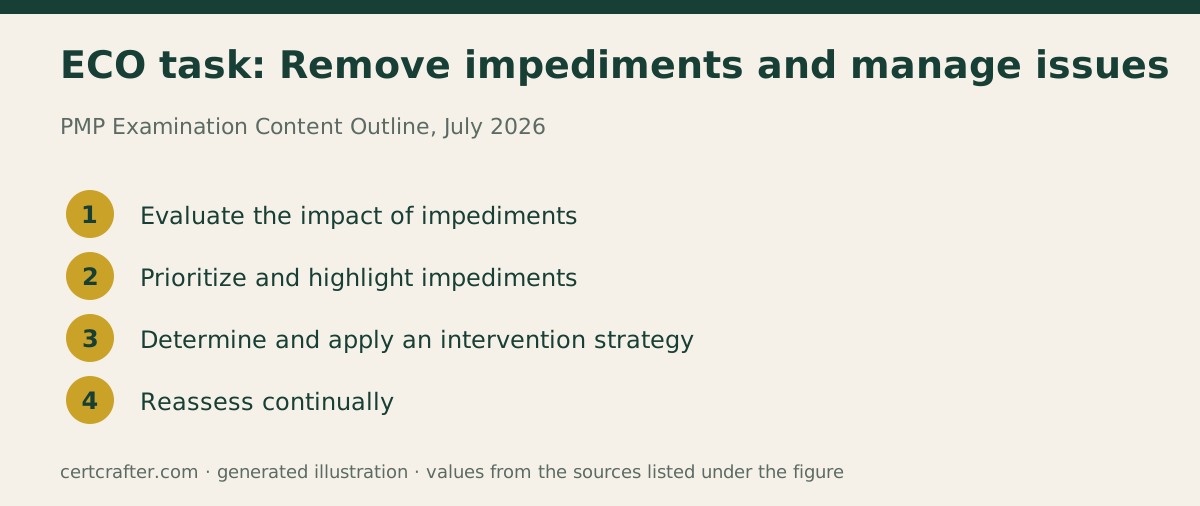
Notice what the list does not say. It does not say the project manager clears every blocker personally. An intervention strategy can be a decision, a request, or a handover to the person with the remit.
How do you tell whose problem a blocker is?
On a real project you ask three things in order. Can the team clear it with its own effort? If not, is the decision inside the project’s stated authority? If not, who does the organization say owns it?
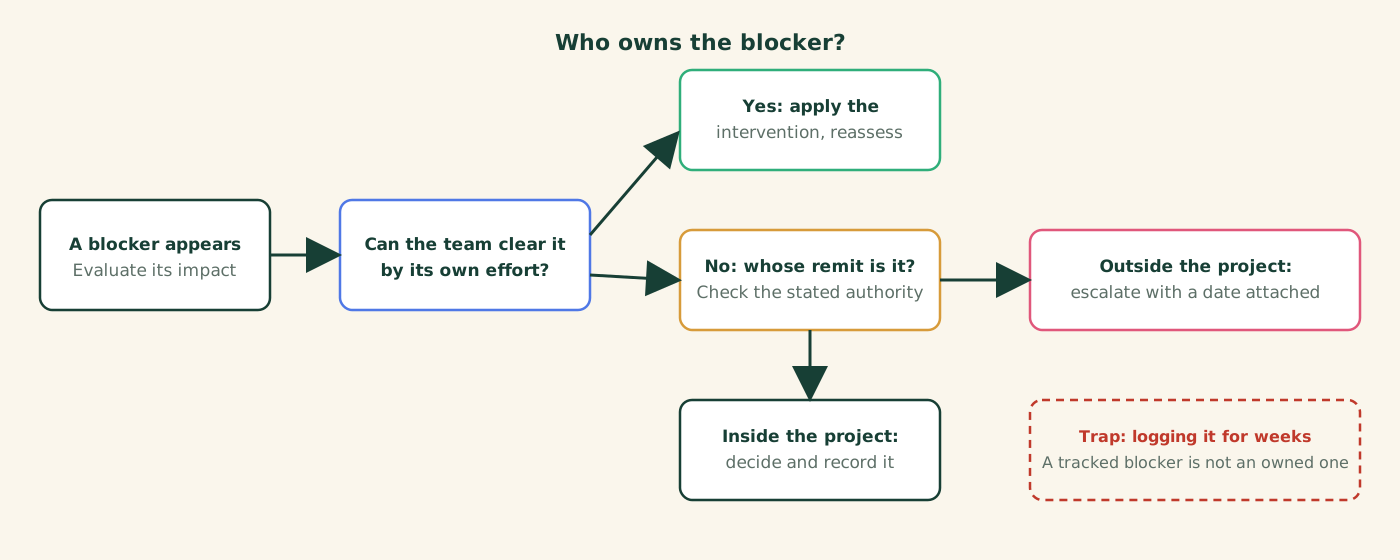
The trap sits in the last box. Teams are good at logging a blocker, raising it at stand-ups and building a workaround. None of that moves it. A blocker that someone outside the project owns needs a request to that person, with a date by which you expect an answer, and a plan for what happens if the date passes.
Which three free questions should you try first?
Cover the options and find the sentence that says who owns the problem. Then choose.
The first is a regulated device release where a test environment lost its link to reference data. The team did everything a team can do. Ask what a team cannot do, and when it should have stopped trying.
The second is an AI assistant for bank staff where two senior heads disagree about what the screen shows. The stem names a committee and its remit. Check whether that remit covers the disagreement, and do not settle for the answer that merely sounds fair.
The third is an iteration where a sign-off role went empty after a restructuring. Count what is blocked and what is not. The stem also tells you who is on leave and who has a stated response target.
What do these three questions test?
| Scenario | ECO task it draws on |
|---|---|
| Environment owned by another function | Remove impediments and manage issues |
| Two executives and a governance committee | Align stakeholder expectations, Manage conflicts |
| Empty sign-off role mid-iteration | Remove impediments and manage issues |
Two of the three sit in the same task. That is typical: the exam returns to the same idea in different clothes, and the clothes are what trip people up.
The PMP Complete Exam Kit works more of these under timed conditions, with every answer explained.
How does this show up on a real project?
Picture a vendor-owned test rig that goes down. The team can write a better workaround every week. Only the vendor’s account manager, or someone above both parties, can get the rig fixed. Experienced project managers escalate early, because they know each week of workaround is a week of accepted risk that nobody with authority has seen.
Governance disputes work the same way. When a model, a safety rule or a regulation is involved, the organization has usually named a body to rule on it. A sponsor can set priorities, but not outside that body’s remit. A project manager who lets two executives trade a compromise on a controlled item creates rework the committee will order later.
Restructurings add a third version. Roles vanish and sign-offs go with them. The useful move is rarely to stop everything. It is to keep unblocked work moving, name the gap to whoever owns the restructuring, and attach a date.
What mistakes do these questions catch?
Three patterns, each with a different fix.
Escalation too late. You tracked a blocker for weeks. The cure is to set a threshold when the blocker appears, for example a number of days, and treat crossing it as the trigger.
Escalation to the wrong person. The sponsor funds the work, so the sponsor decides everything. Read the stem for a named body or role with a remit, and send the matter there.
Doing nothing visible. The team is blocked, so you wait. Look for ready work that does not touch the blocker and pull it in.
Log each miss under one of those labels. After a dozen questions the label that keeps returning tells you which habit to rehearse.
What should you do after the free questions?
Try Set 1 of the free questions if you skipped it, take the free sample quiz, and read how the People domain is tested and which common PMP mistakes cost the most points. The PMP 2026 certification page, the practice test bundle and the PMP guides hub have the rest.
Comments
Comments are read by a person before they appear. How we moderate.